

Magnat Interior IC 62 In-Wall / In-Ceiling Speaker
120,00 €
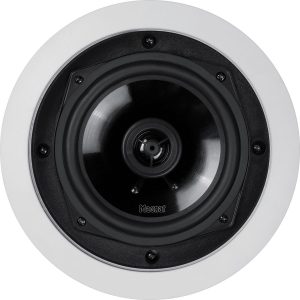
Magnat Interior IC 62 is a two-way recessed speaker for a permanently installed home audio system in a wall or ceiling. Its 160 mm bass driver and two 19 mm tweeters divide the signal through a 3,500 Hz crossover. The 75 W RMS rating and 4-8 ohm impedance help with amplifier selection. Installation requires a 195 mm cut-out and 80 mm of mounting depth.
Magnat Interior IC 62 is a two-way in-wall or in-ceiling speaker designed for a permanently installed home audio system. It is suitable when the speaker needs to be recessed into the mounting surface. A 160 mm driver and two tweeters form a compact two-way system.
Two-way performance
One 160 mm bass driver handles the lower part of the reproduced frequency range. Two 19 mm tweeters operate in the upper range. The internal crossover divides the frequencies at 3,500 Hz, assigning the appropriate operating range to each section.
The frequency range extends from 35 to 35,000 Hz, while sensitivity is rated at 90 dB. This sensitivity was measured with a 2.8 V input at a distance of one metre. For a meaningful comparison, use speakers rated under the same measurement conditions.
Choosing an amplifier
The recommended amplifier power is 20-140 W. The speaker’s 4-8 ohm impedance means that the amplifier should operate reliably with loads within this range.
The 75 W RMS rating indicates the continuous power-handling capacity. The 140 W maximum power figure is not a target for continuous listening. When matching an amplifier, consider not only its power output but also its ability to deliver a clean signal without audible distortion.
System setup
The 3,500 Hz crossover frequency defines the transition between the drivers built into the speaker. It is not a subwoofer filter setting that should be entered into the amplifier. If additional filtering is used elsewhere in the system, adjust it according to the capabilities of all connected speakers and the main listening position.
Begin with neutral tone settings and a low listening level. Increase the volume gradually, and reduce it if you hear distortion.
Installation position and dimensions
Installation requires a 195 mm circular cut-out and at least 80 mm of clear mounting depth. Before cutting, check that there are no structural profiles, pipes, or cables in the intended mounting area. The 228 mm outer diameter must fit on the selected surface.
The speaker can be installed in either a wall or a ceiling. For a stereo pair, choose positions that are symmetrical in relation to the main listening area. Keeping both speakers at an equal distance from the listener helps maintain a more even balance between the channels.
The installation cavity can affect bass response. If the cavities behind the left and right speakers differ substantially, the two channels may not sound the same. For a matched pair, it is therefore worth selecting comparable positions within the wall or ceiling structure.
Technical specifications
| Type | Two-way in-wall or in-ceiling speaker |
| Bass driver | 160 mm |
| Tweeters | 2 × 19 mm |
| Continuous power handling | 75 W RMS |
| Maximum power | 140 W |
| Sensitivity | 90 dB at 2.8 V and 1 m |
| Impedance | 4-8 ohms |
| Frequency range | 35-35,000 Hz |
| Crossover frequency | 3,500 Hz |
| Recommended amplifier power | 20-140 W |
| Outer diameter | 228 mm |
| Cut-out diameter | 195 mm |
| Mounting depth | 80 mm |
FAQ
Which amplifier should I choose?
Choose an amplifier within the power range shown in the specifications. It is important that the amplifier can operate reliably with the speaker’s stated impedance.
Is the 140 W rating intended for continuous listening?
No. The 75 W RMS figure indicates continuous power handling, while 140 W is the maximum power rating.
Can the speaker be installed in both a wall and a ceiling?
Yes, both installation options are supported. Choose a surface that can accommodate the required cavity while allowing the speaker to be positioned appropriately in relation to the listening area.
Should the opening be cut to the outer diameter?
No. The opening must follow the specified cut-out diameter. The outer diameter indicates the speaker’s overall visible width.
Do I need to set the crossover frequency on the amplifier?
No. This value should not be copied to the amplifier’s bass or subwoofer filter setting. It describes how the signal is divided between the drivers inside the speaker itself.
Does 90 dB sensitivity indicate the maximum volume?
No. Sensitivity describes the speaker’s response at the stated input voltage and measurement distance. It is not a maximum sound-level rating.