Eversolo AMP-F10 Power Amplifier
2 580,00 €
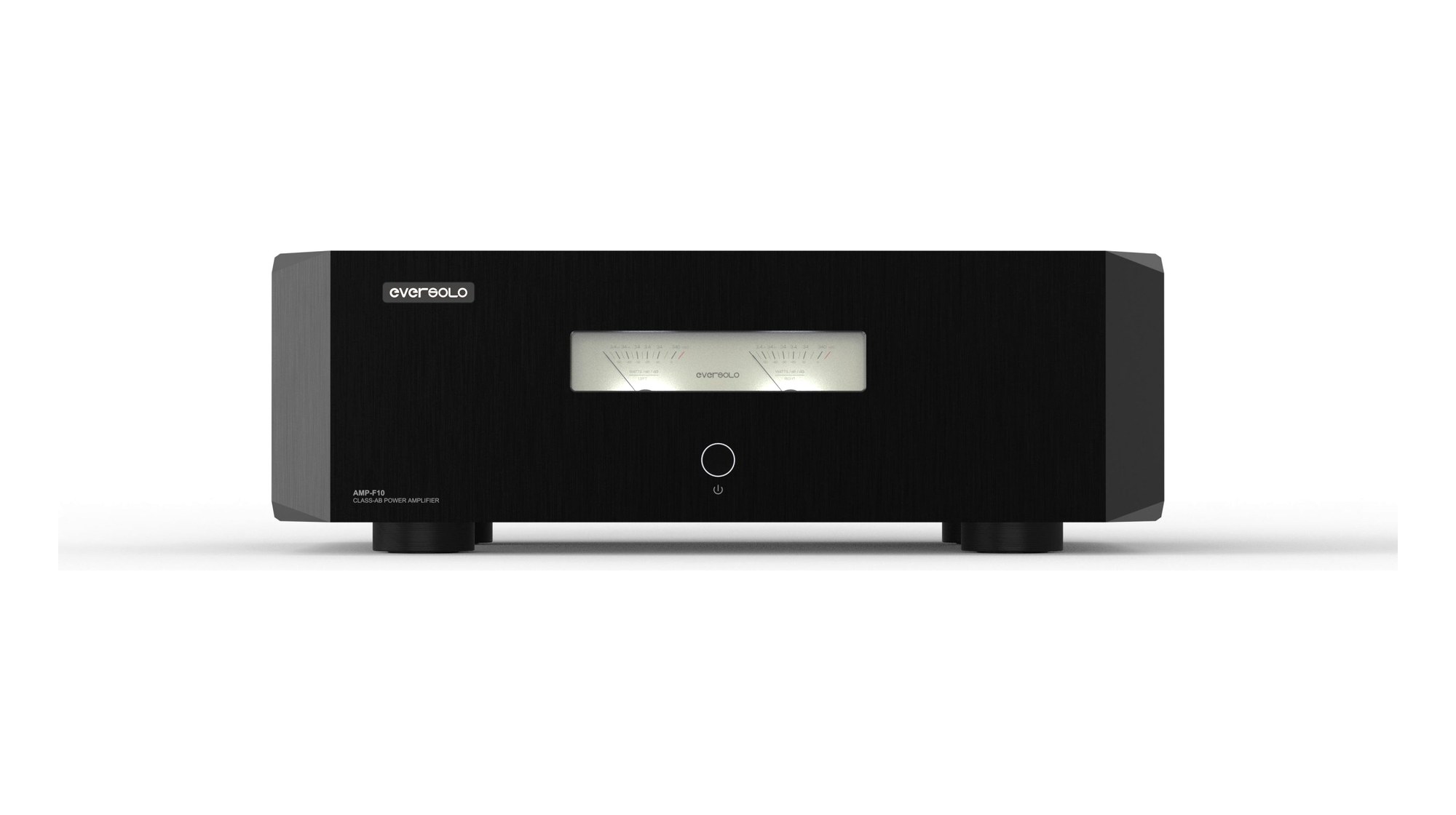
The Eversolo AMP-F10 is a stereo power amplifier designed for powerful two-channel audio systems. In stereo mode, it delivers 320 W RMS per channel into 4 ohms and supports 2-ohm loads. Bridged mode provides up to 950 W RMS into 4 ohms. XLR and RCA inputs accommodate different analog sources, while two gain settings help match their output levels.
The Eversolo AMP-F10 power amplifier is designed for a two-channel Hi-Fi system or a monoblock power stage. It operates in Class AB with Class A bias. In stereo mode, it supports loads as low as 2 ohms. Bridged mode delivers 950 W RMS into 4 ohms.
Applications and operating modes
Stereo mode allows one amplifier to drive the left and right speakers. Each channel delivers 200 W into 8 ohms or 320 W into 4 ohms. With a 2-ohm load, output increases to 450 W RMS per channel.
Bridged mono mode combines both channels to drive one speaker. It provides 650 W into 8 ohms or 950 W into 4 ohms. A stereo system using this mode would require a separate amplifier for each speaker. The 2-ohm specification applies only to stereo mode.
Analog connections
Two balanced XLR inputs accommodate sources with balanced analog outputs. This connection is useful with longer cables or when reducing the influence of environmental interference. Two unbalanced RCA inputs allow connection to a conventional preamplifier, DAC, or network player with an analog output.
There are no digital inputs, so the source must provide an analog signal. Speakers connect through copper speaker terminals. A 5-12 V trigger input and output allow power control to be linked with other compatible audio equipment.
Gain settings
You can select 23 dB or 29 dB gain. The 23 dB setting requires a higher source output voltage. The 29 dB mode reaches the same power with a lower input signal, making it useful when the source has a lower analog output level.
RCA input sensitivity is 2.65 V or 1.3 V, while the corresponding XLR input sensitivity is 5.2 V or 2.4 V. These values were measured at an output of 200 W into 8 ohms at 1 kHz.
Power supply circuit and audio performance
A DC filter is installed between the mains supply and the audio circuitry. It reduces low-frequency DC interference and toroidal transformer hum. The audio circuit uses dual differential amplifier stages for processing low-level signals.
A damping factor greater than 600 helps the amplifier maintain electrical control over the speakers’ bass drivers. THD+N is specified as 0.008% at 1 kHz. The A-weighted signal-to-noise ratio reaches at least 113 dB with 23 dB gain selected.
Placement and power requirements
The aluminium enclosure weighs 18 kg, so it requires a stable shelf with adequate load capacity. The chassis is 430 mm wide and 310 mm deep. Leave additional space behind the amplifier for cables and air circulation. The stated height of 147 mm includes the feet.
Power requirements depend on the regional version: 110-120 V at 60 Hz or 220-240 V at 50 Hz. Before switching the amplifier on, check the voltage and frequency marked on the specific unit.
Package contents
The package includes a power cable, trigger cable, and user manual. Version 1.0 of the user manual is provided for this model.
Technical specifications
| Type | Bridgeable stereo power amplifier |
|---|---|
| Amplifier class | Class AB with Class A bias |
| Operating modes | Stereo and bridged mono |
| Stereo output, 8 ohms | 2 × 200 W RMS |
| Stereo output, 4 ohms | 2 × 320 W RMS |
| Stereo output, 2 ohms | 2 × 450 W RMS |
| Bridged output, 8 ohms | 650 W RMS |
| Bridged output, 4 ohms | 950 W RMS |
| Analog inputs | 2 × balanced XLR, 2 × unbalanced RCA |
| Input impedance | 10 kohms for XLR and RCA inputs |
| RCA input sensitivity | 2.65 V at 23 dB; 1.3 V at 29 dB |
| XLR input sensitivity | 5.2 V at 23 dB; 2.4 V at 29 dB |
| Sensitivity measurement conditions | 200 W, 8 ohms, 1 kHz |
| Gain settings | 23 dB and 29 dB |
| Speaker outputs | Copper speaker terminals |
| Trigger | 5-12 V input and output |
| Frequency response | 10 Hz-30 kHz, ±0.5 dB, at 1 W into 8 ohms |
| THD+N | 0.008% at 1 kHz |
| Signal-to-noise ratio | ≥113 dB at 23 dB; ≥110 dB at 29 dB; A-weighted |
| Signal-to-noise measurement conditions | 200 W, 8 ohms, 1 kHz |
| Channel separation | ≤-95 dB at 200 W into 8 ohms and 1 kHz |
| Damping factor | >600 at 8 ohms and 1 kHz |
| Audio circuit | Dual differential amplifier stages |
| Power filter | DC filtering circuit |
| Power supply | 110-120 V, 60 Hz or 220-240 V, 50 Hz, depending on regional version |
| Standby power consumption | ≤0.5 W |
| Maximum power consumption | 1200 W |
| Enclosure material | Aluminium |
| Dimensions | 430 × 310 × 147 mm, width × depth × height; height includes feet |
| Weight | 18 kg |
| Package contents | Power cable, trigger cable, user manual |
| Manual version | 1.0 |
FAQ
Does this power amplifier require a preamplifier?
Volume is normally controlled by a preamplifier or another source with an analog output. The amplifier has no built-in digital inputs.
Which input should I choose: XLR or RCA?
Choose the analog connection supported by your source. XLR carries a balanced signal, while RCA is intended for an unbalanced output. Both input types have an impedance of 10 kohms.
Can I connect 2-ohm speakers?
A 2-ohm load is supported in stereo mode, where the amplifier delivers 450 W RMS per channel. Bridged output figures are specified only for 4-ohm and 8-ohm loads.
How should I choose between 23 dB and 29 dB gain?
Select 23 dB when using a source that provides a higher analog output level. The 29 dB setting requires a lower input voltage to reach the same output power.
How much space does the amplifier need?
The shelf must support the amplifier’s 18 kg weight and accommodate its 430 mm-wide enclosure. In addition to its 310 mm depth, allow space for connections and ventilation.
What is included in the package?
The package contains a power cable, trigger cable, and user manual. RCA, XLR, and speaker cables must be selected separately.
Related products