
Rotel DT-6000 CD Player
2 300,00 €
The Rotel DT-6000 is a CD player and digital-to-analogue converter for physical disc collections and external digital sources. An ESS Sabre ES9028PRO converter processes the signal, while RCA and XLR outputs allow connection to a stereo amplifier. The PC-USB input accepts PCM up to 32-bit/384 kHz and DSD up to 11.2 MHz. The optical and coaxial inputs accept LPCM signals up to 24-bit/192 kHz.
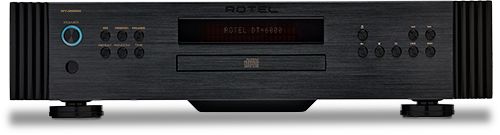
The Rotel DT-6000 CD player is a tray-loading disc player and digital-to-analogue converter (DAC) for a home stereo system. It lets you enjoy a physical CD collection and external digital sources through a single component. Its analogue signal can be sent to an amplifier through RCA or XLR outputs.
For discs and digital sources
This model belongs to Rotel’s Diamond Series. The tray-loading mechanism plays CDs and supports MP3 files recorded on compatible CD media. You can therefore use the same player for conventional audio discs and MP3 collections stored on suitable CDs.
The eight-channel ESS Sabre ES9028PRO converter assigns four conversion channels to each stereo channel. This arrangement is relevant when choosing a CD source that will also process audio from a computer or another digital device.
Dedicated power supplies feed the most important circuits. Inside, Rotel uses its own toroidal transformer together with isolation measures designed to reduce residual noise and distortion.
Connecting digital sources
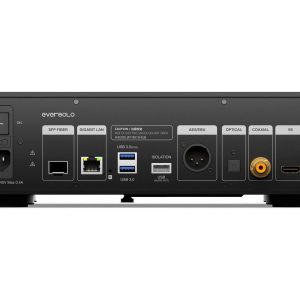
The PC-USB input for computers operates according to USB Audio Class 2.0. It accepts PCM at up to 32-bit/384 kHz, although a driver must be installed. DSD signals up to 11.2 MHz are supported, including transmission via DoP.
The player decodes MQA and MQA Studio at up to 24-bit/384 kHz. It also carries the “Roon Tested” designation. Access to these functions depends on support provided by the source software and services currently being used.
The optical and coaxial digital inputs accept LPCM at up to 24-bit/192 kHz. Choose the connection available on your digital source. Set the source output to LPCM, as this is the signal format intended for these inputs.
Connecting to an amplifier
The player connects to an amplifier through unbalanced RCA or balanced XLR analogue outputs. Choose XLR when the amplifier has a balanced input; otherwise, use RCA.
The RCA output level is 2.1 V, while the XLR output level is 4.3 V. Switching from RCA to XLR may produce a higher listening level because the outputs have different signal levels. Match the volume carefully when comparing them.
Operation and system integration
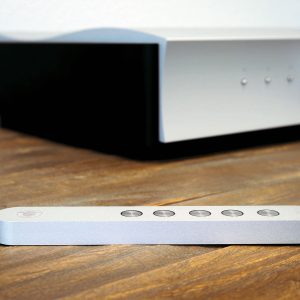
For everyday operation, the DT-6000 provides front-panel buttons, a two-line display and a backlit infrared remote control. The remote control is included.
RS-232, a 12 V trigger connection and an external remote-control input are provided for integration with a wider control system. These connections are useful when the amplifier and source components are operated centrally.
Placement and power requirements
The 431 mm-wide enclosure requires a sturdy shelf and sufficient space behind it for the rear connections. The unit weighs 8.11 kg. The 2U designation describes the height of the front panel; by itself, it does not confirm suitability for installation in a 19-inch equipment rack.
The specified power requirement is 120 V, 60 Hz. This does not match Lithuania’s standard 230 V, 50 Hz mains supply. Before connecting the player, check the rating plate and power-supply version of the specific unit.
Technical specifications
| Type | Tray-loading CD player and digital-to-analogue converter |
|---|---|
| Series | Rotel Diamond |
| Disc support | CDs and MP3 files recorded on compatible CD media |
| Converter | Eight-channel ESS Sabre ES9028PRO, 32-bit/768 kHz |
| Converter configuration | Four converter channels assigned to each stereo channel |
| Power-supply design | Dedicated power supplies for critical circuits and a Rotel-manufactured toroidal transformer |
| PC-USB input | USB Audio Class 2.0, PCM up to 32-bit/384 kHz; driver required |
| DSD | Up to 11.2 MHz; DoP supported |
| MQA | MQA and MQA Studio decoding up to 24-bit/384 kHz |
| Roon | Roon Tested |
| Digital inputs | One optical, one coaxial and PC-USB |
| Optical and coaxial input signal | LPCM up to 24-bit/192 kHz |
| Input sensitivity and impedance | 0 dBFS / 75 Ω, coaxial and optical inputs |
| Analogue outputs | Unbalanced RCA and balanced XLR |
| RCA output level | 2.1 V |
| XLR output level | 4.3 V |
| RCA output impedance | 10 Ω |
| XLR output impedance | 20 Ω |
| Intermodulation distortion | Less than 0.0012% |
| Total harmonic distortion | Optical and coaxial inputs: less than 0.0007%; CD and PC-USB: less than 0.0012% |
| Frequency response | 20 Hz-20 kHz, +0/-0.15 dB; 10 Hz-70 kHz, +0/-3 dB |
| Signal-to-noise ratio | Greater than 115 dB, A-weighted |
| Dynamic range | Greater than 99 dB |
| Channel balance | ±0.5 dB |
| Channel separation | Greater than 115 dB at 10 kHz |
| Controls | Front-panel buttons and backlit infrared remote control |
| Display | Two-line display |
| System-control connections | RS-232, 12 V trigger connection and external remote-control input |
| Dimensions | 431 × 104 × 320 mm or 17 × 4 × 12.6 in |
| Front-panel height | 2U / 88.1 mm or 3.5 in |
| Net weight | 8.11 kg or 17.88 lb |
| Power requirement | 120 V, 60 Hz |
| Power consumption | 25 W |
| Standby power consumption | Less than 0.5 W |
| Included accessory | Backlit infrared remote control |
FAQ
Does this unit work only as a CD player?
No. It also accepts signals through its PC-USB, optical and coaxial inputs. The built-in converter supplies an analogue signal to the amplifier.
Which analogue output should I choose?
Use XLR with an amplifier that has a balanced input. RCA is intended for an unbalanced input. Remember that the two outputs provide different signal levels.
What needs to be prepared before connecting a computer?
The appropriate driver must be installed for the PC-USB connection. The input can then carry PCM, DSD, DoP and supported MQA signals.
Where is the best place to install the player?
Use a stable shelf capable of supporting the 8.11 kg enclosure. Leave space behind the 320 mm-deep cabinet for the power, USB and audio connections.
Can the player be integrated into a centralised control system?
Yes. RS-232 is provided for control-system integration, the 12 V trigger connection can switch compatible equipment, and the external remote-control input accepts a wired control signal.
Can the unit be connected directly to the Lithuanian mains supply?
The stated 120 V, 60 Hz power requirement is not Lithuania’s mains standard. Before use, check the power marking on the specific unit.