


EAR Yoshino 869 Stereo Integrated Valve Amplifier
5 700,00 €
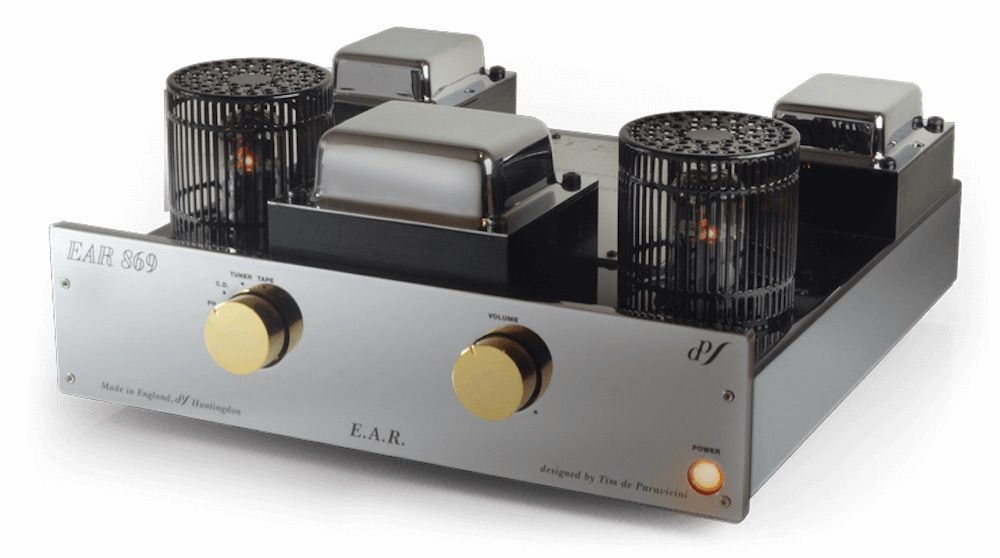
The EAR Yoshino 869 is a stereo integrated valve amplifier for a home music system. Developed from the EAR 859, it offers greater output power and improved control of operating conditions. That control depends less on differences between valves or changes in their characteristics with age. The 869 continues Tim de Paravicini’s EAR valve amplifier lineage.
The EAR Yoshino 869 is a stereo integrated valve amplifier for listening to music in a home stereo system. Its integrated design places stereo amplification in one component. It continues the line of EAR valve amplifiers developed by Tim de Paravicini.
The 869 builds on the EAR 859 with greater output power and improved control of its operating conditions. That control depends less on valve characteristics and their changes with age. These refinements address two concerns for listeners choosing a valve amplifier for home music playback.
The 869 suits listeners assembling a home stereo system around an integrated valve amplifier. It also appeals to EAR 859 owners interested in how Tim de Paravicini developed the design further. The EAR 859 is its predecessor, rather than a component required to use the 869.
Benefits
- Greater output power – The 869 provides more output power than the earlier EAR 859.
- Improved operating control – Its operating conditions are less dependent on differences between individual valves.
- Consideration for valve ageing – The design maintains better control as valve characteristics change over time.
- Integrated stereo design – One amplifier serves the stereo amplification role in a home music system.
- Established design lineage – The 869 develops the EAR 859 design within Tim de Paravicini’s valve amplifier range.
- Purposeful refinement – Its two principal advances address output power and the control of valve operating conditions.
- Home listening focus – The 869 is intended for music playback through a domestic stereo system.
Who Is This For?
The EAR Yoshino 869 is for listeners who want a stereo integrated valve amplifier in a home music system. Its design combines that role with greater output power than the EAR 859. The comparison identifies the 859 as the preceding model, not as equipment the 869 must connect to.
It also suits listeners attentive to changes in valves during use. Valve characteristics can vary between examples and change as valves age. The 869 was developed to keep its operating conditions under better control despite those variations. No particular loudspeaker or source model is identified as a compatibility requirement.
Technical Specifications
| Model | EAR Yoshino 869 |
|---|---|
| Amplifier type | Stereo integrated valve amplifier |
| Intended use | Music playback in a home stereo system |
| Predecessor | EAR 859 |
| Output power | Greater than the EAR 859 |
| Operating-condition control | Improved over the EAR 859 |
| Valve dependence | Operating conditions are less dependent on valve characteristics and age |
| Design lineage | EAR valve amplifiers developed by Tim de Paravicini |
Why Choose the EAR Yoshino 869?
The story behind the 869 begins with the EAR 859, introduced in the early 1990s. By then, Tim de Paravicini had produced push-pull amplifiers for more than a decade. Earlier models in that line included the 509, 519 and 549. The 859 first appeared as a kit offered through Hi-Fi News. It later became a regular EAR product.
The 859 responded to interest in low-power, single-ended amplifiers using triodes. De Paravicini selected the EL519 output valve instead of the 300B, 211 or 2A3 often used in such designs. An EL519 is a pentode in its conventional connection. For the 859, he used his Enhanced Triode Mode, or ETM, to operate it as a triode.
A conventional triode connection for a pentode joins its screen grid to the anode. The 859 used a different arrangement: its control grid joined the cathode, while the signal went to the screen grid. The ETM name reflects an analogy with a MOSFET operating mode. This 859 circuit sought improved linearity, greater power and reliability. The predecessor became known for clear, open sound, low noise and a long production history.
The 869 advances this lineage through higher output power and more consistent control of operating conditions. These changes distinguish it from the 859 without assigning the predecessor’s circuit details to the newer amplifier. For a buyer comparing the two models, those are the documented differences.
Frequently Asked Questions
Is the EAR Yoshino 869 suitable for a home stereo music system?
- Yes. The 869 is a stereo integrated valve amplifier intended for music listening in a home stereo system.
Can the EAR Yoshino 869 serve as the integrated amplifier in a home stereo setup?
- Yes. Its stereo integrated design provides the amplifier component for a domestic stereo music system.
Does the EAR Yoshino 869 have more output power than the EAR 859?
- Yes. The 869 was developed from the 859 with greater output power.
How does valve age affect the EAR Yoshino 869?
- The 869 provides better control of its operating conditions as valve characteristics change with age.
Which model preceded the EAR Yoshino 869?
- The EAR 859 preceded the 869. It began as a Hi-Fi News kit before joining EAR’s regular range.
Did the EAR 859 use an EL519 output valve?
- Yes. Tim de Paravicini chose the EL519 for the 859 and used Enhanced Triode Mode to operate it as a triode.
What did Enhanced Triode Mode change in the EAR 859?
- In the 859, the control grid connected to the cathode, and the signal entered through the screen grid.
Were the EAR 509, 519 and 549 predecessors to this design line?
- They were earlier Tim de Paravicini push-pull models. The EAR 859 is the direct predecessor identified for the 869.
The EAR Yoshino 869 brings the EAR 859 lineage to a stereo integrated amplifier for home music listening. Its defining developments are greater output power and improved control as valve characteristics vary and age.