EAR Yoshino V12 Integrated Valve Amplifier
7 500,00 €
The EAR Yoshino V12 is an integrated valve amplifier for a home stereo system. Five RCA line inputs let you keep several analogue audio sources connected, while a separate RCA recording output sends a signal to a recording device. Its twelve EL84 valves are arranged six on each side, keeping the valve group compact and concentrating weight toward the centre. Allow for its 22 kg weight when choosing a stable place for it.
The EAR Yoshino V12 is an integrated valve stereo amplifier for a home audio system. It uses twelve EL84 (6BQ5) valves and ten ECC83 (12AX7) valves. Five line inputs let you keep several analogue sources connected and select between them at the amplifier. The V12 is intended for a listener who wants valve amplification and source selection in one component.
Design and shelf placement
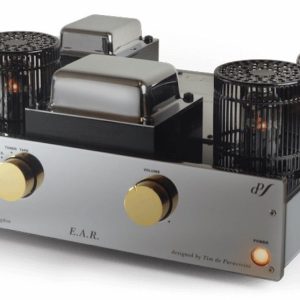
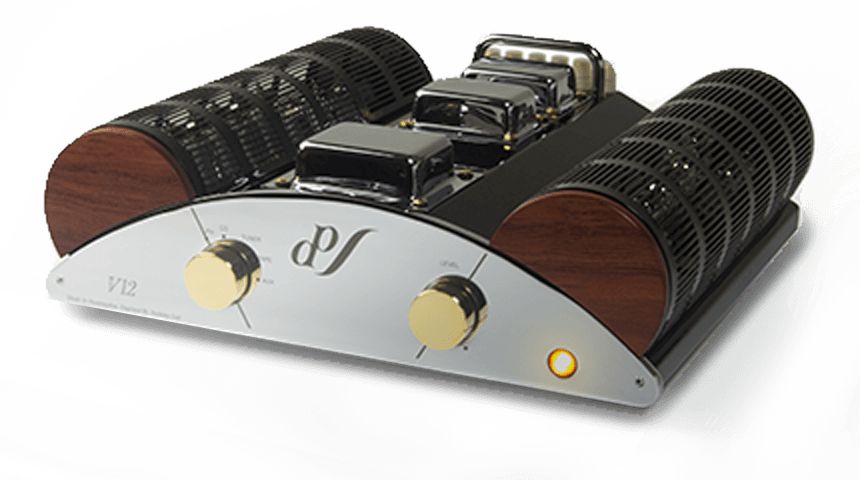
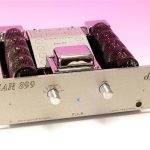
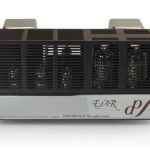
Tim de Paravicini’s fascination with the Jaguar engine inspired the V12’s appearance. Six EL84 valves sit on one side and six on the other. This arrangement keeps the group of valves compact and concentrates the amplifier’s weight toward its centre. That weight matters when choosing furniture: the V12 needs a firm, stable surface capable of supporting it securely.
The transformer covers are chrome plated. Crescent shaped valve covers have hand selected, polished wooden end pieces. These features remain visible when the amplifier is installed, so consider both its appearance and the space available on the shelf. Check the stated chassis dimensions against the intended position, and allow additional room behind the amplifier for its connections and cables. The chassis measurement alone does not include that extra space.
Connecting sources
The five RCA line inputs are for sources that provide an analogue line level audio signal. Connect a source’s line output to one of these inputs. Having several inputs is useful if you listen to more than one source and would like to leave them connected instead of changing cables each time. The input count describes available source connections; it does not change the type of signal those connections require.
A turntable may need a separate phono stage to prepare its signal for a line input. Whether one is needed depends on the turntable and the equipment already in the system. Check that the signal reaching the V12 is suitable for a line input before planning a direct connection. The separate RCA recording output sends a signal to a recording device. It is an output, so it should not be counted as another place to connect a source.
Power and speaker choice
The stated 50 W output rating applies to both 4 Ω and 8 Ω loads over the 20 Hz-20 kHz frequency range. Keep those measurement conditions in view when comparing amplifiers. A wattage figure without its load and frequency range does not describe the same set of conditions. When choosing speakers, consider their load alongside the V12’s stated power rating rather than judging the pairing from the wattage number alone.
An alternative version with 8 Ω and 16 Ω outputs is also specified. It is an optional output version, not a feature that can be assumed for every V12. Check the particular unit when those outputs matter to your system. The amplifier suits a stereo setup with several line level sources. If a home cinema receiver is part of that setup, it would need a suitable analogue line output to serve as a source for the V12. No dedicated home cinema mode is specified.
Power supply and published figures
The V12 is listed in 240 V, 110 V and 100 V mains voltage versions for different markets. The model name alone does not identify the voltage of a particular unit. Confirm the version against the mains supply where it will be used; the distinction concerns the amplifier’s own power supply. Its stated power consumption is also relevant when planning the system’s electrical load and choosing its place in the setup.
The published total harmonic distortion figure has no measurement conditions attached. Keep that limitation in mind if comparing it with figures for other amplifiers, since the figures may have been obtained under different conditions.
Technical specifications
| Type | Integrated valve stereo amplifier |
|---|---|
| Output valves | 12 × EL84 (6BQ5), six on each side |
| Other valves | 10 × ECC83 (12AX7) |
| Line inputs | 5 × RCA |
| Recording output | 1 × RCA |
| Output power | 50 W into 4 Ω and 8 Ω loads, over 20 Hz-20 kHz |
| Optional output version | 8 Ω and 16 Ω |
| Frequency response | 12-60 kHz, -3 dB |
| Signal to noise ratio | 93 dB |
| Input sensitivity | 0.4 V |
| Input impedance | 47 kΩ |
| Damping factor | 10 |
| Total harmonic distortion | Less than 0.03%; measurement conditions not specified |
| Weight | 22 kg (48 lb) |
| Length | 420 mm (16.5 in) |
| Width | 440 mm (17.3 in) |
| Height | 135 mm (5.3 in) |
| Power consumption | 200 W |
| Mains voltage versions | 240 V, 110 V or 100 V, depending on version |
| Exterior details | Chrome plated transformer covers; crescent shaped valve covers with hand selected, polished wooden end pieces |
FAQ
Can I connect a turntable directly?
The RCA inputs are line inputs. If your turntable does not have a built in phono stage, you will need a separate phono stage between the turntable and the amplifier.
What is the recording output for?
It sends a signal to a recording device through an RCA connection. It is not a sixth source input, so do not include it when counting how many sources you can connect.
Can I connect a home cinema receiver?
A suitable analogue line output from the receiver can be used as a source. The V12 has line inputs, but no separate home cinema integration mode is specified.
How should I choose a place for the amplifier?
Choose a stable surface that can support its 22 kg weight. When checking shelf depth, allow for the stated 420 mm chassis length plus space behind it for connectors and cables.
Do all V12 amplifiers have 8 Ω and 16 Ω outputs?
No. That output arrangement is specified as an optional version. You cannot determine whether a particular unit has it from the V12 model name alone.
Why does the mains voltage version matter?
The V12 is made in versions for different mains supplies. The 240 V, 110 V and 100 V versions are not interchangeable specifications, so the particular unit must match the electrical supply where it is used.