Mola Mola DAC Add-on
7 000,00 €
The Mola Mola DAC Add-on is a digital-to-analog converter module for a preamplifier with a suitable accessory slot. It accepts sources through AES/EBU, Toslink, USB, Bluetooth, and Ethernet. USB is a stated path for high-resolution PCM, DoP, and native DSD. Its two-board design processes the digital signal before two mono converters turn it into analog audio.
Mola Mola DAC Add-on is a digital-to-analog converter module that fits in a preamplifier accessory slot. It accepts digital audio through wired, wireless, and network connections, then passes an analog signal to the preamplifier. It is intended for a system in which digital sources are connected through the preamplifier.
Design and place in the system
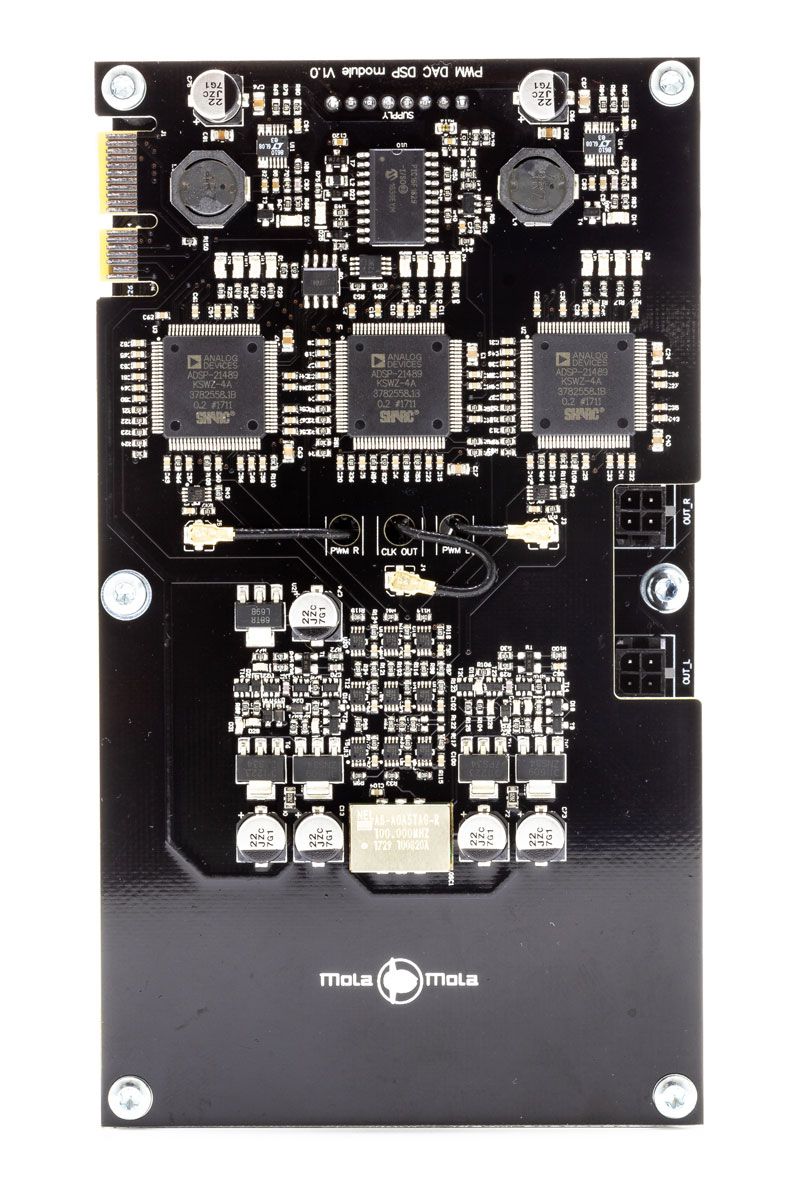
The module consists of two boards mounted one above the other so that it can fit in the accessory slot. Before choosing it, identify the preamplifier it is intended for. The presence of an accessory slot alone does not establish compatibility with a particular model.
The first board upsamples all incoming digital audio to 3.125 MHz and 32 bits and converts it into a noise-shaped PWM signal. The second board contains two separate mono converters. Each uses a discrete 32-stage FIR converter and a single-stage, fourth-order filtering current-to-voltage converter. Together, these circuits turn the PWM signal into analog audio for the preamplifier. The two-board layout therefore accommodates both the digital processing and the conversion stage within the accessory module.
Connecting sources
The AES/EBU connection on XLR accepts a digital AES/EBU signal. A source with an optical output can be connected through Toslink, while a computer or another compatible USB source connects through the USB Type-B port. Check the type of output on your source before choosing a cable: these are digital inputs on the DAC module, even where a connector resembles one used elsewhere for analog audio.
For Bluetooth, the listed codecs are SBC, AAC, aptX, and LDAC. The codec used for a connection also depends on what the sending device supports, so the available list does not mean that every phone or player will use the same one. The Ethernet connection was previously offered for Roon playback. Use with a current Roon system depends on that system’s present support and should be checked before relying on this connection.
Audio formats and connection limits
The stated PCM capability reaches 384 kHz and 32 bits. Sample rates above 192 kHz and bit depths above 24 bits apply only to the USB and Roon paths. This distinction matters when matching the module to a collection of recordings: the highest stated PCM figures should not be assumed to apply through Toslink or AES/EBU. Choose the source connection with the format of the recordings in mind, as well as the outputs available on the source device.
DoP and native DSD up to quad rate are likewise specified only for USB and Roon. If you have DSD recordings, USB is the explicitly identified connection path. DSD support is not stated for the other inputs. These limits describe the paths named for each format; they do not establish that every connected source will supply every listed format.
Clocking and audio characteristics
The asynchronous upsampling algorithm measures the frequency ratio of the incoming signal. Once the signal has locked, that measurement stops after a few seconds. Frequency stability then depends on the internal 100 MHz SC-cut oscillator. This sequence explains how the module handles timing when a digital source is connected: after lock, it relies on its internal clock rather than continuing the initial frequency-ratio measurement.
The stated signal-to-noise ratio is 130 dB. Total harmonic distortion and intermodulation distortion are described as unmeasurable; the -140 dB figure is an estimate, not a measured result. The bandwidth extends to 80 kHz with an apodizing response. When comparing these figures with those of another device, take its measurement conditions into account. The distinction between a stated measurement and an estimate is especially relevant to the distortion figure.
Technical specifications
| Type and installation | DAC add-on for a preamplifier accessory slot; two-board module |
|---|---|
| First-board processing | Upsamples incoming audio to 3.125 MHz and 32 bits; noise-shaped PWM |
| Second-board converters | Two mono DACs, each with a discrete 32-stage FIR converter and a single-stage, fourth-order filtering current-to-voltage converter |
| Clocking | Asynchronous upsampling; frequency-ratio measurement stops a few seconds after signal lock; 100 MHz SC-cut oscillator |
| Digital connections | AES/EBU on XLR, optical Toslink, USB Type-B, Bluetooth, Ethernet |
| Bluetooth codecs | SBC, AAC, aptX, LDAC |
| Network function | Ethernet connection previously offered for Roon playback |
| PCM | Up to 384 kHz and 32 bits; rates above 192 kHz and depths above 24 bits only through USB and Roon |
| DSD | DoP and native DSD up to quad rate; only through USB and Roon |
| Full-scale output level | 20 dBu |
| Signal-to-noise ratio | 130 dB |
| THD and IMD | Described as unmeasurable; -140 dB is an estimate |
| Bandwidth | Up to 80 kHz, apodizing response |
| Integrated clock jitter | Less than 1 ps from 10 Hz; less than 300 fs from 1 kHz |
| Clock-jitter rejection | More than 80 dB at 1 Hz after 20 seconds of signal lock |
FAQ
Does this add-on replace a separate DAC?
It performs digital-to-analog conversion inside the preamplifier. A separate external DAC would need its own space and a connection to the preamplifier; this module occupies the accessory slot instead.
Will the add-on fit any preamplifier?
No. It requires a compatible preamplifier with the appropriate accessory slot. The module’s input list alone does not tell you which preamplifier model it will work with, so check the intended model before choosing the add-on.
Which connection should I use for high-resolution PCM or DSD recordings?
USB is a stated path for both. It covers the specified PCM rates above 192 kHz or depths above 24 bits, as well as DoP and native DSD. The Roon path is also listed for those formats.
Can I connect an analog source to the XLR socket?
The XLR socket on this add-on is for a digital AES/EBU signal. An analog source with an XLR output is not suitable simply because its connector has the same shape.
Will Bluetooth always use LDAC?
No. Several codecs are listed for the add-on, and the codec used also depends on the sending device. A phone or player may support a different codec.
Where does the module sit in the audio signal path?
Digital sources connect to the module inside a compatible preamplifier. The module converts their signals to analog audio and passes it to the preamplifier. The preamplifier and the rest of the system determine the subsequent path to amplification and speakers.
Will Ethernet work with a current Roon system?
Ethernet is associated with Roon playback in the product information, but current compatibility has not been verified. If you plan to use this path, check support for your system before selecting the add-on.