


Rotel RAS-5000 Streaming Integrated Amplifier
3 000,00 €
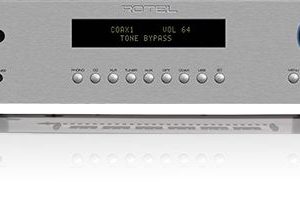
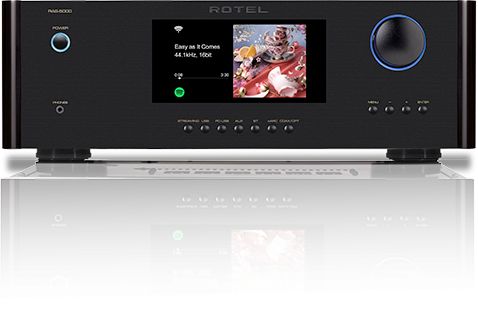
Rotel RAS-5000 is a streaming integrated amplifier for stereo music and TV sound. Its Class AB amplification delivers 140 W per channel into 8 ohms or 220 W into 4 ohms. HDMI, PC-USB, optical, and coaxial inputs accommodate different sources. Spotify Connect, Tidal Connect, AirPlay 2, Google Cast, Roon, and aptX HD Bluetooth provide several wireless playback options.
Rotel RAS-5000 is a network-streaming integrated amplifier designed for a modern stereo system. It combines a network music player and a two-channel Class AB amplifier in one enclosure. The specified output is 140 W per channel into 8 ohms, rising to 220 W per channel into 4 ohms.
This model suits listeners who want to enjoy streaming platforms, computer audio, and digital or analogue sources. An HDMI connection also allows TV sound to be played through the stereo system.
Music playback and network features
Spotify Connect, Tidal Connect, and internet radio provide direct access to online music sources. AirPlay 2 and Google Cast allow audio to be streamed from compatible devices.
Roon Ready status supports a music library managed through Roon. Wireless connectivity also includes Bluetooth with the aptX HD codec. The availability of platforms, codecs, and online services may change over time.
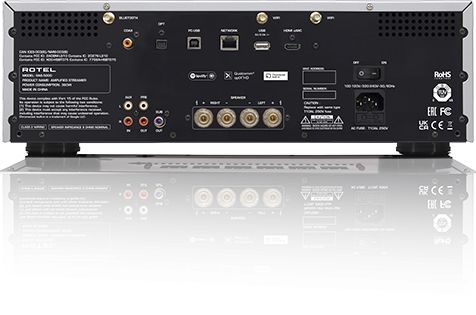
Connections for different sources
The HDMI connection is provided for receiving TV audio, allowing programmes, films, and games to be heard through connected stereo speakers.
Coaxial and optical digital inputs accept S/PDIF LPCM signals up to 24-bit/192 kHz. They can be used with sources equipped with a suitable digital output.
The PC-USB input supports USB Audio Class 2.0 signals up to 24-bit/384 kHz. A driver must be installed when using this connection with a computer. MQA and MQA Studio decoding is specified up to 24-bit/384 kHz.
Line-level inputs are intended for analogue sources. A separate phono preamplifier is required for a turntable unless the turntable itself provides a line-level output.
Sound adjustment and initial setup
Tone controls adjust bass and treble within a ±10 dB range, with adjustment points at 100 Hz and 10 kHz. It is sensible to begin with the controls in their neutral positions. You can then make small adjustments to suit the room and the tonal balance of the speakers.
The damping factor of 290 describes the amplifier’s electrical control over the speaker drivers. This figure should only be compared with other ratings after considering the stated measurement conditions.
Placement and power requirements
The enclosure is 425 mm deep and weighs 15.7 kg, so the supporting furniture must be able to carry this weight. Leave additional space behind the unit for its connections and for cables to bend without strain.
A Class AB amplifier generates heat during operation. Do not cover the top or sides of the enclosure, as air must be able to circulate freely.
The stated 120 V, 60 Hz power requirements are region-specific and do not match Lithuania’s 230 V, 50 Hz mains supply. The power marking on the version being used must correspond exactly to the local electricity supply.
Technical specifications
| Type | Streaming integrated stereo amplifier |
|---|---|
| Amplifier class | AB |
| Output power into 4 Ω | 220 W per channel |
| Output power into 8 Ω | 140 W per channel |
| Total harmonic distortion | Less than 0.03% |
| Intermodulation distortion | Less than 0.03%; 60 Hz and 7 kHz signals at a 4:1 ratio |
| Damping factor | 290 |
| Line-input frequency response | 10 Hz-100 kHz, ±0.5 dB |
| Digital-input frequency response | 10 Hz-70 kHz, ±3 dB maximum |
| Line-input signal-to-noise ratio | 103 dB, IHF “A” weighted |
| Digital-input signal-to-noise ratio | 105 dB, IHF “A” weighted |
| Line-input sensitivity | 0.78 V |
| Digital-input sensitivity | -8 dBFS |
| Line-input impedance | 46 kΩ |
| Digital-input impedance | 75 Ω |
| Line-input overload | 4.1 V |
| Tone controls | ±10 dB at 100 Hz and 10 kHz |
| HDMI | Connection for receiving TV audio |
| Coaxial and optical inputs | S/PDIF LPCM up to 24-bit/192 kHz |
| PC-USB | USB Audio Class 2.0 up to 24-bit/384 kHz; driver required |
| MQA | MQA and MQA Studio decoding up to 24-bit/384 kHz |
| Streaming services | Spotify Connect, Tidal Connect, internet radio |
| Wireless playback | AirPlay 2, Google Cast, Bluetooth with aptX HD |
| Roon | Compatible with Roon; Roon Ready |
| Dimensions | 431 × 144 × 425 mm; 17 × 5 7/8 × 16 in. |
| Front-panel height | 132.6 mm; 5 1/4 in. |
| Weight | 15.7 kg; 34.6 lb |
| Power requirements | 120 V, 60 Hz |
| Power consumption | 380 W |
| Standby power consumption | Less than 0.5 W |
| Heat output | 1027 BTU/h; 4 Ω, 1/8 power |
FAQ
Is this a network player or a stereo amplifier?
It performs both functions. The unit receives signals from network and other sources, then directly powers connected passive speakers.
Which connection should I use for a TV?
The HDMI connection is intended for TV sound. The optical input can be used if the television outputs a compatible S/PDIF LPCM signal.
How do I connect a computer?
The PC-USB input accepts the highest stated resolution. A suitable driver must be installed on the computer before this input is used.
Can I connect a turntable directly?
The line-level input does not perform the function of a phono preamplifier. You need either a turntable with a line-level output or a separate phono preamplifier.
What do the two different power figures mean?
The output is specified with different loads. It is rated at 140 W into 8 Ω and 220 W into 4 Ω.
How much space does the unit require?
The enclosure requires a supporting surface of at least 431 × 425 mm. Allow extra room for cables and do not cover the enclosure surfaces needed for ventilation.