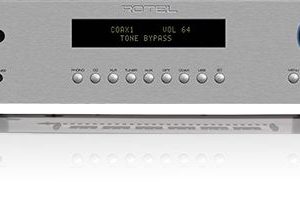


Rotel A12MK2 Integrated Amplifier
1 200,00 €
The Rotel A12MK2 is an integrated stereo amplifier for a home music system with analog, digital, and wireless sources. It delivers 60 W of continuous power per channel into an 8 Ω load. A Rotel-manufactured toroidal transformer supplies the Class AB amplification circuit. The MM phono preamplifier allows direct connection of a turntable fitted with an MM cartridge. PC-USB and aptX Bluetooth expand the available source options.
The Rotel A12MK2 integrated amplifier is a two-channel model for a home stereo system. It accommodates turntables, line-level components, digital devices, computers, and wireless audio sources. Continuous output is rated at 60 W per channel into an 8 Ω load. Its low-profile enclosure takes up relatively little vertical space on an equipment shelf.
Amplification Circuit and Power Supply
An oversized toroidal transformer manufactured by Rotel supplies the Class AB output stage. The specified maximum output is 120 W per channel into a 4 Ω load.
Total harmonic distortion is below 0.018%, while the damping factor is 220. The circuitry is optimized to preserve the integrity of the audio signal as it passes through the amplifier.
Connecting Analog Sources
Four RCA analog inputs accept line-level sources. They can be used for a CD player, an external network player, or another device equipped with RCA outputs.
The built-in MM phono preamplifier allows a turntable fitted with a moving-magnet cartridge to be connected directly. A separate phono stage is not required for this cartridge type. A moving-coil cartridge would require a suitable external phono preamplifier.
The preamplifier output delivers a 1.2 V signal and can be used with a separate power amplifier. Its specified output impedance is 470 Ω.
Digital and Wireless Sources
Four digital inputs broaden the choice beyond analog sources. The S/PDIF connection accepts LPCM signals at up to 24-bit/192 kHz. Digital conversion is handled by a 32-bit Texas Instruments digital-to-analog converter.
The PC-USB connection operates in two modes. USB Audio Class 1 supports resolutions up to 24-bit/96 kHz. USB Audio Class 2 reaches up to 32-bit/384 kHz, but this mode requires a driver to be installed.
aptX Bluetooth enables wireless audio playback from a compatible phone, tablet, or computer. The model is designated Roon Tested, but it is not specified as Roon Ready.
Tone Controls and Initial Setup
The tone controls provide a ±10 dB adjustment range at 100 Hz and 10 kHz. During initial setup, leave both controls at 0 dB. Adjust the bass or treble only after evaluating the sound from the listening position.
Start by optimizing speaker placement, then use the tone controls for small corrections where necessary.
Placement on an Equipment Shelf
The enclosure measures 430 mm wide, 93 mm high, and 345 mm deep. Allow additional room behind the amplifier for connections and cable bends. Its 8.76 kg weight requires a stable, level shelf.
Power consumption during operation is 230 W, so the enclosure should not be placed in a sealed compartment. Standby power consumption is below 0.5 W. The 120 V, 60 Hz power requirement applies to the version marked accordingly.
Technical Specifications
| Model designation | A12MK2 / A12MKII |
|---|---|
| Type | Integrated two-channel stereo amplifier |
| Amplifier class | AB |
| Transformer | Oversized toroidal transformer manufactured by Rotel |
| Continuous power output | 60 W per channel, 8 Ω |
| Maximum power output | 120 W per channel, 4 Ω |
| Total harmonic distortion | <0.018% |
| Intermodulation distortion | <0.03%; 60 Hz and 7 kHz, 4:1 ratio |
| Damping factor | 220 |
| Analog inputs | 4 RCA line-level inputs |
| Phono input | For an MM cartridge |
| Digital inputs | 4 |
| Computer input | PC-USB |
| Wireless connectivity | Bluetooth with aptX |
| Digital-to-analog converter | 32-bit Texas Instruments |
| S/PDIF signal | LPCM up to 24-bit/192 kHz |
| USB Audio Class 1 | Up to 24-bit/96 kHz |
| USB Audio Class 2 | Up to 32-bit/384 kHz; driver installation required |
| Software designation | Roon Tested |
| Line input sensitivity | 230 mV |
| Digital input sensitivity | 0 dBFS |
| MM input sensitivity | 3.4 mV |
| Line input impedance | 24 kΩ |
| Digital input impedance | 75 Ω |
| MM input impedance | 47 kΩ |
| Line input overload | 4 V |
| Phono input overload | 50 mV |
| Preamplifier output level | 1.2 V |
| Output impedance | 470 Ω |
| Tone control | ±10 dB at 100 Hz and 10 kHz |
| Line input frequency response | 10 Hz-100 kHz, 0 ±0.5 dB |
| Digital input frequency response | 10 Hz-90 kHz, 0 ±2 dB |
| Phono input frequency response | 20 Hz-20 kHz, 0 ±0.5 dB |
| Line input signal-to-noise ratio | 100 dB, IHF A-weighted |
| Digital input signal-to-noise ratio | 103 dB, IHF A-weighted |
| Phono input signal-to-noise ratio | 90 dB, IHF A-weighted |
| Dimensions | 430 × 93 × 345 mm; 17 × 3.6 × 13.5 in |
| Front panel height | 80 mm; 3.15 in |
| Weight | 8.76 kg; 19.31 lb |
| Power requirement | 120 V, 60 Hz |
| Power consumption | 230 W |
| Standby power consumption | <0.5 W |
| BTU rating | 632 BTU/h maximum; 4 Ω, 1/8 power |
FAQ
What kind of stereo system is this amplifier designed for?
It is designed to power a pair of passive speakers and accommodate several different music sources. When choosing speakers, consider their impedance, sensitivity, and the volume levels at which you intend to listen.
How do I connect a turntable?
Connect a turntable fitted with an MM cartridge to the phono input. The line-level RCA inputs do not apply the correction and gain needed for the cartridge’s low-level signal.
Which input should I use for a computer?
For the highest specified resolution, use the PC-USB input in USB Audio Class 2 mode. This mode requires a driver to be installed on the computer.
How should I interpret the 60 W and 120 W power figures?
The 60 W-per-channel figure is the continuous output into an 8 Ω load. The 120 W figure into 4 Ω specifies maximum output, not continuous power.
Which tone-control settings should I start with?
Begin with the neutral 0 dB settings. You can then adjust the bass or treble in small increments to suit the room.
What should I consider when choosing a location and power supply?
Allow room for the 345 mm enclosure depth, the connections, and air circulation. The listed power requirement is 120 V at 60 Hz, so check the marking on the specific version before connecting it.