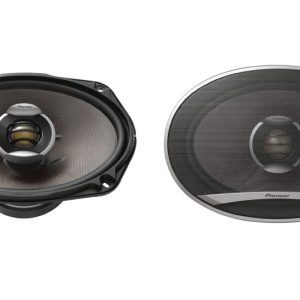

Pioneer TS-A2013i Coaxial Speakers
106,00 €
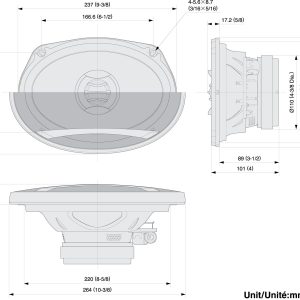
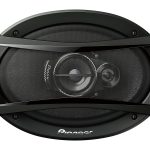
Pioneer TS-A2013i is a set of 20 cm three-way coaxial speakers for a car audio system. The woofer, midrange driver and tweeter are combined in one mounting assembly. The 4 Ω impedance is important when matching the system with a stereo or amplifier. Installation requires a 186 mm cut-out and 89 mm of depth, so the intended location must be measured before purchase.
Pioneer TS-A2013i coaxial speakers are designed for in-car audio systems. This is a 20 cm three-way model combining separate woofer, midrange and tweeter elements. The 4 Ω impedance is an important consideration when matching the speakers with a car stereo or external amplifier. Installation requires a 186 mm cut-out and 89 mm mounting depth.
Who this model is for
This model is suitable for replacing 20 cm speakers in a car audio system or creating new mounting positions. Do not rely on the nominal size alone when choosing. The actual cut-out diameter, available space behind the mounting surface and a load suitable for the amplifier are the deciding factors.
This is not a complete enclosed speaker cabinet. Its final sound will be influenced by the construction of the car door or other installation location. Mounting rigidity and system settings will also affect the result.
Three-way coaxial design
In a coaxial design, several speaker elements are incorporated into one assembly. Here, the 20 cm woofer is complemented by a 57 mm midrange driver and a 17 mm tweeter. This three-way arrangement allows different frequency regions to be reproduced from a single mounting position.
It is a practical solution when the vehicle does not have separate mounting locations for every frequency band. Speaker placement remains important, however. High frequencies are more directional, so the sound from a speaker installed low in a door may depend on the geometry of the passenger compartment.
Cone and surround materials
The woofer uses a carbon and graphite reinforced, aramid fibre interlaced cone. It is surrounded by a cloth surround coated with foam rubber. The cone moves air, while the flexible surround allows it to travel forwards and backwards.
These construction features should not be considered separately from the installation. A frame that has not been tightened correctly or vibrating trim can mask the qualities of the speaker itself. The mounting position should be stable and must not obstruct cone movement.
Impedance and system connections
The model’s 4 Ω impedance must be compatible with the permitted channel load of the chosen amplifier. Check the specifications of the car stereo or amplifier before making any connections. Connecting several speakers in parallel on one channel reduces the total impedance.
The safest arrangement is to connect each speaker to its own amplifier channel. If another wiring configuration is used, the total channel load must be calculated. Polarity should match on both sides of the vehicle. Reversed polarity on one speaker can weaken bass reproduction at the listening position.
Installation dimensions
A 186 mm cut-out diameter is required, while the stated mounting depth is 89 mm. These measurements must be checked together. The window mechanism, inner metalwork and other parts inside the door must remain clear behind the opening.
A nominal 20 cm size does not guarantee that the existing mounting points will align. The outer frame diameter and mounting-hole pattern are not specified. It is therefore advisable to measure the available location against the actual speaker before installation.
Understanding the power figures
The maximum input power is 500 W. This figure is not a recommendation for continuous amplifier power or gain adjustment. 80 W is listed as nominal output power, but its definition and measurement conditions are not provided.
Amplifier gain should only be increased up to the point at which the sound remains clean. Audible distortion indicates that the level should be reduced. A higher power figure alone does not show how the system will sound in a particular vehicle.
Frequency range and sensitivity
The stated frequency range is 25-28,000 Hz, but no tolerance or measurement conditions are given. The volume of the lowest frequencies inside the vehicle therefore cannot be judged from this range alone. The mounting position and the vehicle’s acoustics will have a direct effect on the result.
The stated 91 dB sensitivity helps assess the sound level the speaker can produce. When comparing it with other models, figures measured under the same conditions should be used. The measurement method for this sensitivity rating is not provided.
Adjustment after installation
Begin the first listening test with additional equalisation switched off. This makes reversed polarity, vibrating trim or excessive gain easier to detect. The tone can then be adjusted to suit the vehicle interior and listening position.
If the system uses a low-frequency filter, its setting should be coordinated with the other speakers. Make adjustments in small steps and listen from the driver’s seat. The aim is a smooth transition without an obvious gap in the reproduced frequencies.
The model also carries the phrase “Open & Smooth”. This is not a separate technical specification and does not determine the connection or installation requirements.
Technical specifications
| Model | Pioneer TS-A2013i |
| Type | Coaxial speakers |
| Configuration | Three-way |
| Nominal size | 20 cm |
| Impedance | 4 Ω |
| Frequency range | 25-28,000 Hz; tolerance not specified |
| Sensitivity | 91 dB; measurement conditions not specified |
| Maximum input power | 500 W |
| Nominal output power | 80 W; definition and measurement conditions not specified |
| Woofer cone | Carbon and graphite reinforced, aramid fibre interlaced cone |
| Cone surround | Foam-rubber-coated cloth |
| Midrange driver | 57 mm |
| Tweeter | 17 mm |
| Cut-out diameter | 186 mm |
| Mounting depth | 89 mm |
| Designation | “Open & Smooth” |
FAQ
How can I determine whether the speaker will fit my car?
Measure the existing opening and the free space behind the mounting surface. Also inspect the area through which the window mechanism moves. The nominal size does not indicate the arrangement of the mounting points.
What should I check before connecting the speakers to an amplifier?
The amplifier must operate reliably with the load connected to each channel. If several speakers are connected to one channel, calculate their combined impedance. An unsuitable wiring arrangement may exceed the amplifier’s capabilities.
Does 500 W mean the permitted continuous power?
No. It is the maximum input power rating. It should not be used as the basis for continuous adjustment, so set the gain according to the limit at which the sound remains clean.
Can these speakers be connected to a factory car stereo?
Only if the stereo is designed for this channel load. Its power and the existing wiring arrangement must also be considered. Compatibility with any specific vehicle is not stated.
Why is matching polarity important?
One speaker connected with reversed polarity can weaken bass at the listening position. The polarity should therefore match on both sides of the vehicle.
Do these speakers replace a subwoofer?
The stated frequency range alone does not guarantee that. The level of the lowest frequencies will depend on the mounting location, cabin and system adjustment. The desired result determines whether a separate subwoofer is needed.
Is this model suitable for a home stereo or cinema system?
This is an installable car speaker rather than a complete speaker cabinet with an enclosure. A home amplifier would also need to support its load. The enclosure and frequency tuning would have to be designed separately.