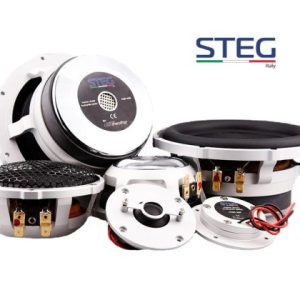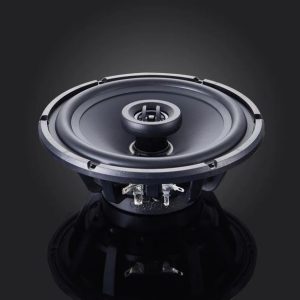
Steg MSS 6 Car Midbass Speaker
370,00 €
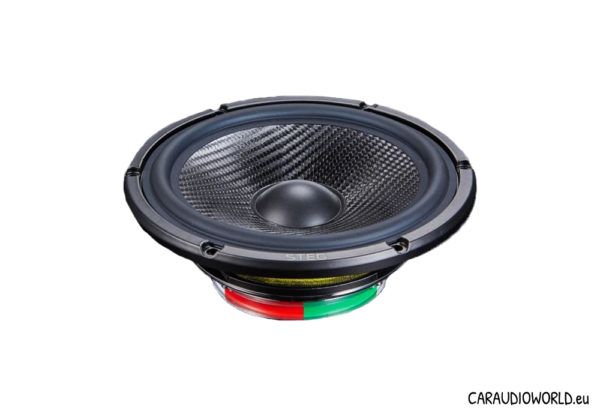
The Steg MSS 6 is a 16.5 cm car midbass speaker designed to reproduce the lower part of your music. It has a 4 ohm impedance. Its stated 200 W RMS rating applies with a high-pass filter set to 150 Hz, so consider that condition when choosing an amplifier and setting up the system. The mounting opening is 141 mm in diameter.
The Steg MSS 6 is a 16.5 cm car midbass speaker designed to reproduce the lower part of your music. It has a 4 ohm impedance. Its stated 200 W RMS power rating applies when a high-pass filter is set to 150 Hz, a condition to keep in mind when choosing an amplifier and setting up the system.
Its place in a car audio system
A midbass speaker covers frequencies between the deep bass handled by a subwoofer and the higher part of the sound range. The stated frequency range for this model is 60-4500 Hz. That range helps you plan which part of the music to send to the speaker, but its limits alone do not determine the right filter setting for your system.
If you use other speakers, consider how their operating ranges meet. Careful adjustment can help avoid a noticeable boost or drop in level around the transition between them. Separately adjustable amplifier channels also let you set each speaker’s level according to its position in the car. Listen to the speakers together when making these decisions: a setting that seems suitable for one speaker on its own may need adjustment as part of the complete system.
Choosing an amplifier and setting the filter
The 4 ohm impedance is a starting point when selecting an amplifier channel. Check what load the channel can handle and how much power it supplies at that load. If you connect several speakers to one channel, the combined load changes. You cannot assess that connection from the impedance of just one speaker.
The 200 W RMS figure is conditional. It is specified with the high-pass filter set to 150 Hz. A high-pass filter keeps frequencies below its selected cutoff from being sent to the speaker. If you plan to use a different setting, do not apply the stated power figure to it without considering that change. Keep the filter condition in view when comparing the speaker with an amplifier’s output.
Set the filter in relation to the operating ranges of the other speakers in the system. As you listen to familiar music, pay attention to the transition between them. Voices and instruments should not suddenly become weaker as their sound moves through that part of the range. Change one setting at a time so you can hear what each adjustment does.
Mounting dimensions and construction
Before installation, distinguish between the two diameter measurements. The 168 mm outer diameter describes the speaker’s outside edge, while the 141 mm mounting diameter is the measurement to check against the opening. The nominal 16.5 cm size does not answer both fitting questions. Compare the mounting diameter with the planned opening and make sure there is room for the outer edge at the chosen location.
The speaker uses a neodymium magnet. The shape of the specific mounting location and the free space around the speaker still determine whether it will fit properly. When securing it, make sure the assembly is stable and that the moving parts cannot touch anything nearby.
What do the other parameters mean?
The stated 87 dB sensitivity is useful when comparing this speaker’s output level with other speakers in the system. The final listening level also depends on the amplifier and its settings. When comparing different models, check the conditions under which their sensitivity figures were provided; a number is most useful when you understand how it was measured.
Fs of 68 Hz is the speaker’s resonant frequency, while Qts of 0.81 describes its overall damping. These parameters can help you plan the acoustic installation, but they are not enough on their own to select a particular enclosure. Xmax of 6.2 mm is a cone-excursion parameter relevant to assessing operation in the lower range. It does not replace the power rating or remove the stated filter condition attached to that rating.
Technical specifications
| Model | Steg MSS 6 |
|---|---|
| Type | Car midbass speaker |
| Size | 6.5 in (16.5 cm) |
| Impedance | 4 ohms |
| Power | 200 W RMS with a high-pass filter set to 150 Hz |
| Frequency range | 60-4500 Hz |
| Sensitivity | 87 dB |
| Magnet | Neodymium |
| Qts | 0.81 |
| Fs | 68 Hz |
| Xmax | 6.2 mm |
| Outer diameter | 168 mm |
| Mounting diameter | 141 mm |
FAQ
What should I consider when choosing an amplifier?
Check the amplifier channel’s power output into a 4 ohm load. When considering it alongside the 200 W RMS speaker rating, remember that the rating is given with a high-pass filter set to 150 Hz.
Can I connect the speaker directly to a car stereo?
Yes, if the stereo’s output is suitable for a 4 ohm load. The speaker’s power rating alone does not tell you how loud a particular stereo will play it.
Where should I start when setting the filter?
If you are working from the stated RMS power condition, start with the high-pass filter at 150 Hz. Then listen and adjust the transition to the other speakers in your system.
Is the nominal 16.5 cm size enough to choose a mounting position?
No. Check the 141 mm mounting diameter against the opening and allow space for the 168 mm outer edge. These measurements address different parts of the installation.
Does this model replace a subwoofer?
It is a midbass speaker with a stated frequency range beginning at 60 Hz. If your system needs to reproduce frequencies below that range, plan for their reproduction separately.
How should I use two of these speakers in a stereo system?
Use one speaker for the left channel and one for the right. You can then adjust each side’s level to suit its position in the car. When planning the wiring, account for the load connected to each amplifier channel.