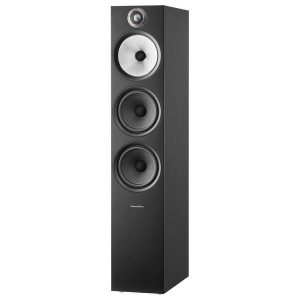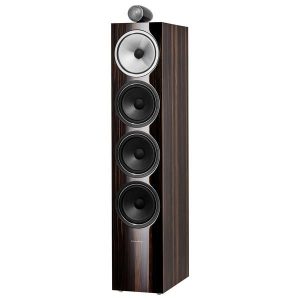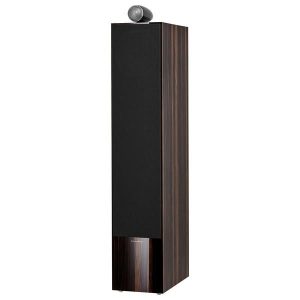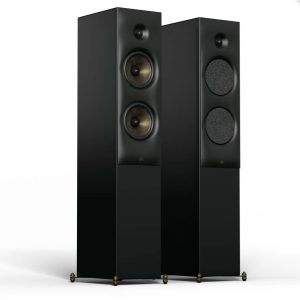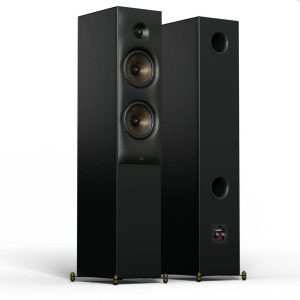
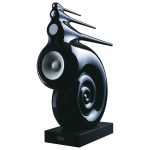
Bowers & Wilkins 803 D4 Floorstanding Speakers
20 000,00 €
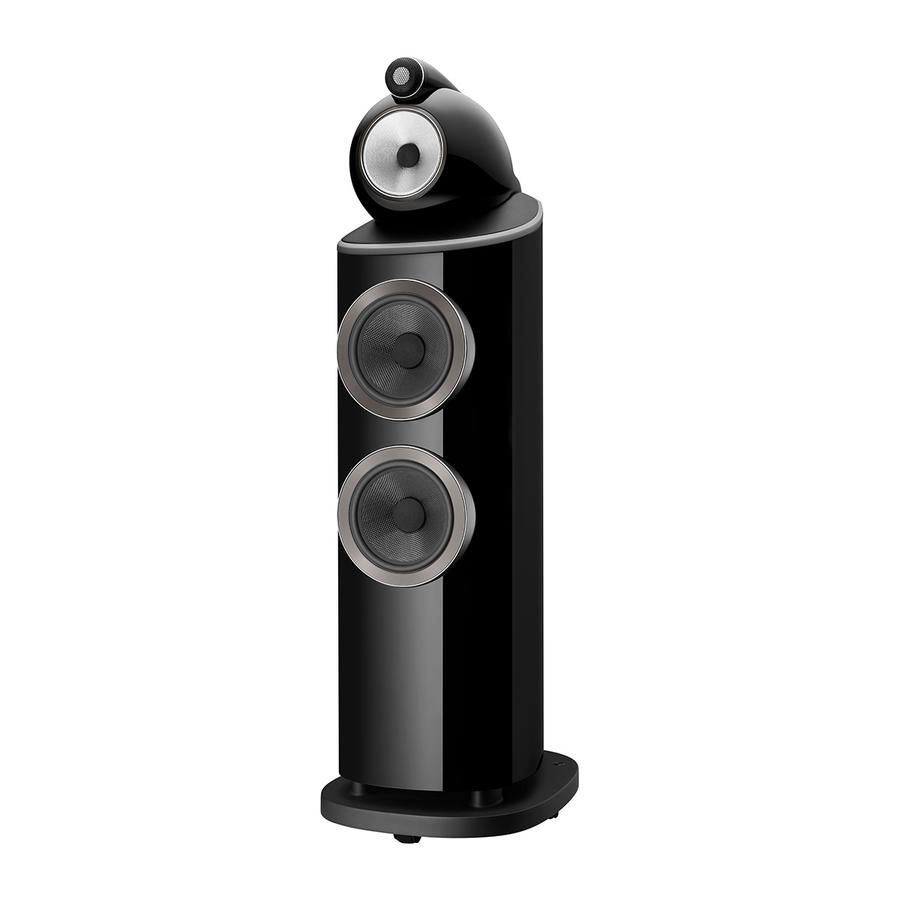
Bowers & Wilkins 803 D4 is a three-way floorstanding speaker designed for a paired home audio system. Its separate enclosure houses a 130 mm Continuum FST midrange driver with Biomimetic Suspension, which reduces unwanted air pressure and coloration. Two 180 mm Aerofoil bass drivers are mounted in solid-metal aluminium pods. When choosing an amplifier, it is important to consider the minimum impedance of 3.0 ohms.
Bowers & Wilkins 803 D4 is a three-way floorstanding loudspeaker designed for a home audio system. It combines a separate midrange enclosure, a diamond-dome tweeter and two Aerofoil bass drivers. The minimum order quantity is two speakers, so the system must be purchased as at least one pair.
Design and purpose
This is the most compact model in the 800 Series Diamond range to feature a separate midrange enclosure. Its three-way vented-box system assigns different frequency bands to dedicated drivers. The design is intended for use as a pair of main left and right channel speakers.
Each speaker weighs 62.15 kg, so it is worth planning its position in the room before connecting the system. This substantial weight must also be considered when assessing the floor load and arranging to move the speakers.
Drivers and enclosure engineering
A 25 mm diamond-dome tweeter reproduces the high-frequency range. Midrange frequencies are handled by a 130 mm Continuum cone FST driver with Biomimetic Suspension.
Biomimetic Suspension reduces the unwanted air pressure and coloration associated with a conventional fabric spider. It is designed to support cleaner midrange reproduction, where much of the information in voices and instruments is heard.
Two 180 mm Aerofoil cone bass drivers are installed in aluminium pods. Each pod is clamped to an internal aluminium plate secured to the stiffest part of the enclosure. The pods are formed from solid pieces of metal, providing the drivers with a rigid mechanical mounting platform.
Choosing an amplifier and speaker cable
The nominal impedance is 8 ohms, but it can fall to 3.0 ohms. Choose an amplifier according to its ability to drive a lower load reliably, rather than relying only on the nominal figure.
The recommended amplifier power is 50-500 W into 8 ohms with unclipped programme material. This is not a statement of the speaker’s continuous power consumption. The stated range should be considered together with amplifier stability and the intended listening level.
The maximum recommended speaker-cable impedance is 0.1 ohm. For a longer cable run, choose a low-resistance cable with a suitable conductor cross-section. This helps prevent the cable from becoming an unnecessary electrical restriction between the amplifier and speaker.
Placement and room adjustment
Begin by positioning the pair symmetrically in relation to the main listening position. Keep the distances from each speaker to the side and rear walls broadly similar. You can then adjust their distance and toe-in toward the listening position in small steps.
The bass balance of a vented enclosure depends on its location within the room. Moving the speakers closer to walls may make the bass more prominent. If low frequencies begin to dominate, increase the distance from the nearest boundaries and compare the result from the listening position.
The stated dimensions are 357 × 1165 × 511 mm, but the order of those measurements is not defined. When planning the installation, consider all three values and allow additional space for connecting the speaker cables.
Understanding the measurement data
The stated frequency range extends from 16 Hz to 35 kHz. A separate frequency response specification covers 19 Hz-28 kHz within ±3 dB of the reference axis. These figures describe different measurement conditions and should not be treated as equivalent.
Sensitivity is rated at 90 dB, measured on-axis at a distance of one metre with a 2.83 Vrms input. This condition allows a meaningful sensitivity comparison only with speakers measured in the same way.
Second- and third-harmonic distortion remains below 1% from 80 Hz to 20 kHz. From 100 Hz to 20 kHz, it remains below 0.3%. Both results are specified at 90 dB, measured on-axis at a distance of one metre.
Technical specifications
| Model | Bowers & Wilkins 803 D4 |
|---|---|
| Type | Floorstanding loudspeaker |
| System | Three-way vented-box system |
| Midrange enclosure | Separate; the most compact model of this kind in the 800 Series Diamond range |
| Tweeter | 1 × 25 mm diamond dome |
| Midrange driver | 1 × 130 mm Continuum cone FST with Biomimetic Suspension |
| Bass drivers | 2 × 180 mm Aerofoil cone |
| Bass pod construction | Solid-metal aluminium pods clamped to an internal aluminium plate |
| Frequency range | 16 Hz-35 kHz |
| Frequency response | 19 Hz-28 kHz, ±3 dB from the reference axis |
| Sensitivity | 90 dB on-axis at 2.83 Vrms and 1 m |
| Harmonic distortion | Second and third harmonics, 90 dB, 1 m, on-axis: below 1% from 80 Hz to 20 kHz; below 0.3% from 100 Hz to 20 kHz |
| Nominal impedance | 8 ohms |
| Minimum impedance | 3.0 ohms |
| Recommended amplifier power | 50-500 W into 8 ohms with unclipped programme material |
| Maximum recommended cable impedance | 0.1 ohm |
| Dimensions | 357 × 1165 × 511 mm; measurement order not specified |
| Net weight | 62.15 kg |
| Minimum order quantity | 2 units |
FAQ
Can I order a single speaker?
The minimum order quantity is two units. You must therefore order at least one pair for the left and right channels.
What should I consider when choosing an amplifier?
Do not consider only the nominal impedance. The minimum impedance places a greater current demand on the amplifier, so stable operation with a varying load is important.
How do I connect the speakers to an audio system?
Connect the speakers to the amplifier’s speaker outputs using suitable speaker cable. Audio sources should first be connected to the stereo amplifier or AV receiver.
How should I begin adjusting their position?
Place both speakers at similar distances from the listening position and the room boundaries. Then try small changes to their spacing and toe-in separately.
What is the difference between frequency range and frequency response?
Frequency range indicates the broader reproduction limits. Frequency response defines a narrower range with a specific ±3 dB tolerance, making it more suitable for like-for-like comparison.
What should I plan before positioning the speakers?
Because each speaker is heavy, choose its final location in advance and arrange assistance when moving it. Also leave enough room for the cables and for subsequent placement adjustments.