Bowers & Wilkins 603 S2 Anniversary Edition Floorstanding Speaker
1 800,00 €
Bowers & Wilkins 603 S2 Anniversary Edition passive three-way floorstanding speakers are designed for stereo and home cinema systems. A decoupled aluminium tweeter, Continuum FST midrange driver and two paper-cone bass drivers divide the reproduced range across three frequency bands. A 30-200 W amplifier into 8 Ω is recommended, but amplifier selection must also account for the impedance falling as low as 3.0 Ω. Minimum order quantity: 2 units.
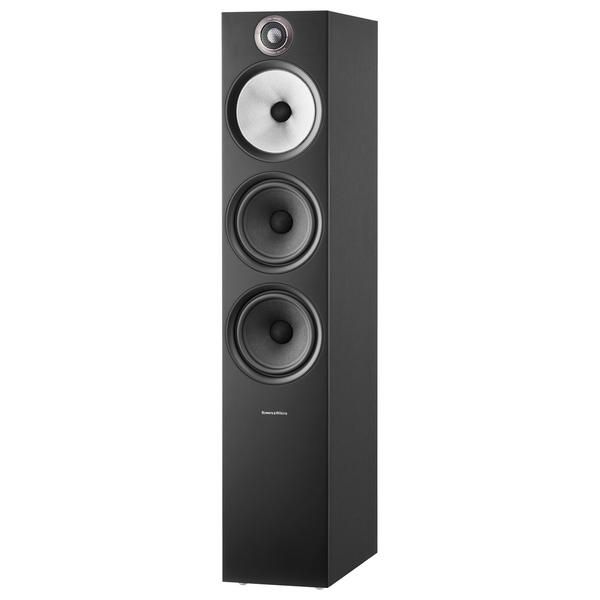
Bowers & Wilkins 603 S2 Anniversary Edition is a passive three-way floorstanding speaker for stereo and home cinema systems. It uses a 25 mm aluminium tweeter, a 150 mm midrange driver and two 165 mm bass drivers.
This seventh-generation 600 Series model was created to mark the series’ 25th anniversary. A stereo system requires two speakers, and the minimum order quantity is 2 units.
Three-way design
Each part of the frequency range is handled by a dedicated driver. The decoupled Double Dome aluminium tweeter is less affected by vibrations from the cabinet, while the 150 mm Continuum FST driver is responsible for the midrange.
Two 165 mm paper-cone drivers reproduce the bass frequencies. The bass-reflex enclosure is complemented by a Flowport opening. The driver technology draws on solutions developed for the 800 Series Diamond range.
Updated crossover components distribute the incoming signal between the three frequency bands. The listed finishes are Oak, Matte White and Matte Black. Choose the specific finish shown in the relevant product offer.
Amplifier selection and connection
This passive floorstanding speaker does not contain an integrated amplifier. The audio source is connected to a stereo amplifier or AV receiver, and the speakers are then connected to its speaker outputs with cables of a suitable cross-sectional area.
The recommended amplifier power is 30-200 W into 8 Ω, provided that the amplifier is not overdriven and the signal is not clipped. The power rating alone is not enough to determine whether an amplifier is suitable. It must also be capable of controlling a load whose impedance falls to 3.0 Ω at certain frequencies.
Avoid amplifier overload and audible signal clipping. An underpowered amplifier that is constantly operated at its maximum level is not automatically safer simply because it has a lower rated output. Clean, controlled operation matters when matching the amplifier to these speakers.
Placement and room adjustment
Each speaker measures 190 × 985 × 340 mm and has a net weight of 24.10 kg. Before installation, account for the cabinet depth, the space required for the cable and the need for a secure supporting surface. Both speakers should stand firmly and at the same height.
The bass-reflex system responds noticeably to the distance from rear and side walls. Placing the speakers closer to a wall will generally increase the perceived bass level. If the low frequencies begin to dominate, move both speakers an equal distance farther into the room.
Begin with a symmetrical arrangement relative to the main listening position. You can then adjust the angle of both speakers gradually so that they point more directly toward the listener. Assess every position from the same seat, and avoid changing the distance from the walls and the toe-in angle at the same time. Adjusting one factor at a time makes the effect of each change easier to judge.
Use in stereo and home cinema systems
In a stereo system, two 603 S2 speakers form the left and right channels. The stated 88.5 dB sensitivity is measured at a distance of one metre with a 2.83 V input signal.
In a home cinema installation, the speakers can be used for the front left and front right channels. Channel levels and delays should be configured in the AV receiver according to the distance between each speaker and the listening position.
If an active subwoofer is added, the crossover between the speakers and subwoofer is set through the AV receiver or audio processor. Adjust the initial crossover point by listening carefully, aiming for a transition without an obvious boost or gap between the speakers and the subwoofer.
Technical specifications
| Type | Passive three-way bass-reflex speaker |
|---|---|
| Series | Seventh-generation Bowers & Wilkins 600 Series Anniversary Edition |
| Tweeter | 1 × 25 mm decoupled Double Dome aluminium dome |
| Midrange driver | 1 × 150 mm Continuum cone FST driver |
| Bass drivers | 2 × 165 mm paper-cone drivers |
| Bass-reflex technology | Flowport |
| Frequency range | 29 Hz-33 kHz at -6 dB |
| Frequency response | 48 Hz-28 kHz, ±3 dB |
| Sensitivity | 88.5 dB SPL with 2.83 V input, measured at 1 m |
| Harmonic distortion | Second and third harmonics: less than 1% from 90 Hz to 22 kHz at 90 dB and 1 m |
| Harmonic distortion | Second and third harmonics: less than 0.5% from 120 Hz to 20 kHz at 90 dB and 1 m |
| Nominal impedance | 8 Ω |
| Minimum impedance | 3.0 Ω |
| Recommended amplifier power | 30-200 W into 8 Ω, without overdriving the amplifier or clipping the signal |
| Dimensions | 190 × 985 × 340 mm |
| Net weight | 24.10 kg |
| Minimum order quantity | 2 units |
| Listed finishes | Oak, Matte White, Matte Black |
FAQ
Do these speakers require a separate amplifier?
Yes. These are passive speakers, so they require a stereo amplifier or AV receiver. The recommended amplifier power is 30-200 W into 8 Ω.
What matters most when choosing an amplifier?
Consider both the rated power and the amplifier’s ability to operate with low-impedance loads. The speaker has a nominal impedance of 8 Ω, but its minimum impedance reaches 3.0 Ω.
How are they connected to a stereo system?
Connect the two speakers with speaker cables to the amplifier’s left and right channel outputs. Audio sources are connected to the amplifier first.
Can this model be used in a home cinema system?
Yes. The speakers can serve as the front left and front right channels. The AV receiver must be suitable for their impedance and the intended listening level.
How should I choose the distance from the wall?
Start by leaving free space around each cabinet. If the bass becomes too prominent, move both speakers an equal distance farther away from the wall.
What is the difference between the two stated frequency measurements?
The 48 Hz-28 kHz response is specified with a ±3 dB tolerance. The wider limits of 29 Hz-33 kHz are measured at -6 dB.
Is an additional subwoofer necessary?
For stereo music, the need for a subwoofer depends on the room and the desired amount of bass. In a home cinema system, a subwoofer can reproduce the separate effects channel.
Can I order a single speaker?
The minimum order quantity for this model is two speakers. This quantity provides the left and right channels required for a stereo system.
![Patricia Barber Café Blue [Un-Mastered] jazz album](https://audiocentras.lt/wp-content/uploads/2026/09/patricia-barber-cafe-blue-un-mastered-1-1-300x300.jpg)