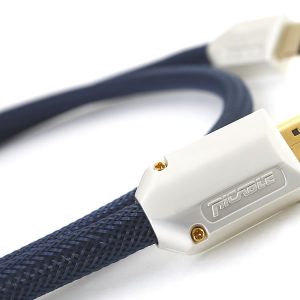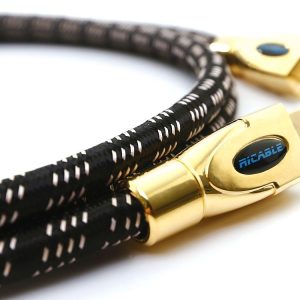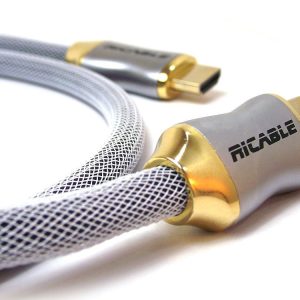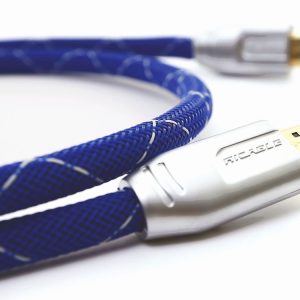


Ricable Magnus Coaxial MKII Digital Coaxial Cable
114,00 €
Ricable Magnus Coaxial MKII is a 75-ohm digital coaxial cable for connecting an audio source to a compatible digital input. Its Mark II solid-core conductor has a cross-sectional area of 1.13 mm² and is made from 99.999% OFC copper. The updated dielectric and larger conductor are associated with more stable impedance. The multi-layer shielding has a claimed 20% greater coverage than the previous version.
Ricable Magnus Coaxial MKII is a 75-ohm digital coaxial cable for connecting digital audio equipment. It carries a signal from a coaxial digital output to a compatible input. In the Mark II version, the conductor, dielectric, shielding and connector contacts have all been revised.
Updated conductor construction
The solid-core conductor is made from 99.999% oxygen-free copper and has a cross-sectional area of 1.13 mm². It is more than 25% larger than the conductor used in the previous version.
The updated dielectric, together with the larger conductor, is associated with impedance stability that is more than 30% higher than in its predecessor. This is a comparison between cable constructions, not an absolute measure of digital signal quality.
Shielding and connector contacts
The multi-layer shielding system has a claimed 20% greater coverage than the previous version. Shielding surrounds the signal-carrying conductor and is an important part of digital coaxial cable construction.
The connector contacts are made from tellurium copper. They are claimed to improve certain electrical parameters by more than 20% compared with standard brass contacts. This comparison applies to unspecified electrical parameters and not to every characteristic of the connector.
The contacts receive a 24-carat gold-plated finish through a special electrolysis process. Every production stage is completed by hand. Each component is inspected by a person using updated tools and testing procedures.
Connecting the cable in an audio system
Choose this cable for a 75-ohm coaxial digital connection. In a typical system, it can connect a source output to the input of a digital-to-analogue converter. It is intended for digital signals rather than analogue line-level signals.
Before ordering, compare the sockets on both devices with the plugs fitted to your chosen cable. The physical connector format cannot be determined from the nominal 75-ohm impedance alone. Measure the actual distance between the sockets as well, allowing for the complete cable-routing path.
Routing and connection
Switch off both audio devices before making the connection. Insert each plug straight into its socket, and never disconnect it by pulling on the cable. Leave a relaxed curve behind the equipment so that the connectors are not placed under continuous strain.
Do not bend the solid-core construction sharply or wind it into a tight coil. Avoid trapping the cable beneath the edge of a piece of furniture. Route the signal cable away from power cables. If they must cross, arrange the crossing at as close to a right angle as practical.
How to interpret the Mark II improvements
The stated percentage changes compare this version with the earlier Magnus Coaxial cable. They describe differences in conductor size, impedance stability, shielding coverage and the electrical parameters of the contacts. The available information does not define the test methods or conditions, so these figures should be treated as construction comparisons.
Technical specifications
| Type | Digital coaxial audio cable |
|---|---|
| Model version | Mark II |
| Nominal impedance | 75 ohms |
| Conductor construction | Solid core |
| Conductor material | 99.999% OFC oxygen-free copper |
| Conductor cross-sectional area | 1.13 mm² |
| Conductor change | More than 25% larger than in the previous version |
| Dielectric | Updated for the Mark II version |
| Impedance stability comparison | More than 30% higher than in the previous version |
| Shielding | Multi-layer system |
| Shielding coverage comparison | 20% greater than in the previous version |
| Connector contacts | Tellurium copper |
| Contact electrical parameter comparison | More than 20% improvement compared with standard brass contacts |
| Contact finish | 24-carat gold plating applied through a special electrolysis process |
| Production | Every stage completed by hand |
| Inspection | Manual inspection of every component using updated tools and testing procedures |
FAQ
When should I choose this cable?
Choose it when both devices have compatible coaxial digital connections. For an analogue line-level connection, use a cable designed for that purpose.
Can it be used with a digital-to-analogue converter?
Yes, provided the converter has a coaxial digital input. The source output and the format of the cable plugs must also be compatible.
Does anything need to be configured after connection?
The cable has no controls. If your device allows you to select an input, choose the coaxial digital input to which the cable is connected.
How should I choose the correct length?
Select the shortest length that reaches both sockets without tension. Allow a little extra length for a relaxed curve and the planned routing path.
How much clearance is required behind the equipment?
Leave enough room to route the cable in a gentle curve without straining the connectors. The available information does not specify an exact clearance.