
Ricable Magnus USB Cable
87,00 €
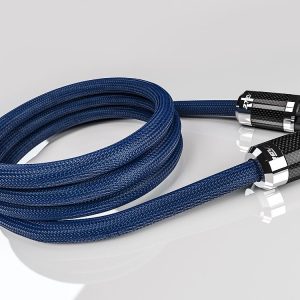
Ricable Magnus USB is a USB audio cable for connecting digital sources, DACs, and computer-data devices. Four shields reduce exposure to external interference, while separate data and power sections help limit interaction between them. The connector housing is easy to grip and protects sensitive soldered areas.
Ricable Magnus USB cable is designed to carry digital audio and computer data. Its construction uses four shields, separate data and power sections, and different dielectric materials. This arrangement helps manage external interference while reducing interaction between the cable’s internal circuits.
This USB audio cable draws on construction principles from Ricable’s higher-tier Invictus series. It is intended for systems where a carefully designed signal path between a digital source and audio equipment matters.
Separate data and power sections
A USB cable carries data and may also supply power to passive devices. In the Magnus cable, these functions use separate twisting geometries, with dedicated insulation between the two sections.
Different dielectric materials are used to balance shielding and signal transmission. The design targets appropriate USB impedance, low capacitance, and low electrical resistance-important considerations when circuits serving different purposes share one cable.
Four-shield construction
The cable incorporates four shields that protect its transmission sections from external electromagnetic interference. They also help isolate the data circuit from the power circuit.
This shielding works together with the separate geometry of the internal sections. Their individual layout and insulation reinforce the separation provided by the four shields.
Connection and cable selection
The cable connects a USB signal source to compatible receiving audio equipment, such as a digital-to-analogue converter (DAC). Its construction is also suitable for transferring computer data.
The specific connector configuration is not stated. The model name alone therefore cannot establish which USB ports a selected variant will fit. Before ordering, check that both connectors match the ports on the source and receiving device.
Choose the length according to the actual distance and allow a little extra slack. Too much spare cable makes neat routing more difficult. Avoid pulling the cable taut or bending it sharply beside the connector housing.
Purpose of the connector housings
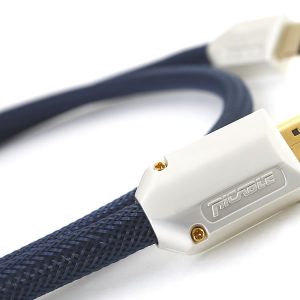
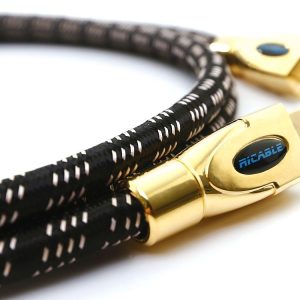
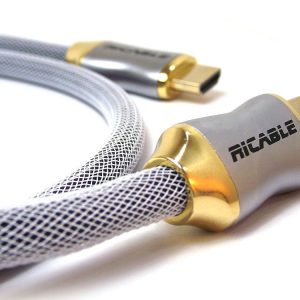
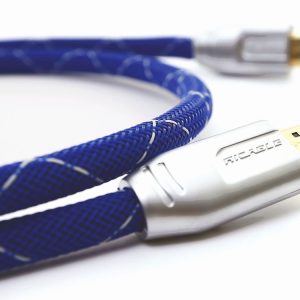
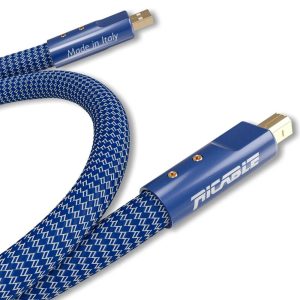
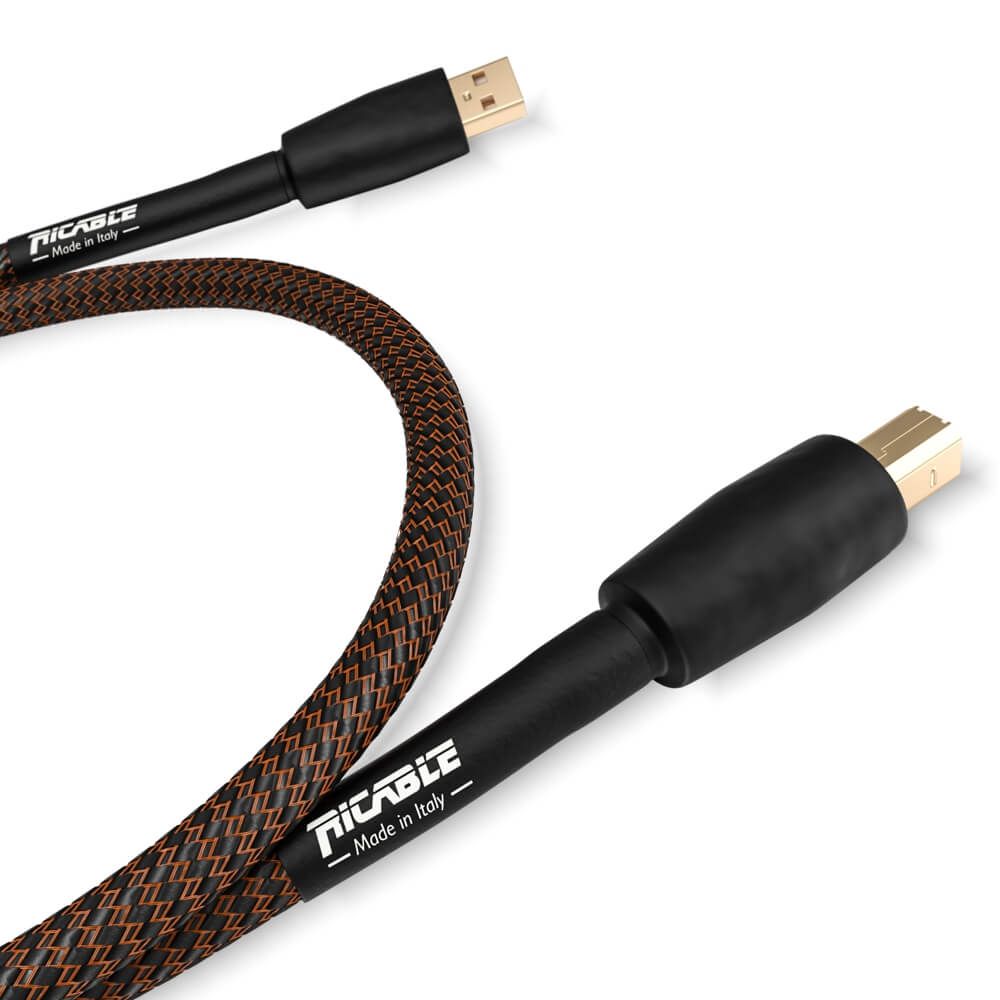
The connector shape is designed for an easy grip, allowing you to hold the housing rather than pull the cable when disconnecting it. The housing also covers the sensitive soldered areas.
Leave enough room for the connector housing when routing the cable behind equipment. This reduces mechanical strain around the soldering area and is especially helpful on deep shelves or with equipment positioned close to a wall.
What the long-cable tests show
In an internal test, a 30-metre cable played 96 kHz audio files through a Hi-Fi DAC. In another test, a passive USB flash drive operated through a 25-metre cable connected directly to a computer’s USB port.
The flash drive had no separate power supply and received power through the cable. These results describe the particular test systems used. They are not universal operating limits or a compatibility guarantee for every combination of USB equipment.
Technical specifications
| Model | Ricable Magnus USB |
|---|---|
| Product type | USB audio cable |
| Information carried | Digital audio and computer data |
| Number of shields | 4 |
| Internal geometry | Separate twisting for the data and power sections |
| Circuit separation | Dedicated insulation between the data and power sections |
| Dielectrics | Different dielectric materials are used |
| Design objectives | Appropriate USB impedance, low capacitance, low electrical resistance, and effective shielding |
| Connector housing | Easy-grip shape and protection for soldered areas |
| Construction basis | Developed using Ricable Invictus series construction principles |
| Internal DAC test | 96 kHz audio playback through a 30-metre cable |
| Internal passive-device test | USB flash drive operation through a 25-metre cable, powered through the cable |
FAQ
What is this cable intended for?
It carries digital audio and computer data over USB. In an audio system, it can connect a source to a DAC when both devices have suitable USB ports.
How do I choose the correct connector variant?
Compare the USB ports on both devices. The connectors on the selected cable must match the ports on the source and receiving equipment exactly.
What difference do the four shields make?
They reduce exposure to external interference and help separate the data and power sections. The cable’s separate internal geometry further supports this isolation.
Will a 30-metre length work with every DAC?
No. That result came from a specific internal test using 96 kHz files. Actual operation depends on the source, DAC, and power conditions.
How should I route the cable behind my equipment?
Allow space for the connector housing and avoid sharp bends. Disconnect the cable by holding the housing so that the soldered areas are not placed under unnecessary strain.