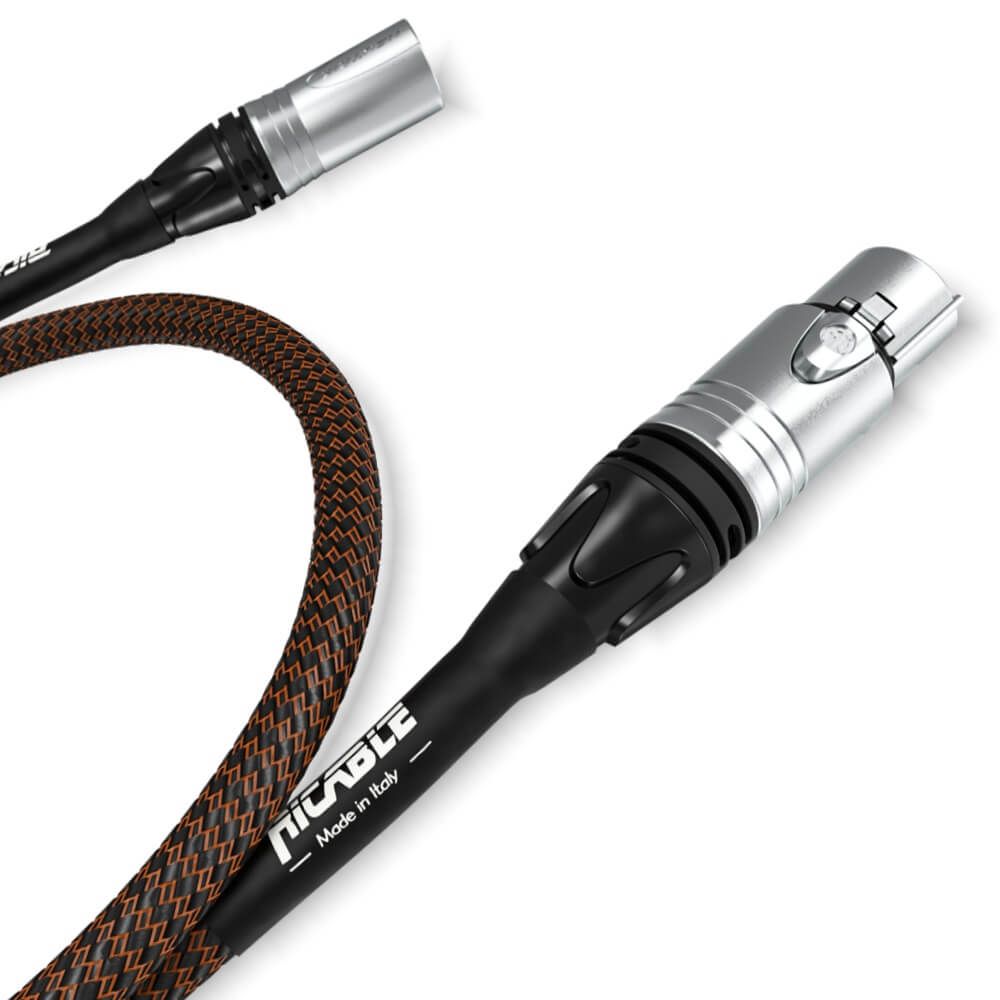

Ricable Magnus AES/EBU Digital Audio Cable
129,00 €
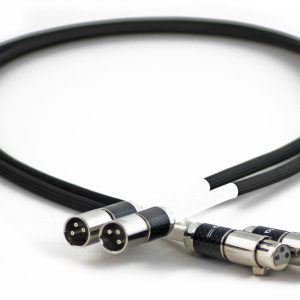
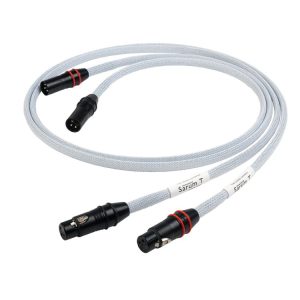
Ricable Magnus AES/EBU is a digital audio cable for connecting a CD player or network audio player to a DAC. It carries a balanced 110-ohm AES/EBU signal through XLR connectors. Dual copper and aluminium shielding protects the 7N MARC copper conductors from EMI and RFI interference. The silver-plated Neutrik connectors are modified for Magnus-series XLR cables.
Ricable Magnus AES/EBU is an AES/EBU digital audio interconnect cable designed to connect a digital source to a DAC. The source may be a CD player or a network audio player. The cable carries a balanced digital signal through XLR connectors.
What this cable is designed for
Choose this cable when your source has an AES/EBU output and your DAC has the corresponding input. The connections on both devices must be labelled AES/EBU. The presence of an XLR socket alone does not confirm compatibility, as an analogue XLR connection may be intended for a line-level audio signal.
Connect the source’s AES/EBU output to the DAC’s AES/EBU input. The cable transfers digital data but does not convert it. Conversion from a digital signal to analogue audio is performed by the digital-to-analogue converter.
Conductors and connectors
The cable uses 7N MARC copper conductors with a cross-sectional area of 0.31 mm². MARC denotes Ricable’s multicore annealed conductor. The stated size of the individual strands is 0.08 mm. This stranded construction is suited to the cable’s balanced geometry.
The silver-plated Neutrik connectors are modified for Magnus-series XLR cables. Insert each connector fully without twisting it, and make sure the cable’s weight does not place strain on the connection.
Shielding and insulation
The cable’s balanced geometry is combined with dual copper and aluminium shielding. This shielding is intended to protect the transmitted signal from EMI and RFI interference. It is particularly relevant in systems where audio cables must run close to power leads or electronic components.
The conductors are insulated with a special polyethylene material based on materials used in Ricable’s Invictus series. The cable has a characteristic impedance of 110 ohms, as required for its intended AES/EBU connection.
Choosing the length and routing the cable
Before selecting a particular length, measure the route between the source and the DAC. Allow enough slack to prevent the connectors from being pulled or placed under tension. Avoid sharp bends behind the equipment rack.
Check which XLR connector types are required at both ends of the cable. Where possible, avoid routing the audio cable parallel to power cables. If the cables need to cross, arrange them at as close to a right angle as practical. This layout reduces close contact with potential sources of electromagnetic interference.
Technical specifications
| Product type | AES/EBU digital audio interconnect cable |
|---|---|
| Purpose | Connecting a digital source to a DAC |
| Signal carried | Balanced digital audio signal |
| Characteristic impedance | 110 ohms |
| Connector type | Silver-plated Neutrik XLR connectors modified for the Magnus series |
| Cable geometry | Balanced |
| Conductor material | 7N MARC copper |
| MARC meaning | Ricable multicore annealed conductor |
| Conductor cross-section | 0.31 mm² |
| Strand size | 0.08 mm |
| Conductor construction | Stranded |
| Shielding | Dual copper and aluminium shielding against EMI and RFI interference |
| Insulation | Special polyethylene based on Invictus-series materials |
FAQ
Is this cable suitable for any XLR socket?
No. Both devices must have XLR connections designed for digital AES/EBU signals. A balanced analogue XLR input is not an AES/EBU input.
Can it be connected directly to an amplifier?
Yes, provided that the amplifier has an AES/EBU digital input. A standard analogue XLR input is not suitable for this connection.
Does this cable replace a DAC?
No. It carries a digital signal between compatible devices. A separate DAC, or one built into the equipment, converts that signal into analogue audio.
Does the cable require any special settings?
No. After connecting the cable, select the AES/EBU input on the receiving device. You may also need to activate the corresponding output on the source if required by its menu.
How should I choose the right length?
Choose the shortest version that comfortably reaches both devices. The cable should not be stretched, trapped or bent sharply.