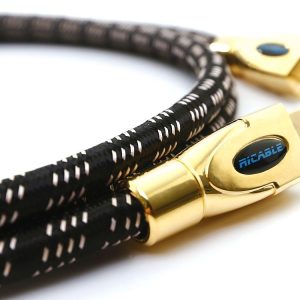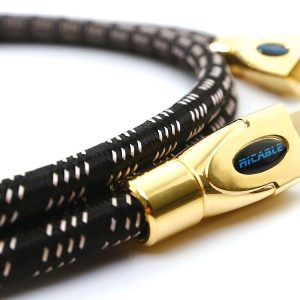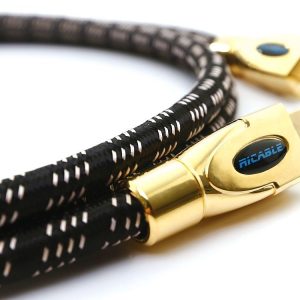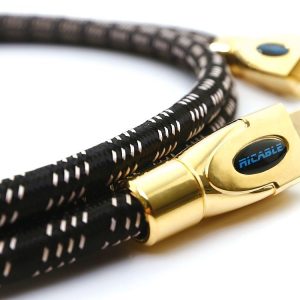
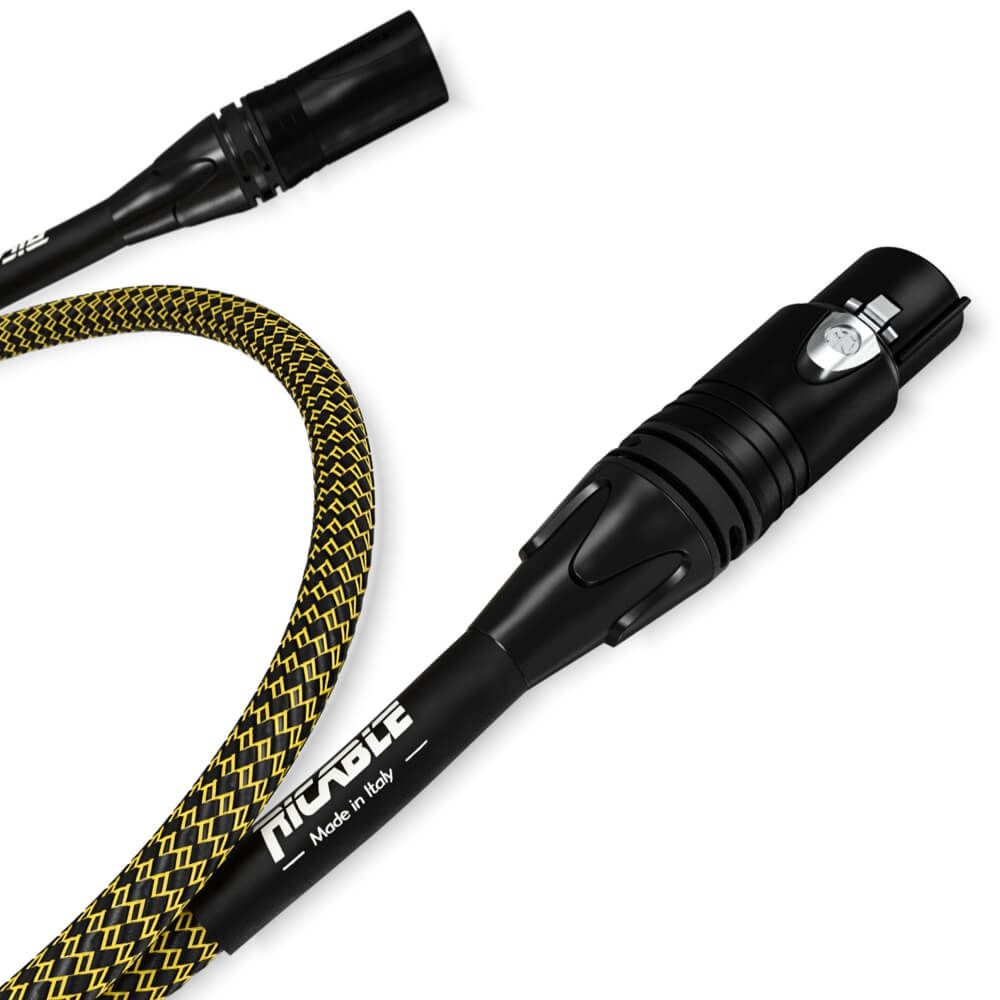


Ricable Dedalus AES/EBU Digital Cable
228,00 €
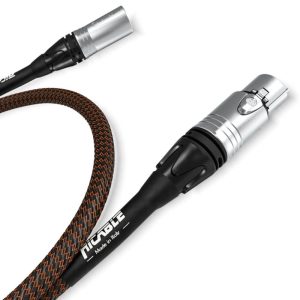
Ricable Dedalus AES/EBU is a balanced digital audio cable for connecting a compatible source to a DAC. Its 110-ohm construction is designed for AES/EBU signals. Three-layer copper, aluminium and magnesium shielding reduces the effects of EMI and RFI. The modified Neutrik XLR connectors use pure-copper contacts with 24-carat gold plating. Both devices must have sockets labelled for AES/EBU.
The Ricable Dedalus AES/EBU cable is a balanced 110-ohm digital audio interconnect fitted with XLR connectors. It carries an AES/EBU signal between a compatible digital source and a digital-to-analogue converter. A typical application is connecting a CD player or network player to a DAC.
Who this cable is for
Both devices must have AES/EBU digital audio connections.
The shape of an XLR connector alone does not establish compatibility. The sockets on both devices must be clearly identified as an AES/EBU digital audio output and input. An analogue XLR connection uses a different signal format and is not interchangeable simply because the plug fits.
Conductors and connectors
The cable uses 0.45 mm² 7N MARC copper conductors. MARC stands for Multicore Annealed Ricable Conductor. Each individual strand has a diameter of 0.08 mm. These details describe the cable’s specific internal construction, rather than merely the external type of XLR connector.
The Neutrik XLR connectors are modified for Dedalus-series XLR cables. Their contacts are made from pure copper and finished with 24-carat gold plating.
A balanced conductor geometry is used internally. The insulation employs special polyethylene materials derived from the construction of Ricable’s Invictus range.
Shielding and cable routing
The cable is protected by three-layer copper, aluminium and magnesium shielding. This shielding is intended to reduce the effect of electromagnetic and radio-frequency interference on the transmitted signal. That is particularly relevant inside equipment racks, where several different cables may have to run close together.
Although the cable is shielded, it should not be installed under tension or bent sharply. Where practical, keep the signal cable separate from mains power leads. If the two must cross, arranging the crossing at a steeper angle is preferable to running them alongside one another.
Connection and setup
Connect the digital source’s AES/EBU output to the corresponding input on the DAC. Select that digital input on the converter. If the source has a digital output that can be enabled or disabled, activate it through the device’s menu.
The cable’s 110-ohm impedance matches its intended AES/EBU application. It should therefore be selected by checking the connection labels on both devices, not solely by looking at the physical shape of their XLR sockets.
Technical specifications
| Model | Ricable Dedalus AES/EBU |
|---|---|
| Cable type | Balanced AES/EBU digital audio interconnect |
| Application | Connecting a digital source to a DAC |
| Connectors | Modified Neutrik XLR connectors |
| Impedance | 110 ohms |
| Conductor cross-sectional area | 0.45 mm² |
| Conductor material | 7N MARC copper |
| MARC meaning | Multicore Annealed Ricable Conductor |
| Individual strand diameter | 0.08 mm |
| Contact material | Pure copper |
| Contact plating | 24-carat gold |
| Conductor geometry | Balanced |
| Conductor construction | Stranded, with crank-pin detorsion |
| Shielding | Three-layer copper, aluminium and magnesium shield against EMI and RFI |
| Insulation | Special polyethylene materials derived from Ricable Invictus construction |
FAQ
Can this cable be used with any XLR connection?
No. The sockets on both devices must be intended for AES/EBU digital audio. An analogue XLR socket does not provide compatibility by itself.
How do I connect a CD player or network player?
Connect the player’s AES/EBU digital output to the DAC’s AES/EBU input. Then select the digital input being used on the converter.
Can the cable carry an analogue XLR signal?
This model is intended for a 110-ohm AES/EBU digital signal. Choose a dedicated analogue XLR cable for an analogue line-level connection.
What needs to be configured after connecting the cable?
Select AES/EBU, or the correspondingly labelled digital XLR input, on the DAC. Enable the source’s digital output if its menu requires you to do so.
How should I route the cable behind my equipment?
Leave enough slack to prevent the cable from pulling on the XLR sockets. Avoid sharp bends and do not trap or press the cable tightly against the equipment cabinet.