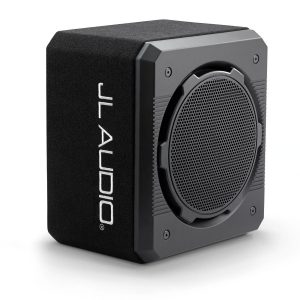

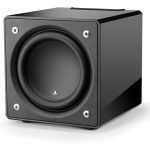
JL Audio E-Sub e112-ASH Powered Subwoofer
1 990,00 €
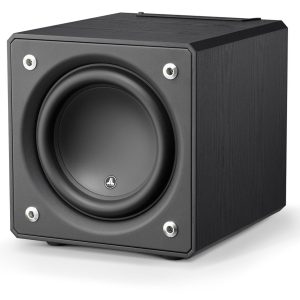
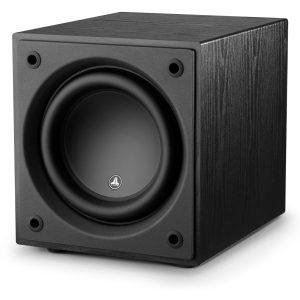
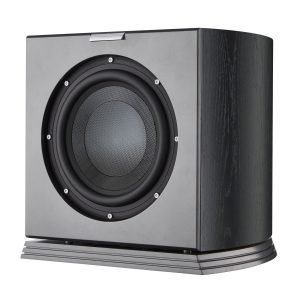
JL Audio E-Sub e112-ASH is a powered subwoofer for stereo and home cinema systems. Its sealed enclosure and adjustable 25-130 Hz filter help integrate it with the main speakers. RCA and speaker-level inputs provide connection options for different systems. The 1500 W RMS rating refers to short-term amplifier power.
JL Audio E-Sub e112-ASH is a powered subwoofer designed for stereo and home cinema systems. It features a sealed enclosure together with RCA and speaker-level inputs.
The Black Ash finish identifies this specific ASH variant. Its anechoic frequency response of 22-118 Hz is specified with a ±1.5 dB tolerance.
Sealed enclosure and intended use
The sealed enclosure suits systems where controlled low-frequency integration is important. The subwoofer can be connected to either a line-level or speaker-level signal source.
The enclosure measures 394 mm wide, 412 mm high and 467 mm deep. As the unit weighs 33.3 kg, it is worth choosing its location before connecting the system.
Inputs and outputs
Two RCA inputs accept an unbalanced stereo or mono signal. A mono connection is suitable for a receiver or processor equipped with a dedicated subwoofer output.
The speaker-level input accepts a stereo or mono signal through a removable plug. This is useful when connecting an amplifier that does not have a separate line-level subwoofer output.
Two RCA line outputs can operate in high-pass filtered or unfiltered pass-through mode. This allows the signal to be passed to another component according to the selected system configuration.
Input grounding can be set to isolated or grounded. If ground-loop hum can be heard in the system, compare both positions. Balanced inputs are not provided.
Setup controls
The low-pass filter is adjustable from 25 to 130 Hz and has a slope of 24 dB per octave. Adjust the frequency while listening to the transition between the main speakers and the subwoofer.
When using an external processor or an AV receiver’s filter, the internal filter can be switched off. This helps prevent the same signal from being filtered twice.
The level control ranges from complete mute to +15 dB above reference gain. Begin with a restrained setting, then increase it until the bass complements the main speakers without overwhelming them.
Polarity can be set to either 0 or 180 degrees. Phase is also continuously adjustable from 0 to 280 degrees, referenced at 80 Hz.
Compare the phase settings from the main listening position. Keep the setting that produces the smoothest transition and avoids a loss of energy through the crossover region.
The available power modes are off, on and automatic. In automatic mode, the subwoofer controls activation by detecting an audio signal.
Understanding the power and frequency figures
The amplifier’s 1500 W RMS rating refers to short-term power, not continuous output power. This qualification is important when comparing the model with other subwoofers.
The frequency response was measured under anechoic conditions. In a room, the result will be affected by the subwoofer’s position, surrounding walls, the listening position and the selected phase settings.
Room placement
Place the subwoofer on a stable surface capable of supporting its weight. Leave access to the rear connections and controls while carrying out the initial setup.
Low frequencies will generally become stronger when the subwoofer is positioned closer to a wall. Compare several locations without changing the level, filter or phase settings. This makes it easier to assess the effect of placement by itself.
Technical specifications
| Type | Powered subwoofer |
| Enclosure | Sealed |
| Finish | Black Ash |
| Frequency response | 22-118 Hz (±1.5 dB), anechoic conditions |
| -3 dB limits | 21 Hz and 120 Hz, anechoic conditions |
| -10 dB limits | 17 Hz and 153 Hz, anechoic conditions |
| Effective piston area | 84.4 sq. in. / 0.0545 m² |
| Effective displacement | 235 cu. in. / 3.9 l |
| Amplifier power | 1500 W RMS, short-term |
| Power modes | Off, on or automatic signal sensing |
| Lighting modes | None |
| Unbalanced inputs | Stereo or mono, two RCA connections |
| Balanced inputs | None |
| Speaker-level inputs | Stereo or mono, removable plug |
| Input grounding | Isolated or grounded |
| Separate input modes | None |
| Level control | Complete mute to +15 dB above reference gain |
| Filter type | Low-pass filter |
| Filter slope | 24 dB per octave |
| Filter range | 25-130 Hz |
| Filter defeat | Yes |
| Polarity | 0 or 180 degrees |
| Phase | Adjustable from 0 to 280 degrees, referenced at 80 Hz |
| E.L.F. adjustment | None |
| Line outputs | Stereo or mono, two RCA connections |
| Line-output modes | High-pass filtered or unfiltered pass-through |
| Output for an additional powered subwoofer | None |
| Calibration mode | None |
| Dimensions | 394 × 412 × 467 mm |
| Net weight | 33.3 kg |
FAQ
Which input should I use with a stereo amplifier?
Use the RCA connections if the amplifier has a line-level subwoofer output. Otherwise, the speaker-level input can be used.
How should I connect the subwoofer to an AV receiver?
Connect the AV receiver’s mono subwoofer output to an RCA input. If you are using the receiver’s filter, switch off the subwoofer’s integrated filter.
What should I do if I hear hum after connecting it?
Compare the isolated and grounded input-grounding positions. Changing this setting may help reduce noise caused by a ground loop.
Does the subwoofer perform acoustic calibration automatically?
No automatic calibration mode is provided. Level, filter, polarity and phase are adjusted manually or through an external system processor.
How should I choose the right position in the room?
Try several locations and assess each one from the main listening position. If placing the subwoofer closer to a wall strengthens the bass, the result can be adjusted using the level and phase controls.