
Hegel V10 Phono Preamplifier
Original price was: 1 500,00 €.1 300,00 €Current price is: 1 300,00 €.
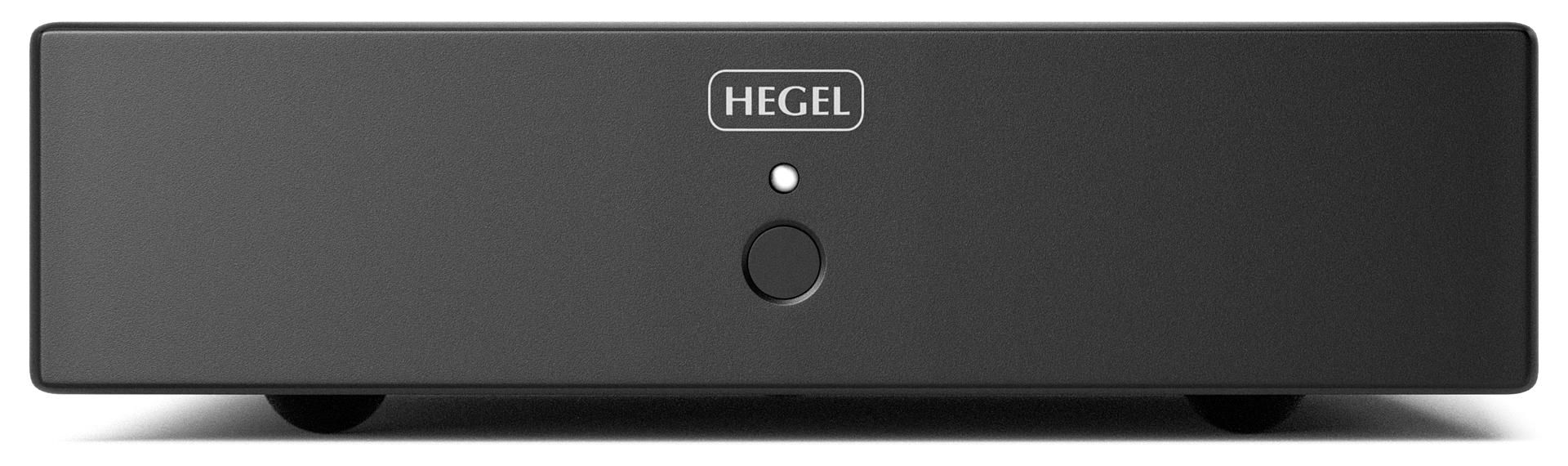
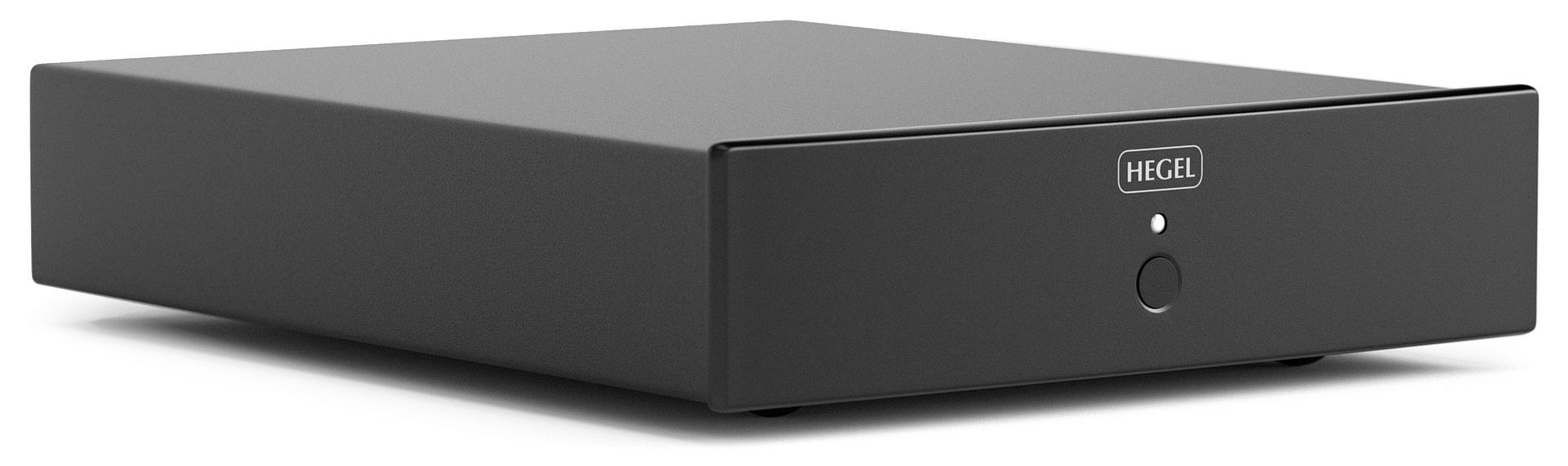
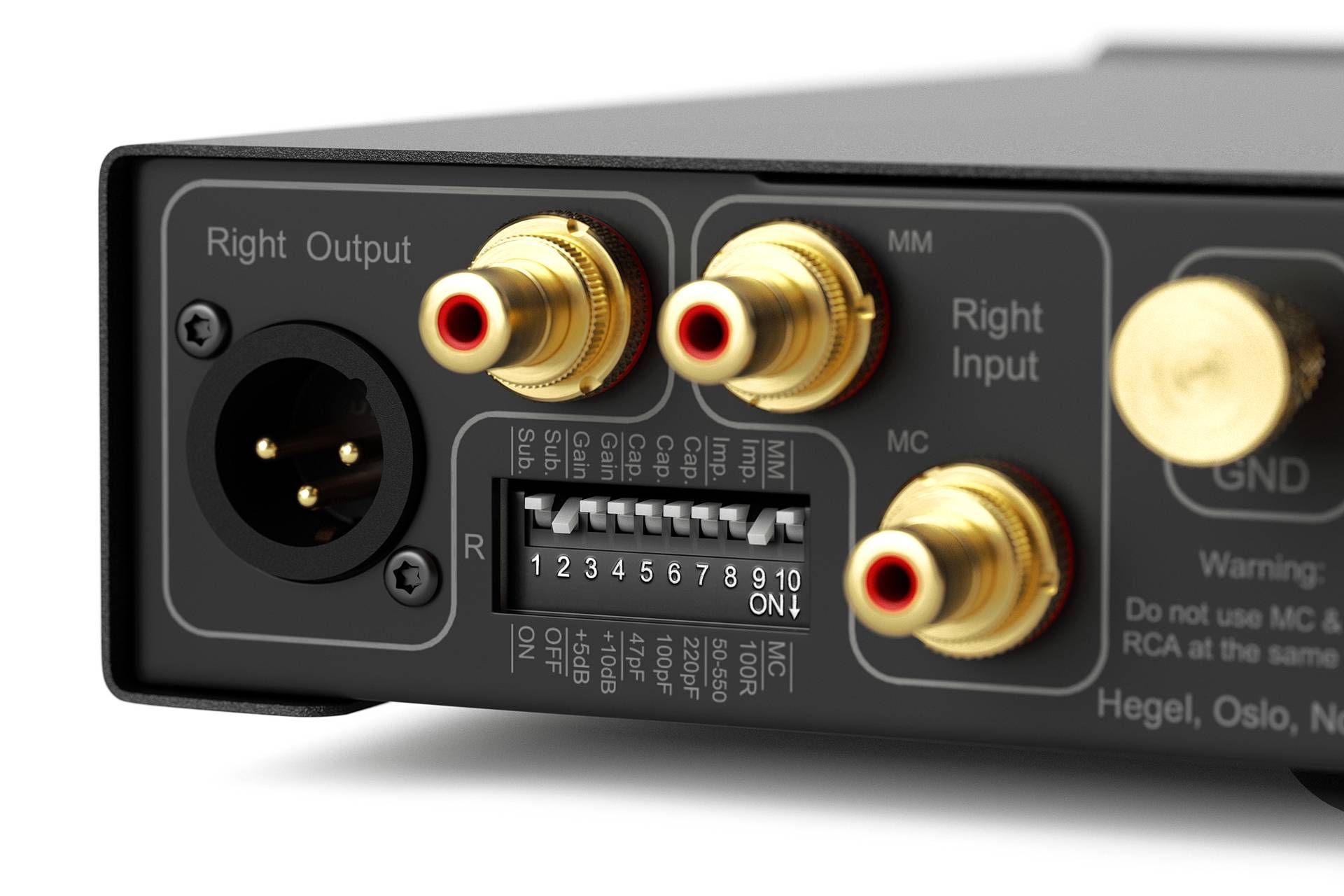
Hegel V10 is a phono preamplifier for MM and MC cartridges. Separate RCA inputs allow the appropriate gain to be selected for each cartridge type. Adjustable MC load resistance and seven MM capacitance settings help match the phono stage to the cartridge. Its fixed-level RCA and XLR outputs are designed for an analogue line-level input in the audio system.
Hegel V10 is a phono preamplifier designed for MM and MC phono cartridges. It amplifies the cartridge’s low-level signal and applies RIAA equalisation before the signal reaches a line-level input on the amplifier. This model is suited to systems that require separate MM and MC inputs together with flexible gain adjustment.
Who it is for
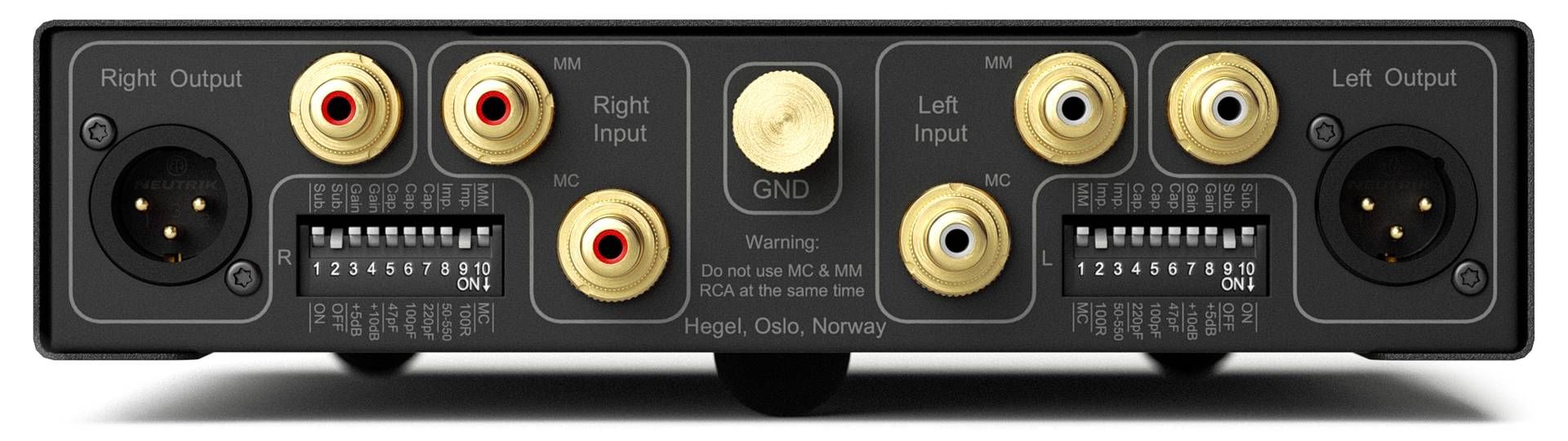
A dedicated MM RCA input is provided for a moving-magnet phono cartridge. A separate RCA input accepts the signal from a moving-coil cartridge. Keeping the inputs separate allows the appropriate gain and loading settings to be applied to each cartridge type.
The input stage uses discrete, ultra-low-noise JFET transistors. This stage works with both cartridge types and is particularly important for MC cartridges, whose lower output signals require substantially more gain.
Choosing between RCA and XLR outputs
You can use either the fixed-level, unbalanced RCA output or the balanced XLR output. The appropriate connection depends on the line-level input available on your amplifier or processor. Choose XLR if the amplifier has a balanced line input; otherwise, use RCA.
The gain range available through the RCA output differs from the range provided through XLR. If you change the output connection, reassess the gain setting rather than assuming the previous position will remain suitable. Both outputs operate at a fixed level, so listening volume must be controlled by the connected amplifier or AV receiver.
Connect the V10 to a conventional line-level input. Do not connect it to another phono input, as the signal would be amplified and equalised a second time. Suitable connections include AUX, CD or another analogue line input.
Matching gain and cartridge loading
Four gain positions are available for MM cartridges with each output type. MC cartridges also have four settings, but their gain is higher. Begin with the lower suitable value and check that the connected amplifier still provides a practical amount of volume adjustment.
If records sound too quiet, select a higher gain setting. If the signal becomes excessively strong or loses clarity, reduce the gain. This allows the phono stage to be matched to both the cartridge’s output level and the sensitivity of the rest of the audio system.
MC load resistance can be adjusted from 33 to 550 ohms, with an additional 47-kilohm position. Start with the load recommended by the cartridge manufacturer. You can then compare nearby values using the same recording and an equal listening volume.
In MM mode, the resistance is 47 kilohms and seven load-capacitance settings are available, covering a range from 100 to 467 pF. Match the capacitance to the cartridge requirements while also accounting for the capacitance of the turntable cable.
Subsonic filter
The subsonic filter can be switched on or off. When enabled, it reduces very-low-frequency movement caused by a warped record or mechanical resonance. Its response is -3 dB at 20 Hz, with a slope of 18 dB per octave.
Consider enabling the filter if you notice pronounced woofer movement without a corresponding audible musical signal. With records that are in good condition, you can compare both positions and select the one that works best in your system.
Signal performance
RIAA equalisation accuracy is specified at ±0.2 dB from 20 Hz to 20 kHz. The stated frequency range extends from 2 Hz to 20 kHz. In MM mode, total harmonic distortion is below 0.005 percent.
In MC mode, total harmonic distortion remains below 0.009 percent. A-weighted output noise is specified separately for the two cartridge types. Output impedance is 200 ohms for both connection types, so choosing between RCA and XLR does not alter this parameter.
System placement
The enclosure is 21 cm wide and measures 28 cm deep with its feet. Allow additional shelf space behind the unit for the RCA or XLR connectors and for the cables to bend without strain. Its 2.2 kg weight helps it sit securely on a dedicated shelf.
A phono cartridge produces a very weak signal, so keep the V10 away from strong sources of electromagnetic interference. Avoid routing signal cables closely alongside power cables for long distances. Power is provided by the designated Hegel M30103 adapter.
Technical specifications
| Type | MM and MC phono preamplifier |
|---|---|
| Input stage | Discrete ultra-low-noise JFET transistors for MM and MC cartridges |
| MM gain via XLR | 40 dB, 45 dB, 50 dB or 52 dB |
| MC gain via XLR | 60 dB, 65 dB, 70 dB or 72 dB |
| MM gain via RCA | 34 dB, 39 dB, 44 dB or 46 dB |
| MC gain via RCA | 54 dB, 59 dB, 64 dB or 66 dB |
| MC load resistance | Continuously adjustable from 33 to 550 Ω; additional 47 kΩ position |
| MM load capacitance | 100, 147, 220, 247, 320, 420 or 467 pF at 47 kΩ |
| Subsonic filter | Switchable on or off; -3 dB at 20 Hz; 18 dB per octave |
| RIAA equalisation accuracy | ±0.2 dB from 20 Hz to 20 kHz |
| MM output noise | -84 dB, A-weighted, referenced to 0 dBV |
| MC output noise | -81 dB, A-weighted, referenced to 0 dBV |
| RCA and XLR output impedance | 200 Ω |
| Channel crosstalk | -84 dB at 1 kHz and 0 dBV |
| Frequency range | 2 Hz-20 kHz |
| MM total harmonic distortion | Less than 0.005% at 1 kHz and 0 dBV |
| MC total harmonic distortion | Less than 0.009% at 1 kHz and 0 dBV |
| MM input | 1 unbalanced RCA |
| MC input | 1 unbalanced RCA |
| RCA output | 1 unbalanced, fixed-level |
| XLR output | 1 balanced, fixed-level |
| Designated power adapter | Hegel M30103 |
| Dimensions including feet | 6 × 21 × 28 cm or 2.4 × 8.3 × 11 inches, H × W × D |
| Weight | 2.2 kg or 4.9 lb |
FAQ
Does this phono stage work with both MM and MC cartridges?
Yes. Each cartridge type has its own RCA input, dedicated gain range and appropriate loading adjustments.
Which output should I choose: RCA or XLR?
Choose according to the available line-level input on your amplifier and the cable you intend to use. If you change the output type, remember to check the gain setting as well.
Can the V10 be connected to an AV receiver?
Yes, provided that the receiver has an analogue line-level input. Connect the V10 to a line input, not to another phono input.
Does the unit control system volume?
No. The RCA and XLR outputs are fixed-level, so volume is controlled by the connected integrated amplifier, preamplifier or AV receiver.
What cartridge information do I need before setting up the V10?
You need to know the cartridge’s output level and the manufacturer’s recommended MC load resistance or total MM capacitance. For an MM cartridge, the turntable cable’s capacitance must be included in that total.
When should I use the subsonic filter?
Enable it when warped records or mechanical resonances cause unnecessary very-low-frequency movement of the loudspeaker drivers.
Related products
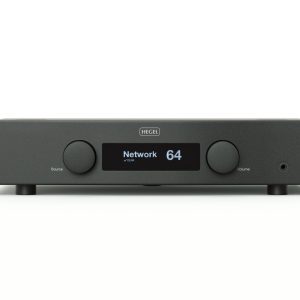
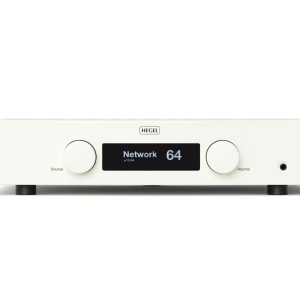
Hegel H120 Integrated Amplifier
Original price was: 2 500,00 €.1 800,00 €Current price is: 1 800,00 €.