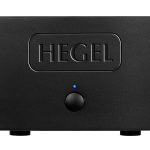
Hegel H20 Power Amplifier
5 995,00 €
The Hegel H20 is a two-channel power amplifier for a stereo system built from separate components. Its dual-mono construction and output of more than 200 W per channel into 8 ohms-measured at 1 kHz, 1% total harmonic distortion and a 100, 120 or 230 V AC supply-provide substantial power reserves. XLR and RCA inputs allow connection to a preamplifier with balanced or unbalanced outputs. Volume control requires a separate component with a variable line output.
The Hegel H20 power amplifier is a two-channel model for demanding stereo systems. Its dual-mono construction provides separate amplification for both channels. Output power exceeds 200 W per channel into 8 ohms. This figure is measured at 1 kHz, 1% total harmonic distortion and an AC supply voltage of 100, 120 or 230 V.
This is a power amplifier, not an integrated amplifier. It requires a separate preamplifier or a source with variable-level line outputs. Volume is controlled by the connected component. The H20 is intended for buyers assembling a system from separate audio components.
Channel design and power reserves
The dual-mono 1000 VA power supply provides 90,000 µF of capacitance. Dual-mono construction means that the amplification circuits for the two channels are separate. Crosstalk of less than -100 dB helps preserve separation between the stereo channels.
The output stage uses 20 high-speed, ultra-low-distortion bipolar transistors. Each output transistor is specified for up to 15 A and 200 W. A current capability greater than 130 A is stated, although the measurement conditions are not defined.
The amplifier uses field-effect transistor technology (FET) and patented, laser-trimmed SoundEngine modules. Its circuitry is based on solutions developed for the H30 reference power amplifier. Distortion below 0.006% is specified at 100 W into an 8-ohm load.
Choosing between RCA and XLR inputs
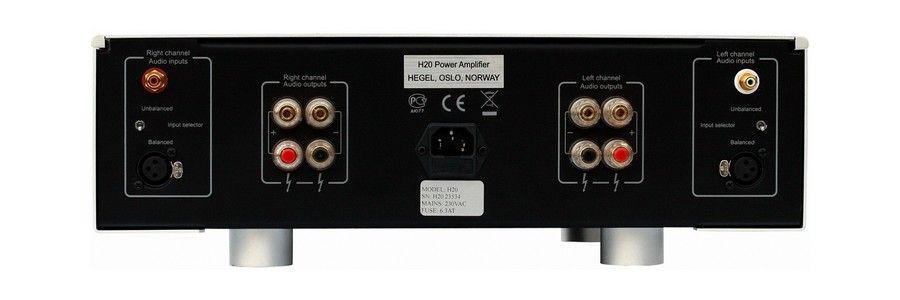
You can choose either a balanced XLR input or an unbalanced RCA input. The XLR connection is suitable for a preamplifier equipped with balanced outputs. A balanced connection helps reject common-mode interference picked up by the cable.
The RCA connection is intended for a source or preamplifier with an unbalanced output. Its input impedance is 50 kilohms, while the XLR input impedance is 10 kilohms. Choose the connection type according to the outputs provided by the connected component, rather than simply according to whether an adapter is available.
Two pairs of heavy-duty, gold-plated speaker terminals provide connections for the left and right channels. The gold-plated contact surfaces are less susceptible to oxidation. Switch off the amplifier using its front-panel button before connecting speaker cables.
Operation and system configuration
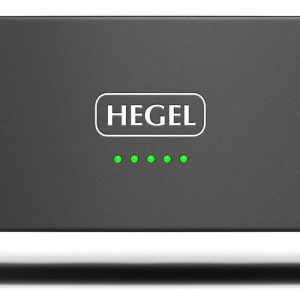
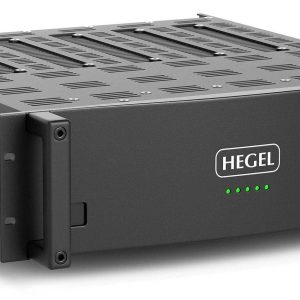
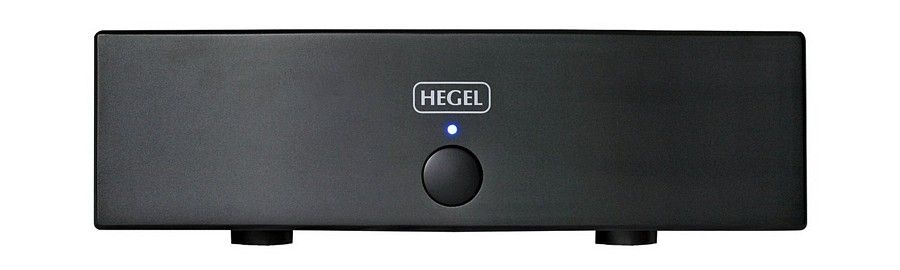
The front panel has a single power button. Input selection and volume adjustment are handled by the preamplifier or another component with a variable output. This keeps the H20’s role in the system straightforward: it receives a line-level signal and drives the speakers.
In a stereo system, the amplifier can be connected to a separate preamplifier, network player or converter with a variable line output. A source with a fixed-level output requires a preamplifier. This prevents an uncontrolled signal level from being sent directly to the power-amplifier stage.
In a home cinema system, the H20 can amplify the front left and right channels. The AV amplifier must provide volume-controlled line outputs for those channels. The remaining channels are then driven by the system’s other power-amplifier channels.
Enclosure and placement
The front, top and side panels of the black enclosure are glass-bead blasted and anodised. The unit weighs 18 kg, so it needs a stable shelf capable of supporting both this weight and its 43 × 37 cm footprint.
Leave space above the amplifier so that heat can escape. The H20 switches off automatically if it overheats. This protection does not replace proper ventilation, so the enclosure should not be confined within a tight, unventilated cabinet.
The AC power supply must not be switched on or off using an external mains switch. Use the front-panel button for everyday operation. The stated 60 W consumption applies to a condition described as “standby switched on.” This figure should not be treated as conventionally defined standby consumption.
What the audio specifications mean
The damping factor exceeds 1000. It describes the power stage’s ability to control speaker-driver movement electrically. The actual result also depends on the speaker design, its impedance and the cables used.
Frequency-response deviation remains within ±0.2 dB from 20 Hz to 20 kHz. Across the same range, phase deviation is less than two degrees. A signal-to-noise ratio greater than 100 dB indicates a low level of background noise.
Technical specifications
| Type | Two-channel power amplifier |
|---|---|
| Design | Dual mono |
| Output power | More than 200 W per channel into 8 ohms at 1 kHz and 1% total harmonic distortion |
| Supply voltage during power measurement | 100, 120 or 230 V AC |
| Line inputs | Balanced XLR and unbalanced RCA |
| Balanced input impedance | 10 kilohms |
| Unbalanced input impedance | 50 kilohms |
| Speaker outputs | Two pairs of heavy-duty, gold-plated terminals |
| Frequency response | Deviation within ±0.2 dB from 20 Hz to 20 kHz |
| Phase response | Less than 2° deviation from 20 Hz to 20 kHz |
| Signal-to-noise ratio | Greater than 100 dB |
| Crosstalk | Less than -100 dB |
| Distortion | Less than 0.006% at 100 W into an 8-ohm load |
| Intermodulation distortion | Less than 0.01% using 19 kHz and 20 kHz signals |
| Damping factor | Greater than 1000 |
| Power supply | 1000 VA, dual-mono construction |
| Power-supply capacitance | 90,000 µF |
| Output stage | 20 high-speed, ultra-low-distortion bipolar transistors |
| Each output transistor | Specified for up to 15 A and 200 W |
| Current capability | Greater than 130 A; measurement conditions not defined |
| Technologies | Field-effect transistor technology and laser-trimmed SoundEngine modules |
| Controls | One front-panel power button |
| Protection | Automatic shutdown in the event of overheating |
| Stated power consumption | 60 W in the condition described as “standby switched on” |
| Finish | Black; glass-bead-blasted and anodised front, top and side panels |
| Dimensions | 14.5 × 43 × 37 cm or 5.7 × 17 × 15 inches |
| Weight | 18 kg or 39.7 lb |
FAQ
Does this amplifier require a preamplifier?
Yes. It requires a preamplifier or another source with a variable-level line output. The power amplifier itself does not provide volume control.
When should I use XLR rather than RCA?
Choose XLR with a preamplifier that has a balanced output. Use RCA with an unbalanced output. An adapter does not turn an unbalanced source into a fully balanced source.
Can it be used in a home cinema system?
Yes, provided that the AV amplifier has variable-level line outputs for the front channels. The H20 then drives the front left and right speakers.
How should I choose a location for an 18 kg amplifier?
Choose a strong, stable shelf and allow for the 43 × 37 cm footprint. Leave space around the enclosure for natural airflow.
Can the power be controlled by an external mains switch?
No. The AC power supply should not be switched using an external switch. Turn the unit on and off with the button on its front panel.
What do the two pairs of speaker terminals mean?
They provide the connections for the left and right stereo channels. They do not confirm that the amplifier supports switchable A and B speaker sets.
What happens if the amplifier overheats?
The protection circuit switches it off automatically. Before using it again, remove the cause of the overheating and provide freer airflow around the unit.