

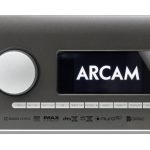
Arcam AVR5 AV Receiver
2 400,00 €
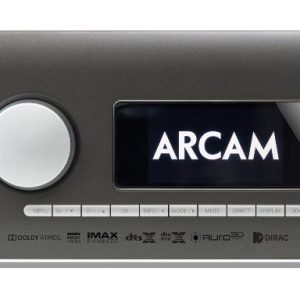
Arcam AVR5 AV receiver is designed for music and home-cinema systems requiring seven built-in power-amplifier channels. Dolby Atmos and DTS:X processing supports loudspeaker layouts up to 7.1.4, although four channels require an external power amplifier. HDMI 2.0b passes 4K/60 Hz video, while AirPlay 2, Google Cast, Spotify Connect and Bluetooth aptX HD provide several ways to play music.
Arcam AVR5 is a seven-channel AV receiver designed for music and home cinema. It combines video-source management, audio processing and loudspeaker amplification in a single component. Support for Dolby Atmos and DTS:X makes it possible to build an immersive surround system with height channels.
Purpose and system size
Seven built-in power-amplifier channels allow the AVR5 to drive a 5.2.2 or 7.2 system without an additional power amplifier. A 5.2.2 arrangement uses two of those channels for height speakers, adding a vertical dimension to compatible film soundtracks. A 7.2 layout instead assigns all seven internal channels to the horizontal surround layer.
The audio processor supports configurations up to 7.1.4. This arrangement comprises eleven main and height channels together with one LFE channel. Because the receiver contains seven power-amplifier channels, four channels in a 7.1.4 system must be driven by an external power amplifier. This distinction is important when planning the complete system and deciding which additional components will be required.
HDMI connections and video signals
Seven HDMI 2.0b inputs accommodate set-top boxes, disc players, games consoles and other video sources. Two HDMI outputs can be used to connect a television and a projector. This is particularly useful in a home cinema that employs two different display devices without requiring the main HDMI cable to be moved between them.
The eARC connection returns audio from a compatible television to the receiver through the same HDMI cable used for the display connection. HDCP 2.2 support is provided for protected 4K content, while the video path passes signals up to 4K at 60 Hz. HDMI 2.1 and 8K video pass-through are not supported, so buyers planning to route 8K sources through their receiver will need a different HDMI solution.
Network music and wireless playback
The AVR5 can connect to a home network over Wi-Fi or Ethernet. A wired connection is useful in a permanently installed system where a consistent network link is a priority. Wi-Fi reduces the number of cables that need to be routed to the equipment position and may therefore be more convenient in rooms without an existing network socket.
Apple AirPlay 2 provides audio streaming from compatible Apple devices. Google Cast and Spotify Connect offer additional ways to play music over the network. For a direct wireless connection from a nearby phone or computer, the receiver also provides Bluetooth with aptX HD.
UPnP playback is available through the Arcam MusicLife app for iOS and Android. Roon Ready support allows the AVR5 to become part of a music system managed through Roon. The receiver also supports MQA content, giving listeners several options for accessing and organising digital music.
Construction and audio circuitry
Digital signals are handled by an ESS 9026PRO digital-to-analogue converter. The power supply uses a frame-type transformer. According to the manufacturer, the power-supply circuitry has been designed to maintain a low noise level.
All seven internal channels use Class AB amplification. Their amplifier circuits draw on solutions developed for Arcam stereo amplifiers. As a result, the same component can serve as the centre of a multichannel film system and also power a conventional two-channel loudspeaker setup for music listening.
Control and room correction
The receiver is Dirac Live Ready. Its hardware is prepared for the Dirac Live room-correction system, but the required software licence is not included and must be purchased separately. Buyers who intend to use Dirac Live should therefore include the separate licence when planning their system.
An RS-232 connection enables integration with a centralised control system. Infrared control is also supported. These options are useful when the receiver is installed with other home-cinema equipment in a shared cabinet or incorporated into a wider control installation.
Placement and initial setup
Seven Class AB power-amplifier channels generate heat during operation. Place the AVR5 on a stable surface and leave sufficient free space for air to circulate around it. A closed cabinet without ventilation is not suitable for this receiver.
Begin setup by defining how many loudspeakers are connected and the role assigned to each one. Do not activate channels that are absent from the system. If a subwoofer is used, choose the initial crossover according to the frequency range reproduced by the main loudspeakers rather than treating one setting as suitable for every system.
Evaluate the subwoofer phase setting from the main listening position. Compare the available positions and select the one that produces the smoother transition between the loudspeakers and subwoofer. Room measurements are most useful only after the loudspeakers have been placed, the channel layout has been finalised and this initial subwoofer adjustment has been completed.
Technical specifications
| Product type | Seven-channel home-cinema AV receiver |
|---|---|
| Built-in power channels | 7 |
| Amplification class | Class AB |
| Audio processing | Up to 7.1.4 |
| Surround formats | Dolby Atmos, DTS:X |
| HDMI inputs | 7 |
| HDMI outputs | 2 |
| HDMI version | HDMI 2.0b |
| Video pass-through | Up to 4K/60 Hz |
| Content protection | HDCP 2.2 |
| TV audio return | eARC |
| Digital-to-analogue converter | ESS 9026PRO |
| Transformer | Frame type |
| Network connections | Wi-Fi, Ethernet |
| Network playback | Apple AirPlay 2, Google Cast, Spotify Connect, UPnP, Roon Ready |
| UPnP control | Arcam MusicLife app for iOS and Android |
| Bluetooth | Bluetooth with aptX HD |
| Audio-file support | MQA |
| Room correction | Dirac Live Ready; licence sold separately |
| System control | RS-232 and infrared control |
FAQ
Does the system require an external power amplifier?
No. The seven internal channels can power a 5.2.2 or 7.2 system. A 7.1.4 arrangement requires an external four-channel power amplifier.
Is this model suitable for 8K video sources?
It is designed for a video path supporting up to 4K/60 Hz. Buyers planning to pass 8K video through the receiver will need a different HDMI solution.
Does Dirac Live work immediately after unpacking the receiver?
The receiver is prepared for this room-correction system, but the licence is not included. It must be purchased separately before Dirac Live correction can be carried out.
When should I choose Ethernet rather than Wi-Fi?
Choose Ethernet when a network cable is available at the equipment position. Wi-Fi is more convenient when you do not want to install an additional cable.
Can the AVR5 be used solely for two-channel music?
Yes. A stereo pair of loudspeakers can be powered by two internal channels, with music played over the network, through Bluetooth or from a connected source.
How should I choose a music-streaming method?
AirPlay 2 is convenient for compatible Apple devices, while Google Cast or Spotify Connect can be used with compatible apps. Bluetooth is intended for a direct connection to a nearby device.
What should be completed before taking room measurements?
Finalise the loudspeaker positions, select the channel layout being used and adjust the subwoofer. Take the measurements across the main listening area.