

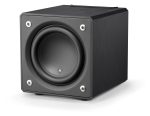


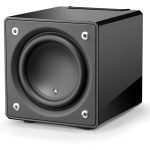
JL Audio E-Sub e110-ASH Subwoofer
1 790,00 €
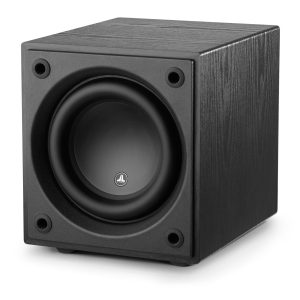
JL Audio E-Sub e110-ASH is a powered subwoofer designed to extend the bass response of stereo and home cinema systems. Its sealed cabinet has no bass-reflex port, making placement more straightforward. RCA and high-level inputs accommodate different amplifier outputs. An adjustable 25-130 Hz filter, switchable polarity and variable phase help integrate the subwoofer with the main speakers and room acoustics.
JL Audio E-Sub e110-ASH is a powered subwoofer designed to extend the low-frequency range of stereo and home cinema systems. Its sealed enclosure houses an integrated amplifier rated at 1200 W RMS short-term power. The specified anechoic frequency response is 25-116 Hz with a tolerance of ±1.5 dB. This figure is not based on measurements taken in a typical room.
Sealed enclosure design
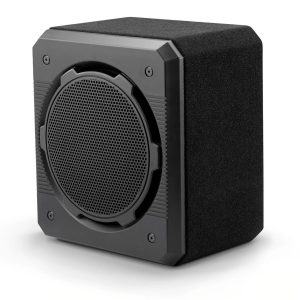
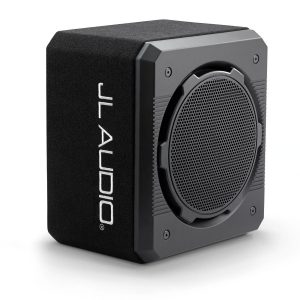
The sealed enclosure has no bass-reflex port, so no additional clearance is required for port airflow. However, nearby walls and room corners can reinforce the lowest frequencies. The Black Ash finish gives the cabinet the appearance of black ash wood.
The effective piston area is 0.0379 m², while the effective displacement is 2.1 litres. These figures describe the working capability of the bass driver and allow more meaningful comparisons between different models.
Connection options
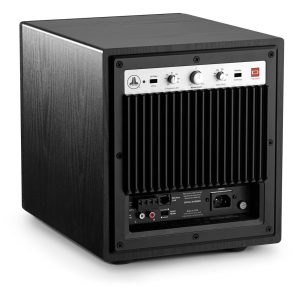
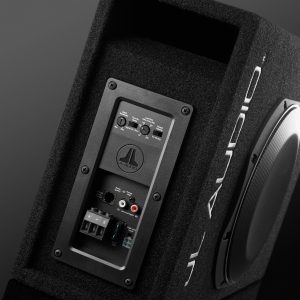
Two RCA input sockets accept either an unbalanced stereo signal or a single-channel mono signal. Use the RCA connection with a preamplifier, processor or receiver that has a suitable line-level output. This model does not have a balanced input.
The high-level input accepts a stereo or mono signal through a removable plug-type connector. It is useful when the amplifier does not provide a dedicated line-level subwoofer output. Selectable isolated or grounded input modes allow the grounding arrangement to be matched to the particular system.
Two RCA line outputs can operate in stereo or mono. Their selectable modes are high-pass filtered and direct pass-through. The first supplies a filtered signal to the next component in the audio chain, while the second passes the incoming signal without that filtering. There is no dedicated output for a second subwoofer.
Sound adjustment
The level control ranges from full mute to 15 dB above reference gain. Begin with a restrained setting and increase it while listening from the main seating position. The bass should support the main speakers rather than overpower them.
The low-pass filter can be set from 25 to 130 Hz and has a slope of 24 dB per octave. Choose an initial frequency according to the low-frequency extension of the main speakers. If an AV processor handles the crossover, bypassing the subwoofer’s filter helps prevent double filtering.
Polarity can be switched between 0 and 180 degrees. Compare both settings from the listening position and choose the one that produces the smoothest transition from the main speakers. For finer adjustment, continuously variable phase is available from 0 to 280 degrees, referenced at 80 Hz. There is no separate extreme-low-frequency trim.
Power control
Three power modes are available: off, permanently on and automatic. In automatic mode, the subwoofer responds when it detects an audio signal. The permanently on setting is suitable when you want to control the unit’s operating state directly.
Room placement
Begin with the subwoofer near the front wall, but not immediately in a room corner. Moving the cabinet closer to a wall or corner can increase the level of the lowest frequencies. If the bass becomes excessive, move the subwoofer farther away and repeat the level and phase adjustments.
Choose the final position by listening from the main seat. Room resonances may have a greater effect than a small control adjustment. The 23.9 kg weight should also be considered when selecting a stable surface and allowing convenient access to the rear connection panel.
Technical specifications
| Product type | Powered subwoofer |
|---|---|
| Enclosure type | Sealed |
| Finish | Black Ash – black ash appearance |
| Frequency response | 25-116 Hz, ±1.5 dB, anechoic |
| -3 dB limits | 23 Hz and 120 Hz |
| -10 dB limits | 18 Hz and 165 Hz |
| Effective piston area | 58.78 sq. in. / 0.0379 m² |
| Effective displacement | 131 cu. in. / 2.1 l |
| Amplifier power | 1200 W RMS short-term |
| Power modes | Off, on or automatic signal sensing |
| Unbalanced inputs | Stereo or mono, two RCA sockets |
| Balanced inputs | None |
| High-level input | Stereo or mono, removable plug-type connector |
| Input grounding | Isolated or grounded |
| Level adjustment | Full mute to +15 dB above reference gain |
| Filter type | Low-pass filter |
| Filter slope | 24 dB per octave |
| Filter frequency range | 25-130 Hz |
| Filter bypass | Yes |
| Polarity | 0° or 180° |
| Phase adjustment | 0-280°, referenced at 80 Hz |
| Extreme-low-frequency trim | None |
| Line outputs | Stereo or mono, two RCA sockets |
| Output modes | High-pass filtered or direct pass-through |
| Dedicated output for a second subwoofer | None |
| Width | 343 mm / 13.5 in. |
| Height | 362 mm / 14.24 in. |
| Depth | 419 mm / 16.51 in. |
| Net weight | 23.9 kg / 52.7 lb. |
FAQ
Which input should I use with a stereo amplifier?
Use the RCA input if the amplifier has a line-level subwoofer output or preamplifier output. Otherwise, you can use the high-level input, which accepts a signal from the amplifier’s speaker circuit.
How do I connect the subwoofer to an AV receiver?
Connect the AV receiver’s subwoofer output to one RCA input in mono mode. If the receiver manages the crossover itself, bypass the subwoofer’s internal filter.
How should I begin adjusting the filter and phase?
Match the filter frequency to the low-frequency capability of the main speakers. Then compare both polarity settings. Use the variable phase control to fine-tune the transition while listening from the main seating position.
What should I do if the room reinforces the bass too much?
Move the subwoofer farther away from the wall or room corner. After changing its position, readjust the level and phase from the listening position.
How should I interpret the amplifier power rating?
The stated amplifier rating is a short-term figure and should not be treated as continuous output power. The enclosure, frequency-response and connection details are also important when choosing a subwoofer.