SME Audio Model 20/3 Turntable
11 800,00 €
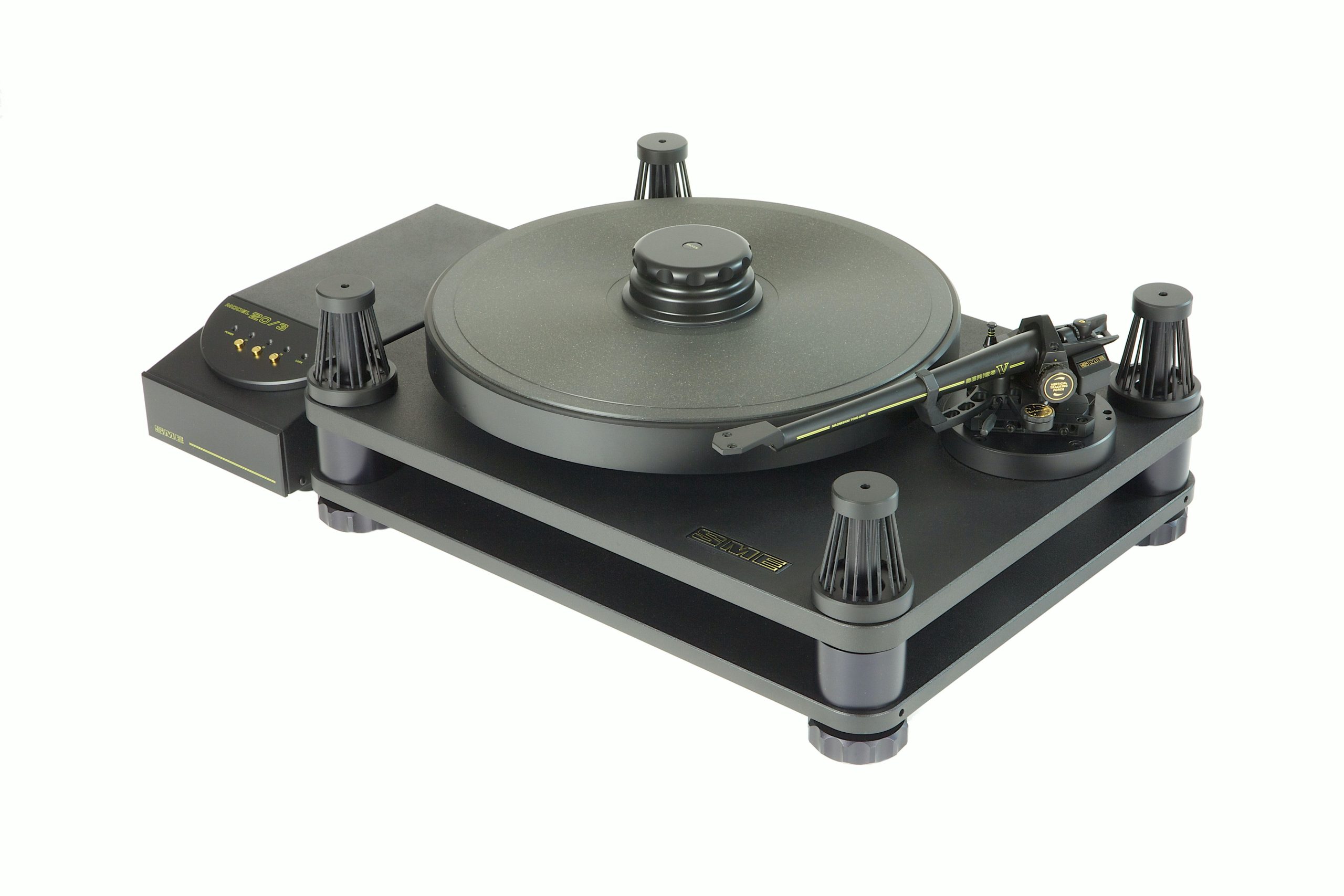
SME Audio Model 20/3 is a suspended belt-drive turntable designed for a precisely assembled vinyl system. Its 11 kg inner chassis, rubber suspension and central fluid damper control structural vibration. A three-phase brushless motor drives the 6.5 kg platter. Select 33.3, 45 or 78 rpm and fine-tune the speed in 0.01% increments.
SME Audio Model 20/3 is a suspended belt-drive turntable designed for a carefully assembled vinyl playback system. It features a substantial inner chassis, a 6.5 kg platter and three selectable speeds. Fine speed adjustment is available in increments of 0.01%.
The design places particular emphasis on controlling unwanted vibration. This is important in vinyl playback because the cartridge responds not only to the record groove but also to mechanical disturbances. The suspended inner chassis, central fluid damper and isolated motor work together to reduce the transmission of these disturbances.
Construction and vibration control
The inner chassis measures 440 × 350 mm, is 16 mm thick and weighs 11 kg. Its mass and rigidity restrict flexing at low frequencies. Extensional damping is applied to the principal surfaces to control higher-frequency resonances.
The chassis is suspended on 80 rubber strands arranged as 40 specially moulded O-rings. Their mounting supports allow the rings to be removed and replaced. This construction also makes long-term suspension maintenance more straightforward.
A centrally positioned fluid damper controls chassis movement. Its resistance reduces oscillation when a record is placed on or removed from the turntable, providing a more stable platform during everyday operation.
Extensional damping is also used at the junction between the tonearm mounting plate and the inner chassis. The reversible mounting plate accommodates a nine-inch tonearm. This limitation should be considered when selecting the tonearm for the system.
Platter and record clamping
The platter weighs 6.5 kg. Its surface is precision-machined with a fine spiral pattern, creating a mechanical contact area for the record. The platter’s substantial mass also contributes to consistent rotation.
A reflex record clamp is included. It presses the record against the platter and can also secure records with pronounced warping. This helps the record surface maintain closer contact with its support.
Motor and speed control
The drive system uses a three-phase brushless outrunner motor. It incorporates eight-pole neodymium magnets and three integrated Hall sensors. The motor itself weighs 2.5 kg.
The motor is isolated by adjustable urethane mounts. Their position can be altered to align the belt accurately. Correct alignment is an important part of the mechanical setup after installation or maintenance.
The electronic controller uses a microprocessor configured for motor operation. Closed-loop speed control works with a proportional and integral algorithm. Using information from the sensors, the system continuously corrects the motor drive.
You can select 33.3, 45 or 78 rpm. Fine adjustment raises or lowers the selected speed in 0.01% increments. This function is useful when setting rotational speed precisely with the aid of suitable measuring equipment.
Installation and system placement
The 440 × 350 mm base requires a rigid, level and stable supporting surface. Overall height is 172 mm. Allow sufficient clearance for placing records on the platter and reaching the controls.
Keep the turntable away from loudspeakers and furniture subject to strong vibration. Although the suspension attenuates vibration, a suitable support reduces how much corrective work the suspension must perform. After installation, check that the belt follows its intended path.
The Model 20/3 can serve as the principal analogue source in a stereo system. The cartridge signal requires a phono stage compatible with the cartridge type. This may be built into the amplifier or used as a separate system component.
The correct mains-voltage version must be selected when ordering. Available versions are 90-110 V, 105-125 V and 220-240 V. All versions are intended for 50 or 60 Hz mains supplies.
Technical specifications
| Type | Suspended belt-drive turntable |
|---|---|
| Inner chassis dimensions | 440 × 350 mm |
| Inner chassis thickness | 16 mm |
| Inner chassis weight | 11 kg |
| Chassis damping | Extensional damping of the principal surfaces |
| Suspension | 80 rubber strands forming 40 specially moulded O-rings |
| Suspension maintenance | Removable and replaceable O-rings |
| Chassis movement control | Centrally positioned fluid damper |
| Platter weight | 6.5 kg |
| Platter surface | Fine machined spiral pattern |
| Record clamp | Reflex clamp included |
| Tonearm mounting plate | Reversible, for a nine-inch tonearm |
| Mounting-plate junction | Extensional damping |
| Motor | Three-phase brushless outrunner motor |
| Motor magnets | Eight-pole neodymium magnets |
| Motor sensors | 3 integrated Hall sensors |
| Motor weight | 2.5 kg |
| Motor isolation | Adjustable urethane mounts |
| Controller | Microprocessor-based electronic motor controller |
| Speed regulation | Closed-loop control with a proportional and integral algorithm |
| Fine speed adjustment | Increase or decrease in 0.01% increments |
| Rotational speeds | 33.3, 45 and 78 rpm |
| Power-supply versions | 90-110 V, 105-125 V or 220-240 V |
| Mains frequency | 50 or 60 Hz |
| Overall dimensions | 440 × 350 × 172 mm |
| Weight with shipping packaging | 45 kg |
FAQ
Who is this turntable intended for?
It is intended for a carefully assembled vinyl system where mechanical isolation and precise speed adjustment are important. The mounting plate is designed for a nine-inch tonearm.
How do I connect the turntable to a stereo amplifier?
Connect the cartridge signal to a PHONO input compatible with the cartridge type. If the amplifier does not have a suitable input, a separate phono stage is required between the turntable and amplifier.
Can the turntable be used in a home cinema system?
Yes, provided the AV amplifier has a suitable PHONO input. Otherwise, use a separate phono stage connected to a line-level input on the amplifier.
How do I select the correct rotational speed?
Use the speed stated on the record release. Three speed modes are available, so the turntable is also suitable for records intended for playback at 78 rpm.
When should fine speed adjustment be used?
Use it when measuring equipment indicates a speed deviation. Make adjustments in small 0.01% increments until the required value is reached.
What does the central fluid damper do?
It restricts movement of the suspended chassis. This allows the structure to respond more calmly when a record is placed on the platter or the clamp is used.
Can a twelve-inch tonearm be installed?
The reversible mounting plate is designed for a nine-inch tonearm. Compatibility with ten- or twelve-inch tonearms should not be assumed.
What must be specified before ordering?
You must select the power-supply version appropriate for the local mains supply. For the mains supply used in Lithuania, select the 220-240 V, 50 Hz version.