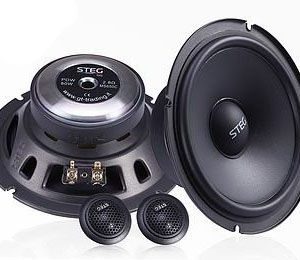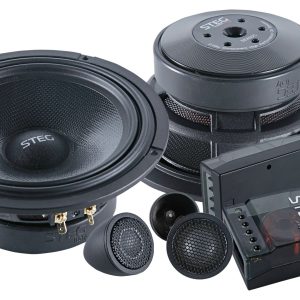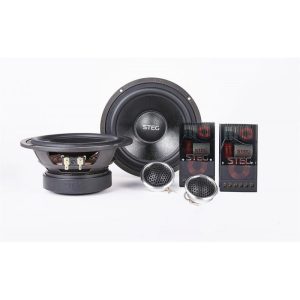
Steg ME 30 Midrange Speaker
190,00 €
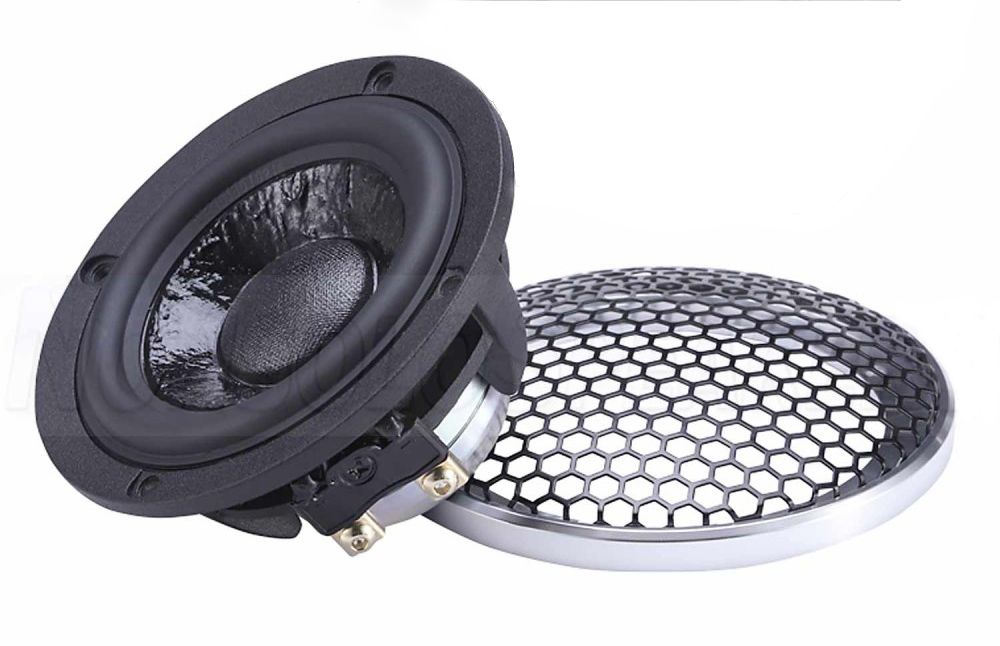
The Steg ME 30 is an 87 mm midrange speaker for a multi-way car audio system. The package contains a pair with protective grilles. The 30 W RMS rating and 4 Ω nominal impedance help with amplifier-channel selection. A paper cone, neodymium magnet and ventilated cast-aluminium basket form a compact installable driver. A suitable frequency crossover must be selected separately.
The Steg ME 30 speaker is an 87 mm midrange driver for a multi-way car audio system. It reproduces frequencies from 100 to 15,000 Hz and is designed to work alongside the system’s other speakers. The package contains a pair, allowing you to create left and right channels.
Each speaker has a 30 W RMS power rating and a 4 Ω nominal impedance, helping you select suitable amplifier channels. The 88 dB sensitivity rating is specified at 1 W and measured from a distance of one metre.
Role in a car audio system
This is not an enclosed loudspeaker or a full-range solution. The 87 mm figure is the speaker’s nominal size, not the diameter of the required mounting hole. The driver is intended to reproduce the midrange portion of a car audio system.
Low and high frequencies must be handled by other speakers and correctly configured filters. This pair can serve the front left and right channels. The 30 W RMS figure describes continuous nominal power handling, not a short-term maximum rating.
Cone, magnet and basket
The paper cone is the specified material used for this model’s moving diaphragm. Its motor assembly uses a neodymium magnet, while the cast-aluminium basket provides a rigid support for the cone and magnet assembly.
Basket ventilation assists airflow behind the speaker while it is operating. The included protective grilles cover the front of each installed driver. They are useful in positions where the cone might otherwise be reached by loose objects or interior trim components.
Connections and frequency filtering
Connect the two speakers as separate left- and right-channel units. Each amplifier channel must be suitable for a 4 Ω nominal load. The 3.6 Ω DCR figure is the driver’s DC resistance and does not represent a different nominal impedance class.
A frequency crossover is not included. The operating band must be limited using a separately selected passive crossover or active filtering provided by an amplifier or DSP. Although 100 Hz is the lower limit of the stated frequency range, it is not a universal crossover recommendation. Choose the high-pass filter and upper crossover settings according to the other system components, installation position and any audible distortion.
Begin with low amplifier gain and increase it only until the required listening level is reached without audible distortion. Filter and level adjustments are made using external audio equipment. Start with matching settings for both channels. The sensitivity specification helps compare output under identical 1 W and 1 m conditions, but it does not indicate a safe amplifier gain-control position.
Preparing the installation position
The installation depth is 42 mm. Leave additional space behind the basket for the magnet and ventilation openings. Door or dashboard trim must not touch the cone or obstruct the area required for its movement.
Measure the actual speaker and mounting position before cutting an opening. The nominal 87 mm size must not be used as a cutting template. Consider the 42 mm depth together with the clearance required behind the basket.
Keep the speaker orientation as similar as the vehicle interior allows on both sides. This makes it easier to balance channel levels and time alignment in a DSP-controlled system. The grilles also require sufficient clearance above the cones.
Tuning a multi-way system
Qms 6.2, Qes 0.39 and Qts 0.37 are provided for acoustic calculations. These parameters describe aspects of the driver’s mechanical and electrical damping. On their own, however, they are not sufficient to calculate a complete enclosure or sealed installation cavity.
The practical result is also affected by the mounting cavity, surrounding trim and speaker orientation. After installation, balance the level of both channels. When using a DSP, check polarity, time alignment and the crossover relationship with adjacent drivers.
Change one setting at a time and listen from the driver’s seat. This helps distinguish the effects of filtering, level adjustment and time correction. Begin with identical filter settings for the left and right channels.
Technical specifications
| Manufacturer | STEG |
|---|---|
| Model and catalogue number | ME 30 |
| Type | Car audio midrange speaker |
| Quantity | Pair |
| Nominal size | 87 mm |
| Rated power | 30 W RMS |
| Sensitivity | 88 dB, 1 W / 1 m |
| Nominal impedance | 4 Ω |
| DC resistance | 3.6 Ω DCR |
| Frequency range | 100-15,000 Hz |
| Installation depth | 42 mm |
| Cone material | Paper |
| Magnet | Neodymium |
| Basket | Ventilated cast aluminium |
| Qms | 6.2 |
| Qes | 0.39 |
| Qts | 0.37 |
| Frequency crossover | Not included |
| Package contents | Two speakers and protective grilles |
FAQ
How many stereo pairs are included for the stated price?
The stated price covers one stereo pair: two midrange speakers intended for the left and right channels. Protective grilles are also included.
Can the pair be connected directly to a car stereo?
The output must be suitable for a 4 Ω load, and the signal must be filtered correctly. A separate amplifier provides more tuning options. Its channels and filters must be suitable for the chosen system configuration.
What type of frequency filter is required?
At minimum, low frequencies must be limited with a high-pass filter. If a tweeter is used, the upper crossover must also be coordinated. The precise crossover frequency depends on the other system components and the installation position.
Does 87 mm refer to the mounting-hole diameter?
No. It is the speaker’s nominal size. Measure the speaker basket and the specific installation position before cutting the opening.
Where should these speakers be installed in a car?
The location must accommodate the 42 mm installation depth without blocking basket ventilation. Install the left and right speakers at orientations that are as similar as possible. This makes stereo-system tuning easier.
Can they replace full-range speakers?
No. These are midrange drivers intended for a multi-way system. Suitable speakers for the other frequency bands must supplement their reproduction of low and high frequencies.
Is this model intended for a home cinema system?
The model is designed for car audio and is sold without a loudspeaker enclosure. Home cinema use would require a separate acoustic design, an enclosure and a suitable frequency crossover.
| Garsiakalbių tipas | Komponentiniai |
|---|