EAR Yoshino 509 Unbalanced Monoblock Power Amplifier
12 383,00 €
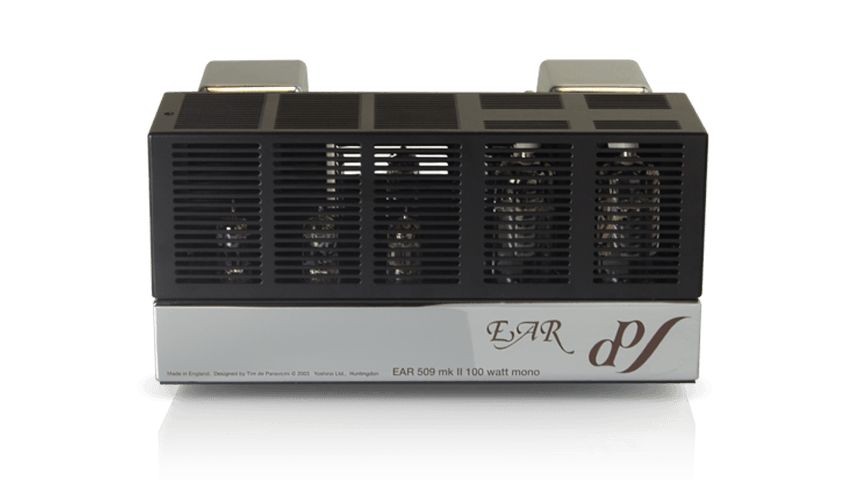
The EAR Yoshino 509 Unbalanced is a valve monoblock power amplifier for one channel of a home audio system. Its stated 100 W output applies into a 4 or 8 Ω load across 20 Hz-20 kHz. The unbalanced RCA input accepts a line-level signal, while controls and four LEDs assist with valve bias adjustment. A stereo system needs a separate amplifier for each channel.
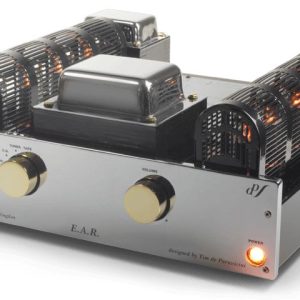
EAR Yoshino 509 Unbalanced is a valve monoblock power amplifier designed to drive one audio channel. Created by Tim de Paravicini, the 509 was originally used in professional recording studios; this Unbalanced version is also suited to a home audio system. Its stated output is 100 W per amplifier into a 4 or 8 Ω load, measured across 20 Hz-20 kHz. The unbalanced line input uses an RCA connector.
Its role in your system
Each 509 amplifies one channel. A two-channel stereo system therefore needs two monoblocks, one for the left channel and one for the right. It also needs a source of separate left and right line-level signals. That source may be a preamplifier or an integrated amplifier equipped with outputs intended for a separate power amplifier. Decide which channels you want to amplify before working out how many 509 units your system requires.
The same one-channel principle applies in a home cinema system. An individual 509 can receive the chosen channel from the corresponding line output of a processor or AV amplifier through its RCA input. One unit cannot amplify every channel. If you intend to build the system in stages, the number of monoblocks you need will follow the number of channels you choose to drive with them.
Casework and placement
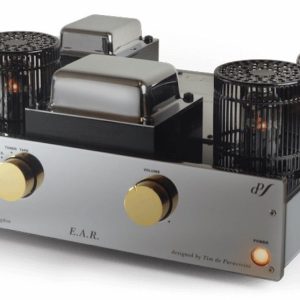
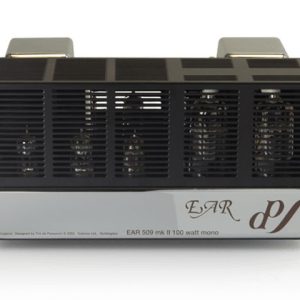
The straight-lined case has a hand-finished polished chrome finish. Its dimensions help you plan shelf space, but remember that each amplifier weighs 15.3 kg. Provide a firm support for every unit. Leave open space around the valves so heat can escape, and keep the top of the case uncovered.
For a stereo pair, allow room for both amplifiers rather than planning around a single case. Position them so that the connection and the operating-point controls remain accessible. The polished chrome is a visible feature of the case; it does not reduce the space the valves need for ventilation.
Connection and adjustment
This version has one RCA line input and requires an unbalanced line-level signal from the component controlling the system. If your source offers only XLR outputs, the RCA connector on this version does not itself provide an XLR connection. When choosing an input version, first check the outputs available on your preamplifier or processor.
The valves have a self-biasing function. When adjustment is needed, two sets of controls and four LEDs are provided to help compare their glow. The aim during adjustment is equal LED brightness. These controls set the valves’ operating point; they do not set listening volume. Volume is controlled by the component managing the system.
Each monoblock contains two PL509 (EL519), two ECC83 (12AX7) and one ECC85 (6AQ8) valve. Knowing the exact complement helps when planning maintenance. This is the complement for one unit, so each amplifier in a two-channel system has its own set.
Reading the specifications
The stated output power applies to one amplifier under the specified load and frequency-range conditions. It is not a combined power figure for a stereo pair. The frequency-response figure carries a +0/-1 dB tolerance; keep that qualification in view when comparing it with figures for other amplifiers.
Unbalanced input sensitivity indicates the signal level the line source must provide, while input impedance is relevant when matching that source to the amplifier. The table gives these and the other technical figures together. As you plan a system, consider them alongside the available line outputs, the number of channels required and the physical space for each unit.
Technical specifications
| Type | Valve monoblock power amplifier |
|---|---|
| Input | One unbalanced RCA line input |
| Output power | 100 W per monoblock into a 4 or 8 Ω load, across 20 Hz-20 kHz |
| Frequency response | 3 Hz-30 kHz, +0/-1 dB |
| Signal-to-noise ratio | 96 dB |
| Intermodulation distortion | Less than 0.2% |
| Unbalanced input sensitivity | 1.2 V |
| Unbalanced input impedance | 25 kΩ |
| Damping factor | 20 |
| Valves per unit | 2 × PL509 (EL519), 2 × ECC83 (12AX7), 1 × ECC85 (6AQ8) |
| Bias control | Self-biasing, two sets of controls and four LEDs |
| Finish | Hand-finished polished chrome |
| Dimensions per unit | 300 mm long × 254 mm wide × 150 mm high |
| Weight per unit | 15.3 kg |
| Power consumption per unit | 180 W |
| Mains voltage variants | 100 V, 110 V or 240 V, depending on the unit |
FAQ
Is one amplifier enough for a stereo system?
No. One unit amplifies one channel, so the left and right channels each need their own monoblock. Allow shelf space and firm support for both units.
Which output should I use on an integrated amplifier?
Use a line output intended for a separate power amplifier, if the integrated amplifier has one. The 509 Unbalanced receives its signal through an RCA line input; a speaker output alone is unsuitable for that input.
How does it connect in a home cinema system?
Send one selected channel from the corresponding line output on the processor or AV amplifier to the 509’s RCA input. Each additional channel amplified this way requires another monoblock.
Where is the listening volume adjusted?
Set listening volume on the component that controls the system.
What should I consider when choosing a location?
Account for each unit’s weight and dimensions, and leave open space around its valves. If you use two amplifiers, give each a firm support and keep both case tops uncovered.
Can I choose the amplifier on its 100 W rating alone?
The rating is for one monoblock into a 4 or 8 Ω load across 20 Hz-20 kHz. Also consider the line outputs you have and the number of channels you need to amplify.
What should I know about mains voltage?
The 509 was made in 100 V, 110 V and 240 V mains-voltage variants. Check the voltage marked on the particular unit before connecting it.
Related products and categories
Related products