

JBL L100 Classic Speaker
Original price was: 4 200,00 €.3 400,00 €Current price is: 3 400,00 €.
The JBL L100 Classic is a passive home audio speaker for a stereo system, offered in a configuration with stands. A 12-inch pure-pulp driver reproduces the lower part of the frequency range, while separate midrange and high-frequency drivers handle the remaining signal. Its 4-ohm impedance and recommended amplifier power of 25-200 W RMS help guide amplifier selection.
The JBL L100 Classic speaker, offered in the “with stands” configuration, is a passive home audio speaker designed for a stereo system. Separate drivers reproduce the low, midrange, and high frequencies. An external amplifier is required to supply both the audio signal and power.
Drivers and frequency distribution
The low-frequency driver is a 12-inch JW300PW-8 model made from pure-pulp material. Its 300 mm cone reproduces the bass frequencies. The 105H-1 midrange driver uses a 125 mm polymer-coated cone.
The JT025TI1-4 high-frequency driver has a 25 mm titanium dome. An internal crossover divides the signal at 450 Hz and 3.5 kHz. These figures describe how frequencies are distributed inside the speaker, so they do not need to be configured on the amplifier.
Choosing and connecting an amplifier
The recommended amplifier power is 25-200 W RMS, while the speaker has an impedance of 4 ohms. The amplifier must be designed to operate with this load. Power output alone does not determine suitability, so stable amplifier operation at the specified impedance is also important.
Connect the speaker to the amplifier’s speaker outputs using speaker cable. A line-level RCA connection or subwoofer output is not a direct connection for this passive model. Volume and source selection are controlled through the amplifier.
Positioning and initial setup
The enclosure measures 636.52 × 389.64 × 371.48 mm and weighs 26.7 kg. Before installation, allow enough space for both the speaker and its stand. A firm, level surface is important for safely supporting a product of this weight.
Begin with the speakers positioned symmetrically in relation to the listening position. Avoid placing them tightly into room corners, where bass may become stronger. If the bass is excessive, gradually increase the distance from the wall. Adjust the angle toward the listening position in small steps, comparing each change with the same recording.
Understanding the measurement data
The 40 Hz to 40 kHz frequency range is specified at a -6 dB limit. This is a measurement tolerance, not a promise of equal output across the entire range. It is useful for comparing speakers only when the other models have been measured and specified under the same conditions.
Sensitivity is rated at 90 dB, measured with a 2.83 V input at a distance of one metre. This value helps compare the sound pressure produced by different speakers under identical measurement conditions. It does not state the maximum possible volume.
Technical specifications
| Model | JBL L100 Classic |
|---|---|
| Type | Passive audio speaker, configuration with stands |
| Low-frequency driver | 12-inch (300 mm) pure-pulp JW300PW-8 |
| Midrange driver | 5.25-inch (125 mm) polymer-coated cone 105H-1 |
| High-frequency driver | 1-inch (25 mm) titanium-dome JT025TI1-4 |
| Sensitivity | 90 dB at 2.83 V / 1 m |
| Recommended amplifier power | 25-200 W RMS |
| Crossover frequencies | 450 Hz and 3.5 kHz |
| Impedance | 4 ohms |
| Frequency range | 40 Hz-40 kHz at the -6 dB limit |
| Dimensions | 636.52 × 389.64 × 371.48 mm |
| Weight | 26.7 kg |
FAQ
Does the speaker require a separate amplifier?
Yes. This is a passive speaker and does not contain an integrated power amplifier. An external amplifier supplies the audio signal and the power required by the speaker.
How do I connect it to a stereo amplifier or AV receiver?
Use speaker cable and the speaker outputs on the amplifier or receiver. The connected equipment must be suitable for the load stated in the technical specifications table.
Where is the volume controlled?
Volume is controlled through the connected amplifier or AV receiver. The audio source is also selected using the same system component.
How should I begin positioning it in the room?
Start by maintaining symmetrical placement in relation to the listening position. Then adjust the distance from the walls and the speaker angle until you achieve a balanced result.
What is included in the “with stands” configuration?
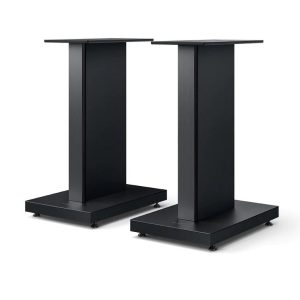
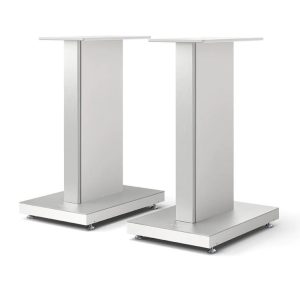
The supplied information does not specify this. Before purchasing, confirm the stand model, quantity, dimensions, and finish, as well as the number of speakers included in the package.
![Patricia Barber Café Blue [Un-Mastered] jazz album](https://audiocentras.lt/wp-content/uploads/2026/09/patricia-barber-cafe-blue-un-mastered-1-1-300x300.jpg)