Hegel H190 Integrated Amplifier
3 600,00 €
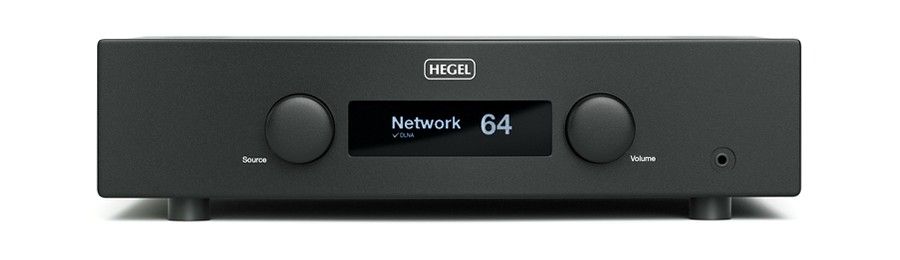
The Hegel H190 is a network-enabled integrated stereo amplifier designed for systems using analogue, digital and network sources. Its built-in DAC allows suitable sources to connect directly through USB, optical or coaxial inputs. An output of 2 × 150 W into 8 Ω, measured at 1 kHz and 1% THD, is provided for passive stereo speakers. Fixed and variable RCA outputs offer different options for expanding the system.
The Hegel H190 amplifier is a network-enabled integrated stereo amplifier with a built-in digital-to-analogue converter (DAC). The Hegel H190 is designed for a system that brings together analogue, digital and network music sources. It delivers 2 × 150 W into 8 Ω, measured at 1 kHz and 1% THD.
The minimum supported speaker load is 2 Ω. The amplifier was offered with either a black or a white finish. These are two separate colour variants, not a two-tone enclosure.
One component for the main stereo system
This integrated amplifier combines a preamplifier, power amplifier, DAC and network music playback functions in a single enclosure. A separate DAC is therefore unnecessary when you use the available digital inputs.
An output of 2 × 250 W into 4 Ω makes the model worth considering for lower-impedance speakers. Power figures must still be compared using the stated load and measurement conditions. The 8-ohm rating is specified at 1 kHz and 1% THD.
The damping factor of more than 4000 applies to the main power-output stage. This figure describes the amplifier’s electrical control over connected loudspeakers, but it does not remove the need to choose suitable speakers for the system.
Connecting analogue sources
One balanced XLR input is provided for a source equipped with corresponding XLR outputs. This connection is particularly worth considering for a longer cable run or when the source offers a genuinely balanced output.
Two unbalanced RCA inputs accommodate conventional line-level sources. They can be used with a CD player, external DAC or another component fitted with RCA outputs.
A turntable requires a separate phono stage unless one is built into the turntable itself. The input list for this model does not include a dedicated phono input.
Digital and network sources
The digital connection options include three optical S/PDIF inputs and one coaxial S/PDIF input. An optical connection provides electrical isolation between the source and amplifier. The coaxial connection is convenient for a transport or network player equipped with a suitable output.
One USB input can carry a digital signal from a suitable source to the internal DAC. The USB connector type, supported file formats and maximum resolution are not specified.
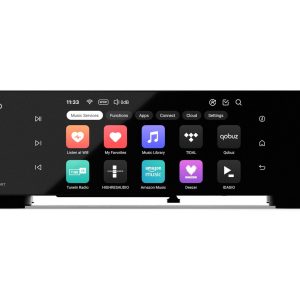
The network input is intended for music playback over a local network. The model’s original network features include DLNA and AirPlay. As this model has been discontinued, support for current apps or specific streaming services has not been established.
Outputs and system expansion
The fixed-level RCA output passes a signal without changing it in step with the amplifier’s volume setting. It can be used with a separate recording device or another component that provides its own level control.
The variable-level RCA output follows the volume control. This makes it useful for connecting a separate power amplifier or another component that accepts a line-level signal.
A 6.3 mm headphone output is located on the front panel, allowing headphones to be connected without reaching the sockets on the rear of the amplifier.
Operation and system setup
The volume control adjusts the level of both the main power-amplifier stage and the variable RCA output. During initial setup, begin with the volume set low and increase it gradually.
Connect the fixed output only to a component that can control the level of the incoming signal independently. This prevents a full line-level signal from being sent to equipment without a suitable means of level adjustment.
If an AV receiver’s line-level output is connected to one of the RCA inputs, the volume settings of both components must be coordinated carefully. A dedicated home-cinema bypass function is not specified for this model.
Placement in an equipment system
Including its feet, the enclosure measures 43 cm wide, 41 cm deep and 12 cm high. Allow additional shelf space behind it for the rear-panel connections and the natural bend of the cables.
Place this 17 kg component on a stable surface capable of supporting its weight. Do not cover the enclosure or fit it tightly inside a closed compartment without air circulation.
When selecting furniture, consider more than the amplifier’s 41 cm chassis depth. Extra clearance will be required for XLR, RCA, network and digital cable plugs.
Technical specifications
| Product type | Network-enabled integrated stereo amplifier with DAC and headphone output |
|---|---|
| Output power into 8 Ω | 2 × 150 W at 1 kHz and 1% THD; for 100, 120 and 230 V AC versions |
| Output power into 4 Ω | 2 × 250 W |
| Minimum load | 2 Ω |
| Analogue inputs | 1 × balanced XLR, 2 × unbalanced RCA |
| Digital inputs | 1 × coaxial S/PDIF, 3 × optical S/PDIF, 1 × USB |
| Network connection | 1 × network input |
| Original network features | DLNA and AirPlay |
| Fixed line-level output | 1 × unbalanced RCA |
| Variable line-level output | 1 × unbalanced RCA; level controlled by the volume control |
| Headphone connection | 6.3 mm, front panel |
| Frequency response | 5 Hz-100 kHz |
| Signal-to-noise ratio | Greater than 100 dB |
| Crosstalk | Less than -100 dB |
| Distortion | Less than 0.01% at 25 W into 8 Ω and 1 kHz |
| Intermodulation distortion | Less than 0.01% using 19 kHz and 20 kHz test signals |
| Damping factor | Greater than 4000 at the main power-output stage |
| Dimensions including feet | 12 × 43 × 41 cm (H × W × D) |
| Dimensions in inches | 4.72 × 16.93 × 16.15 in (H × W × D) |
| Unit weight | 17 kg |
| Shipping weight | 19 kg |
| Finishes | Black or white |
| Model status | Discontinued model |
FAQ
Which analogue input should I use?
Choose the XLR input when the source has a balanced XLR output. In other cases, use either of the two RCA inputs.
How do I connect a television?
You can use an optical S/PDIF input if the television has a compatible optical output. Set the television’s audio format to suit the signal accepted by the amplifier.
What is the difference between the two RCA outputs?
The fixed output is unaffected by the volume control. The variable output follows the selected volume level and is suitable for controlled system expansion.
Can the amplifier be included in a home-cinema system?
A line-level signal from an AV receiver can be sent to an RCA input. The volume settings on both components will need to be coordinated consistently.
Can I use an additional power amplifier at the same time?
The variable RCA output can send a volume-controlled signal to an additional power-amplifier stage. Reduce the volume on both components before making the connection.
Do the network music features support modern services?
The model provides DLNA and AirPlay capabilities. Support for specific current services, apps and newer AirPlay versions has not been established.
How much shelf space is required?
Consider the 43 × 41 × 12 cm enclosure dimensions together with the additional clearance needed for rear plugs, cable bends and air circulation.