

Alpine SXE-1025S Car Speaker
33,00 €
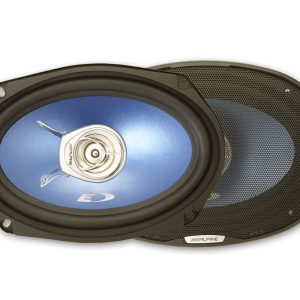
Alpine SXE-1025S is a speaker designed for car audio systems. Its 25 W RMS rating is used when assessing sustained power handling, while 180 W denotes peak power. The 100 Hz-20 kHz frequency range focuses on midrange and high frequencies. Sensitivity of 90 dB/W/m helps indicate the attainable sound level under consistent measurement conditions. The construction uses a Mylar-titanium tweeter dome, a natural cellulose dome, and neodymium and ferrite magnets.
Alpine SXE-1025S car speaker is designed for use in a car audio system. Its frequency range covers midrange and high frequencies, while its construction combines domes and magnets made from different materials.
The 100 Hz-20 kHz frequency range covers the midrange and treble regions. The lower limit of 100 Hz means that this model is not intended to reproduce the deepest bass. A dedicated separate speaker can be used to handle low frequencies in the car audio system.
Construction and materials
The tweeter uses a balanced Mylar-titanium dome. This construction is intended for reproducing the high-frequency range.
The speaker also incorporates a long-fibre natural cellulose dome. Neodymium and ferrite magnets are used in the design. The available information does not assign each magnet material to a particular speaker element, so its purpose should not be inferred from the material name alone.
Understanding the power ratings
25 W RMS is the most important reference value when matching the speaker with a head unit or separate amplifier. It describes a power rating intended to represent sustained operation. The stated 180 W peak power is the maximum specified figure, not a recommended continuous operating level.
An amplifier should not be selected using the peak-power figure alone. The RMS rating and the amplifier requirements for the speaker load must both be considered. Excessive volume or clearly audible distortion indicates that the system load should be reduced. Turning the volume down when distortion appears helps keep the speaker from being driven beyond clean reproduction.
Sensitivity and volume adjustment
The 90 dB/W/m sensitivity states a sound level associated with one watt of power at a measuring distance of one metre. This value is useful when comparing speakers under the same measurement conditions. It does not replace the RMS power rating, and it does not indicate whether the speaker will physically or electrically fit a particular installation.
The final listening volume inside a vehicle is affected by the output of the head unit or amplifier, the installation position and the acoustics of the passenger compartment. Begin adjustment at a low volume. The level can then be increased gradually until reaching the point at which reproduction remains clean and free from audible distortion.
Frequency setup in a car audio system
The 100 Hz lower frequency limit provides a useful reference when planning how frequencies will be divided across the system. If the head unit or amplifier provides a suitable high-pass filter, a setting of approximately 100 Hz can be used as an initial starting point. The filter frequency can be raised if low-frequency distortion becomes audible at higher volume levels.
When a separate bass speaker is used, its filter settings should be adjusted together with those of the main speakers. There should not be a clearly audible gap between the frequency ranges. Excessive overlap can make a narrow part of the bass and midrange region sound too prominent.
Carry out the final adjustment while listening from the driver’s seat. Surfaces within the passenger compartment and the positions in which the speakers are installed affect the balance that reaches the listener. Identical control settings in different vehicles will not necessarily produce the same result.
Planning the installation
Before purchasing, measure the vehicle’s speaker opening, the available mounting depth and the clearance behind the grille. The mounting points should also be compared. The model name alone does not establish whether the speaker will physically fit a particular position in a vehicle.
The membrane and domes must be able to move without touching the grille or surrounding trim. Wiring must be kept away from moving vehicle components. For a door installation, check whether the lowered window could come into contact with the speaker or its wiring.
When installing a pair or several speakers, maintain the same polarity across all units. A speaker connected with reversed polarity can weaken the combined low-frequency output. After connection, compare the volume of both channels and check the position of voices within the stereo image.
Technical specifications
| Model | Alpine SXE-1025S |
|---|---|
| Product type | Car speaker |
| RMS power | 25 W |
| Peak power | 180 W |
| Frequency range | 100 Hz-20 kHz |
| Sensitivity | 90 dB/W/m |
| Tweeter dome | Balanced Mylar-titanium dome |
| Cellulose element | Long-fibre natural cellulose dome |
| Magnets | Neodymium and ferrite |
FAQ
What should I check before buying?
Compare the vehicle’s mounting opening, available depth, mounting points and electrical compatibility requirements. These parameters cannot be determined from the model name alone.
Is 180 W the continuous power rating?
No. The 180 W figure is the peak-power rating. For long-term system matching, the 25 W RMS rating is the more relevant value.
Can this model reproduce deep bass?
The frequency range begins at 100 Hz, so a separate bass speaker is required for the deepest bass. Its filter must be coordinated with the main speakers to avoid an audible gap or excessive overlap.
How should I set the frequency filter?
If the head unit or amplifier has a suitable filter, begin at approximately 100 Hz. Raise the setting if distortion becomes audible when the system is played at a higher volume.
Will the speaker fit a specific vehicle?
Fit depends on the opening, mounting depth, mounting points and the space behind the trim. These measurements and installation details must be compared before fitting the speaker.
How should I choose an amplifier?
Use the 25 W RMS rating as a reference, but do not rely on that figure alone. The amplifier must also be suitable for the speaker’s nominal impedance and the chosen wiring arrangement.
Can it be used in a home stereo or cinema system?
This is a car speaker. It should not be selected for a home system without knowing its nominal impedance, enclosure requirements and compatibility with the intended amplifier.
What should I check after connection?
Check the polarity of both channels, the volume balance and any audible distortion. The speaker’s moving parts must not touch the grille or the vehicle trim.