JL Audio CR-1 Active Crossover
2 700,00 €
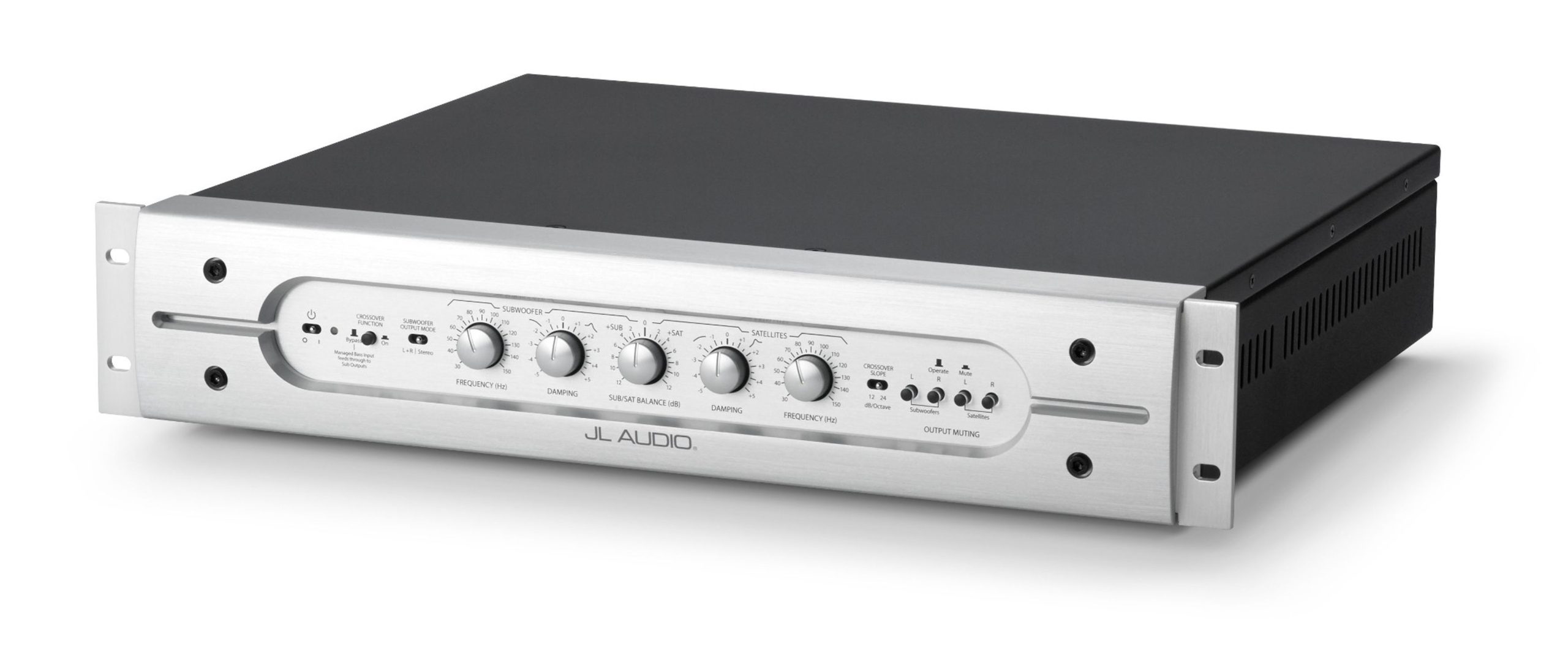
JL Audio CR-1 is an active analogue crossover for two-channel audio systems, studios and recording-mixing rooms. Independently adjustable high-pass and low-pass filters allow the operating ranges of the main speakers and subwoofer to be aligned more precisely. Users can select a 12 or 24 dB-per-octave Linkwitz-Riley slope, adjust each filter’s Q and change the relative output level across a ±12 dB range.
JL Audio CR-1 is an active analogue subwoofer crossover designed for two-channel systems, studios and mastering rooms. It filters the signals sent to the subwoofer and the main speakers separately.
Analogue audio circuitry
The audio signal is processed through an entirely analogue signal path. Filter frequencies are controlled by multiplying digital-to-analogue converters with monolithic ratio matching, but the audio signal itself is never digitised. The circuit uses 1% precision resistors, audio-grade operational amplifiers with JFET inputs, polypropylene film-and-foil capacitors and metallised polypropylene film capacitors.
Connections and system modes
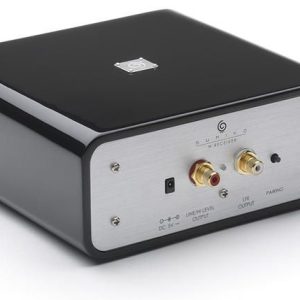
Main stereo sources can be connected through RCA sockets or balanced XLR/TRS combination inputs. Satellite-speaker and subwoofer signals are available through RCA, TRS or XLR outputs. The subwoofer output can operate in stereo or summed mono L+R mode.
A separate Managed Bass input accepts the signal from a multichannel system. In bypass mode, this signal is routed to the subwoofer outputs, allowing the same subwoofer chain to be shared between two-channel and multichannel systems.
System adjustment
The crossover frequency is continuously adjustable from 30 to 150 Hz. The high-pass and low-pass filters have separate frequency controls, while a front-panel switch selects either a 12 or 24 dB-per-octave Linkwitz-Riley slope.
Independent damping controls adjust the Q value of each filter. At the upper centre “0” mark, Q is 0.5. A central control adjusts the relative level between the subwoofer and satellite-speaker outputs across a ±12 dB range. Each output can also be muted independently, making it easier to assess the contribution of each part of the system during setup.
Installation
The enclosure is 441 mm wide and 398 mm deep, so additional space must be allowed for connectors and plugs. A rear ground-lift switch provides a choice of isolated or grounded operation. The mains voltage is set at the factory, so the factory power version must be selected to match the electrical supply in the destination country.
Technical specifications
Note: these specifications were supplied by the retailer and have not been independently verified against the manufacturer’s page or manual for this exact model.
| Type | Active analogue subwoofer crossover |
|---|---|
| Applications | Two-channel systems, studios and recording-mixing rooms |
| Audio circuitry | Entirely analogue |
| Filters | Separate Linkwitz-Riley high-pass and low-pass filter sections |
| Frequency control | Multiplying DACs with monolithic ratio matching |
| Circuit components | 1% precision resistors and operational amplifiers with JFET inputs |
| Capacitors | Polypropylene film-and-foil; metallised polypropylene film |
| Crossover frequency | 30-150 Hz, continuously adjustable |
| Frequency adjustment | Separate controls for the high-pass and low-pass filters |
| Filter slopes | 12 or 24 dB/octave, Linkwitz-Riley |
| Slope selection | Front-panel switch |
| Damping at 12 dB/octave | Q 0.3-1.4 |
| Damping at 24 dB/octave | Q 0.16-4.0 |
| Centre damping position | Q 0.5 at the upper centre “0” mark |
| Subwoofer-to-satellite balance | ±12 dB, continuously adjustable |
| Crossover operation | Engaged or bypassed using a front-panel switch |
| Subwoofer output modes | Stereo or summed mono L+R |
| Output muting | Each output is muted by a separate front-panel button |
| Ground lift | Isolated or grounded operation, selectable on the rear panel |
| Main stereo inputs | 2 RCA; 2 balanced XLR/TRS combination sockets |
| Managed Bass inputs | 2 RCA; 2 balanced XLR/TRS combination sockets |
| Satellite-speaker outputs | 2 RCA; 2 balanced TRS; 2 balanced XLR |
| Subwoofer outputs | 2 RCA; 2 balanced TRS; 2 balanced XLR |
| Maximum input voltage | 8 Vrms (+18 dBV) |
| Unbalanced input impedance | 50 kΩ |
| Balanced input impedance | 20 kΩ, 10 kΩ per leg |
| Maximum output voltage | 8 Vrms (+18 dBV) |
| Unbalanced output impedance | 150 Ω |
| Balanced output impedance | 300 Ω, 150 Ω per leg |
| THD+N | <0.002% at 8 Vrms into 10 kΩ, 20 Hz-20 kHz, 90 kHz measurement bandwidth |
| Channel separation | >80 dB at 1 kHz |
| Low-pass filter response | +0/-1 dB from 5 Hz to one-quarter of the filter frequency |
| High-pass filter response | +0/-1 dB from four times the filter frequency to 80 kHz |
| Power consumption | 30 W typical, with or without a signal |
| Power versions | 120 V, 60 Hz; or 230/240 V, 50 or 60 Hz; factory configured |
| Dimensions | 441 × 97 × 398 mm |
| Net weight | 10 kg |
FAQ
What is this crossover designed for?
It is intended for a system with a separate subwoofer and a line-level signal path positioned before the power amplifiers or active speakers.
When should I use RCA, and when should I choose XLR or TRS?
Use RCA for unbalanced connections. Choose XLR or TRS when every connected component supports a balanced signal.
How should I begin setting up the crossover?
Set the filter frequencies according to the operating ranges of the speakers, and initially leave the damping controls at “0”. Then adjust the frequencies, relative level and Q from the listening position.
How can one subwoofer be shared between stereo and multichannel systems?
Connect the stereo signal to the main inputs and the signal from the multichannel processor to the Managed Bass input. Switch between the systems using the bypass function.
Is the audio signal converted to digital?
No. Multiplying DACs control the frequencies of the analogue filters, but the audio signal remains analogue.