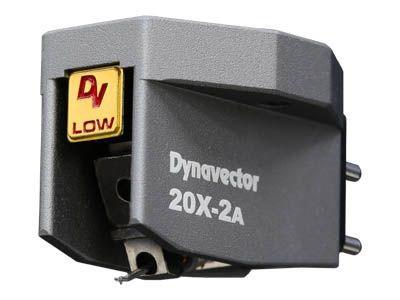

Dynavector DV 20X2A LOW Phono Cartridge
1 200,00 €
Dynavector DV 20X2A LOW is a low-output moving-coil phono cartridge for vinyl systems equipped with a suitable MC phono stage. Its 0.3 mV output requires adequate signal gain. The hard aluminium cantilever and solid-diamond Micro-Ridge stylus are designed for precise groove tracing, while the one-piece aluminium-alloy body provides a rigid mechanical foundation.
Dynavector DV 20X2A LOW is the low-output moving-coil version of the DV 20X2A-L phono cartridge. It is intended for vinyl systems equipped with a phono stage designed for low-output MC cartridges. Its 0.3 mV output voltage is the most important consideration when matching the cartridge to an existing audio system.
Construction and stylus
The one-piece aluminium-alloy body provides a rigid mechanical foundation. The cartridge uses the same basic construction as the Dynavector XX-2A and Te Kaitora Rua models.
A 6 mm hard aluminium tube cantilever is fitted with a Micro-Ridge stylus tip made from a solid diamond. This profile is designed to trace the record groove precisely. Careful cartridge alignment is important, however, as the final result depends on accurate installation and adjustment.
The generator incorporates a magnetic flux damper and a softened-magnetism design.
Connecting the cartridge to your system
For this version, choose an MC phono-stage input intended for low-output cartridges. The phono stage must provide suitable gain for the cartridge’s 0.3 mV signal. The correct load resistance cannot be selected solely from the fact that this is an MC cartridge, so it should be determined with reference to the equipment used in the system.
If your amplifier has only an MM phono input, you will need a suitable MC step-up transformer or a separate MC phono stage. The cartridge must not be connected directly to a conventional line-level input. Settings intended for the DV 20X2A-H do not apply to this low-output version.
Installation and initial setup
The cartridge’s 9.2 g mass must be taken into account when balancing the tonearm. Tonearm effective mass is also required when calculating the system’s resonant frequency. However, before relying on the seller-listed compliance value of 12 mm/N, its unit and underlying data should be verified.
The permitted tracking-force range is 1.8 to 2.2 g. Starting at 2.0 g leaves an equal amount of adjustment in either direction. Measure the tracking force with a gauge designed for phono-cartridge setup rather than relying only on the tonearm’s scale.
Align the cartridge with a protractor intended for the geometry of the specific tonearm. Check the overhang, offset angle and azimuth carefully. For the initial tonearm-height setting, position the cartridge body parallel to the record surface.
Technical specifications
| Model version | DV 20X2A-L (LOW) |
|---|---|
| Type | Low-output moving-coil phono cartridge |
| Generator design | Magnetic flux damper and softened magnetism |
| Output voltage | 0.3 mV at 1 kHz and 5 cm/s |
| Channel separation | 25 dB at 1 kHz |
| Channel balance | 1.0 dB at 1 kHz |
| Frequency range | 20 Hz-20 kHz, ±2 dB |
| Compliance | Seller-listed value: 12 mm/N |
| Tracking force | 1.8-2.2 g |
| Body | One-piece aluminium alloy |
| Cantilever | 6 mm hard aluminium tube |
| Stylus tip | Micro-Ridge profile, solid diamond |
| Mass | 9.2 g |
| Basic construction | As used in the Dynavector XX-2A and Te Kaitora Rua models |
FAQ
Is this the low-output or high-output version?
This is the low-output DV 20X2A-L version. Its output voltage is 0.3 mV. The high-output DV 20X2A-H is a separate model and should not be confused with this cartridge.
What kind of phono stage is required?
You need a phono stage that supports low-output moving-coil cartridges and provides suitable gain for a 0.3 mV signal. A suitable step-up transformer used with an MM phono input is an alternative.
What tracking force should I start with?
Begin at 2.0 g and verify the setting with a cartridge tracking-force gauge. Any subsequent adjustment must remain within the specified range of 1.8 to 2.2 g.
How should I assess tonearm compatibility?
Calculating the resonant frequency requires the cartridge’s 9.2 g mass, the tonearm’s effective mass and an appropriate compliance figure. Before using the seller-listed value of 12 mm/N, verify its unit and data. The tonearm counterweight must also be capable of balancing the cartridge together with its mounting hardware.
How precisely should the Micro-Ridge stylus be aligned?
Use an alignment protractor designed for your tonearm’s geometry. Set the overhang and offset angle accurately, then check the azimuth. The Micro-Ridge profile is sensitive to installation accuracy, so each of these adjustments should be completed carefully.