
Steg NIKO 1.7000 Car Audio Amplifier
1 900,00 €
Steg NIKO 1.7000 is a Class D car audio amplifier designed for high-power SPL systems. According to the seller’s specifications, its 7000 W RMS mono rating applies at a 1-ohm load with a 10-14.4 V power supply. Two isolated power-supply sections reduce the likelihood of interference between the branches and limit power losses. The protection system monitors temperature, short circuits, DC voltage at the outputs, and power-supply conditions.
Steg NIKO 1.7000 is a Class D car audio amplifier designed for demanding SPL systems. According to the seller’s specifications, its 7000 W RMS mono rating applies with a 1-ohm load and a 10-14.4 V power supply. Separate power figures are provided for the available stereo and mono configurations.
Who This Amplifier Is For
This model is intended for high-power in-car audio systems and sound pressure level competitions. It can operate in either stereo or mono mode. The permitted load and available output power depend on the selected configuration.
Begin by choosing how the system will operate. Then calculate the total impedance of the connected speakers. This will allow you to select the appropriate combination of power, load, and operating mode shown in the specification table.
Construction and Power-Supply Architecture
According to the seller’s specifications, the power stage uses 24 MOSFET transistors, with a stated current rating of 160 A for each transistor. The seller also states that the amplifier’s power-input current capability reaches up to 4000 A.
The amplifier contains two completely isolated power-supply sections. This arrangement is intended to reduce the likelihood of interference between the two power branches. It is also designed to limit power losses and reduce the risk of faults within the amplifier.
Low-tolerance resistors and capacitors are used in the design.
Connection and Load Selection
In stereo mode, a separate RMS power figure is specified for each channel. In mono mode, the rating refers to a single output. The two stereo channel figures should not simply be added together and treated as a mono specification, because the operating conditions and permitted loads are different.
Before connecting the speakers, calculate their final impedance according to whether they are wired in series or in parallel. The lowest stated output load is 0.5 ohm. However, the power figure for this load is provided only for stereo operation and does not establish support for a 0.5-ohm mono configuration.
The regulated power supply can operate at 10 V. All output ratings are stated for the specified supply-voltage range. The vehicle’s actual electrical system must be capable of maintaining the required operating voltage while also meeting the amplifier’s very high current demand.
Input Signal Matching
The input sensitivity range is 0.2-5 V RMS. This range allows the amplifier to be matched to line-level signal sources or audio processors with different output levels. The signal supplied by the source must remain within the stated range.
Begin setup with a clean source signal and a lower gain setting. Increase the sensitivity gradually while checking that the sound remains free from audible distortion. An excessive input level can overload the input stage before the intended output level has been reached, so gain should not be treated as a volume control.
Protection and Status Indication
The protection system monitors for an output short circuit, DC voltage at the speaker outputs, and excessive temperature. It also responds when the supply voltage moves outside the permitted operating range.
The amplifier is muted during the power-on transition. The INTELLISPEED system controls fan operation. A separate function monitors power-input imbalance between the amplifier’s two power connections.
Sensors throughout the circuits continuously provide information to the protection system. If protection is activated or a fault occurs, LEDs on the control panel indicate the amplifier’s status. An additional modulator-controlled function monitors the switching circuit in the output stage.
Installation Location and Vehicle Electrical System
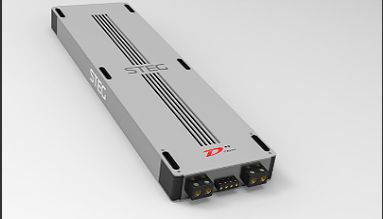
The amplifier measures 830 × 55 × 232 mm and weighs 10 kg. Its long enclosure requires sufficient installation space and a rigid mounting surface. Leave enough clearance around the housing for air circulation, and make sure trim panels, cables, or other equipment do not obstruct the fan’s airflow path.
Select the alternator, battery, power-cable cross-section, and fuses according to the system’s calculated real-world current requirement. Both power connections must be supplied under equal conditions. This is important for the amplifier’s integrated monitoring of imbalance between the two power inputs.
Technical Specifications
According to the seller’s specifications, the following technical details apply. These figures have not been independently verified.
| Model | Steg NIKO 1.7000 |
|---|---|
| Product type | Class D car audio amplifier |
| Intended use | High-power SPL systems |
| Supply voltage for power ratings | 10-14.4 V |
| Lower limit of regulated power supply | 10 V |
| Power-supply sections | Two completely isolated sections |
| MOSFET transistors | 24 |
| Stated current per MOSFET | 160 A |
| Stated power-input current capability | According to the seller’s specifications, up to 4000 A |
| Minimum output load | 0.5 Ω |
| Power at 4 Ω mono | 2350 W RMS × 1 at 10-14.4 V |
| Power at 2 Ω stereo | 1220 W RMS × 2 at 10-14.4 V |
| Power at 2 Ω mono | 3850 W RMS × 1 at 10-14.4 V |
| Power at 1 Ω stereo | 2000 W RMS × 2 at 10-14.4 V |
| Power at 1 Ω mono | According to the seller’s specifications, 7000 W RMS × 1 at 10-14.4 V |
| Power at 0.5 Ω stereo | 3500 W RMS × 2 at 10-14.4 V |
| Input sensitivity | 0.2-5 V RMS |
| Passive components | Low-tolerance resistors and capacitors |
| Protection functions | Short circuit, DC voltage at the outputs, temperature, and incorrect supply voltage |
| Additional monitoring | Power-input imbalance and output-stage switching circuit |
| Power-on function | Muting during the power-on transition |
| Fan control | INTELLISPEED |
| Status indication | LED indicators on the control panel |
| Dimensions | 830 × 55 × 232 mm |
| Weight | 10 kg |
FAQ
When should I use stereo mode, and when should I use mono mode?
Choose stereo mode when powering two separate loads. Mono mode is intended for a system that requires one high-power output. In either case, the total speaker impedance must remain within the limits specified for the selected operating mode.
Can a 0.5-ohm load be used in mono mode?
The 0.5 Ω power figure is stated only for stereo operation. The lowest listed load for mono operation is 1 Ω. The 0.5 Ω stereo rating must therefore not be interpreted as a specification for a 0.5-ohm mono connection.
How should the amplifier be matched to the audio source?
Use a clean line-level signal and begin with a lower gain setting. Raise the level gradually until the required volume is reached without audible distortion. The output level of the signal source must fall within the amplifier’s specified input sensitivity range.
What kind of vehicle power supply is required?
The electrical system must maintain the operating voltage under a heavy load. The battery, alternator, power cables, and fuses must be selected according to the calculated current demand of the complete system.
Where should this amplifier be installed?
Choose a long, rigid, and well-ventilated installation area. The mounting surface must safely support the weight of the enclosure. The fan’s airflow path must not be blocked by interior trim or other equipment.
Is it suitable for a home stereo or home cinema system?
This is a car audio amplifier that operates from a low-voltage DC power supply. It is not a direct replacement for a domestic stereo amplifier or home cinema amplifier.
What do illuminated control-panel indicators mean?
The LED indicators show that a protection function has been activated or that an operating fault is present. If this happens, check the connected load, amplifier temperature, outputs, and the condition of both power connections.