
![Anne Bisson - Keys to My Heart [One-Step Pressing] music album](https://audiocentras.lt/wp-content/uploads/2026/09/anne-bisson-keys-to-my-heart-one-step-pressing-1-150x150.jpg)
Yamaha NS-F51 Floorstanding Speaker
240,00 €
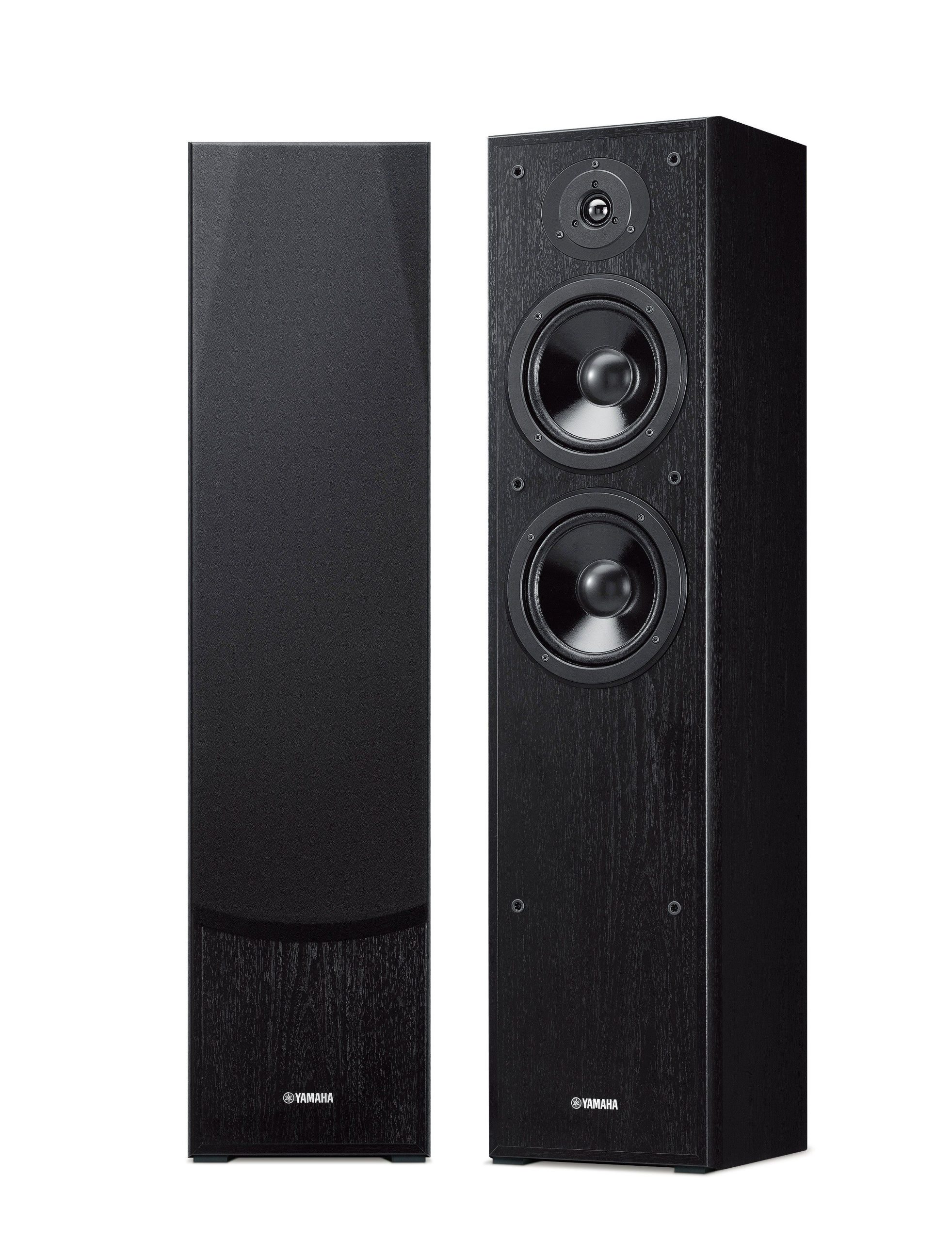
The Yamaha NS-F51 floorstanding speaker is designed for stereo music and home cinema systems. Two 16 cm woofers and a 3 cm soft-dome tweeter divide the reproduced range across two frequency bands. Its braced, rounded cabinet helps suppress unwanted resonance and reduce diffraction. The nominal 6-ohm impedance is an important consideration when choosing an amplifier or AV receiver.
The Yamaha NS-F51 floorstanding speaker is designed for music and home cinema systems. It uses a 2-way, 3-driver bass-reflex design, combining two 16 cm woofers with one 3 cm soft-dome tweeter. Its approximately 97 cm tall cabinet is intended to stand directly on the floor.
This model can be used in a stereo system or as a front speaker in a home cinema setup. It is also suitable for an audio system accompanying a large-screen television. The speaker must be connected to a separate amplifier or AV receiver.
Cabinet and Driver Design
Two 16 cm cone woofers operate within the same cabinet. Together, they provide a larger total cone area than a single driver of the same diameter. The 3 cm soft-dome tweeter reproduces the upper frequency range.
Internal cabinet bracing is intended to suppress unwanted cabinet resonance. This is particularly important in a tall floorstanding speaker, where the cabinet panels are affected by the movement of both woofers.
The rounded, low-diffraction cabinet shape helps reduce sound reflections from sharp edges. The crossover network uses a wooden circuit board. This is part of the speaker’s internal construction and does not require adjustment during the initial system setup.
Connection and Amplifier Selection
The speaker must be connected to the speaker output of an amplifier or AV receiver using speaker cable. A television’s headphone or line-level output cannot drive it directly. A television-based system therefore requires an amplifier or AV receiver that accepts the relevant audio sources.
The nominal impedance of 6 ohms is the main figure to consider for electrical compatibility. The specifications of the amplifier or AV receiver must permit a 6-ohm speaker load. If the receiver includes a speaker-impedance setting, select the position specified for 6-ohm speakers in its instructions.
The 80 W nominal input power and 240 W maximum input power describe the speaker’s power handling. These figures should not be interpreted as a requirement for an amplifier with the same continuous output rating. Listening distance and the desired volume level should also be considered when selecting an amplifier.
The 89 dB sensitivity figure is measured with a 2.83 V input at a distance of one metre. It is useful when comparing speakers under the same measurement conditions, but it is not a measure of maximum volume or a recommendation for amplifier power.
Positioning in the Room
The 233 mm wide and 254 mm deep cabinet requires a stable position on the floor. Each speaker weighs 13.7 kg, so it is sensible to choose the final location before making precise adjustments to a stereo system. Before purchasing, check whether the selected product variant includes one speaker or a pair. Hold the cabinet with both hands when moving it.
For a stereo pair, begin by placing both speakers at similar distances from the rear and side walls. The listening position should face the two speakers. Turning them slightly towards the listener can alter the treble balance and the precision of the central stereo image.
Because this is a bass-reflex design, its bass balance is affected by the distance from nearby walls. If the bass becomes too prominent, move both speakers equally farther away from the rear wall. If the bass sounds insufficient, adjust their positions in small, equal increments.
Use in Stereo and Home Cinema Systems
A stereo system requires two matching speakers connected to the amplifier’s left and right channels. Symmetrical placement helps maintain a balanced soundstage. Begin by setting the channel balance on the amplifier, then fine-tune the position of the speakers.
In a home cinema system, this model can serve as the front-left and front-right speaker. The distance and level for each channel should be configured in the AV receiver according to the listening position. Whether a separate subwoofer is needed depends on the desired depth of cinema effects and the selected crossover arrangement.
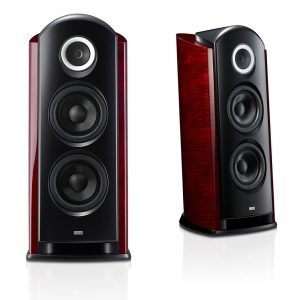
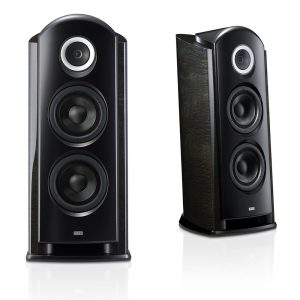
Yamaha produces this model in black and walnut finishes. Both versions use the same driver configuration and share the principal technical characteristics, but the finish included in a particular offer must be checked in the selected product variant.
Technical Specifications
| Type | 2-way, 3-driver bass-reflex floorstanding speaker |
|---|---|
| Woofers | 2 × 16 cm cone drivers |
| Tweeter | 1 × 3 cm soft-dome driver |
| Frequency range | 43 Hz-26 kHz; measurement tolerance not specified |
| Nominal input power | 80 W |
| Maximum input power | 240 W |
| Sensitivity | 89 dB at 2.83 V / 1 m |
| Nominal impedance | 6 ohms |
| Dimensions | 233 × 973.5 × 254 mm (width × height × depth) |
| Dimensions in inches | 9-1/8 × 38-3/8 × 10 inches (width × height × depth) |
| Weight | 13.7 kg per speaker |
| Cabinet construction | Internal bracing and a rounded, low-diffraction form |
| Crossover circuit board | Wooden |
| Model finishes | Black or walnut; check the selected product variant for the finish being offered |
FAQ
Does this speaker require a separate amplifier?
Yes. It connects to the speaker output of a stereo amplifier or AV receiver. Additional amplification is required if the original audio source provides only a line-level output.
How should I choose a suitable amplifier?
The amplifier must be designed to support the speaker’s nominal impedance. The stated input-power limits do not mean that you must choose an amplifier with an identical continuous output rating.
Is this model suitable for a stereo system?
Yes. A stereo system uses two matching speakers connected to the left and right channels. They should be positioned as symmetrically as possible in relation to the listening position.
How can I use these speakers with a television?
First route the television’s audio to an AV receiver or stereo amplifier. Connect the speakers to its front-channel speaker outputs rather than directly to the television.
Are additional stands required?
No. The cabinet is almost one metre tall and is designed for floor placement. Choose a level, stable location for both speakers in a stereo pair.
Is a subwoofer essential for home cinema?
This model’s stated frequency range begins at 43 Hz, although the measurement tolerance is not specified. A separate subwoofer is useful when deeper cinema effects are desired.
How should I begin adjusting the speakers’ position?
Place both speakers equally in relation to the surrounding walls and aim them towards the listening area. Then change their distance from the rear wall in small steps while listening to the bass balance.
Related products