Wine Dark Sea Music Album
20,00 €
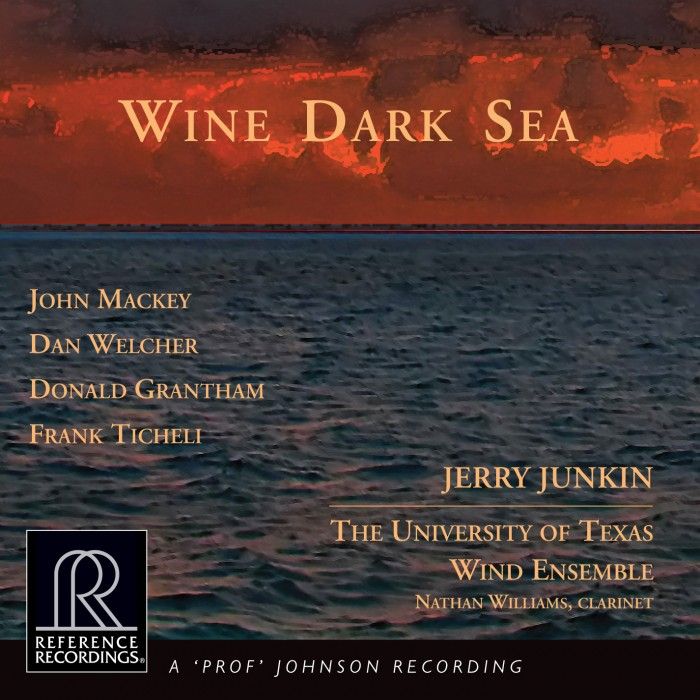
Wine Dark Sea music album is intended for listeners interested in contemporary works for wind orchestra. Its eight-track programme features music by Dan Welcher, Donald Grantham, Frank Ticheli and John Mackey. Nathan Williams performs the solo clarinet part in the three-movement concerto, and John Mackey’s three-movement symphony for wind orchestra concludes the programme.
Wine Dark Sea music album is an eight-track programme of contemporary music for wind orchestra. It is intended for listeners seeking substantial orchestral works alongside a clarinet concerto. The programme features compositions by Dan Welcher, Donald Grantham, Frank Ticheli and John Mackey.
The album presents three distinct layers of repertoire. The first two works stand alone, followed by a three-movement clarinet concerto and a three-movement symphony for wind orchestra.
Programme Structure
The recording opens with Dan Welcher’s “Spumante”, followed by Donald Grantham’s “J’ai été au bal”. These two independent works form the introductory part of the programme before the larger multi-movement compositions begin.
Tracks three, four and five comprise Frank Ticheli’s “Concerto for Clarinet”. The solo clarinet part is performed by Nathan Williams, the only performer identified in the available description.
The remainder of the programme is devoted to John Mackey’s “Wine Dark Sea: Symphony for Band”. Its three movements appear as tracks six, seven and eight. The album title is taken directly from this concluding symphony.
Clarinet Concerto
Frank Ticheli’s concerto consists of “Rhapsody for George”, “Song for Aaron” and “Riffs for Lenny”. Each movement is recorded as a separate track, allowing listeners to hear the complete cycle or select an individual movement.
This part of the programme is especially relevant to anyone looking for a work for solo clarinet and wind orchestra. Nathan Williams is clearly credited as the soloist. No other performers, conductor or orchestra are named.
Symphony for Wind Orchestra
John Mackey’s symphony begins with “Hubris”. It continues with “Immortal Thread, so weak” and concludes with “The attentions of souls”. This order keeps the complete three-movement work together at the end of the album.
The symphony makes the album suitable for listeners choosing a recording primarily by repertoire rather than by featured soloist. Here, the focus moves from the clarinet concerto to a large-scale symphonic form for wind orchestra. Together, the concerto and symphony occupy six of the album’s eight tracks.
Track Listing
- Dan Welcher – “Spumante”
- Donald Grantham – “J’ai été au bal”
- Frank Ticheli – “Rhapsody for George”
- Frank Ticheli – “Song for Aaron”
- Frank Ticheli – “Riffs for Lenny”
- John Mackey – “Hubris”
- John Mackey – “Immortal Thread, so weak”
- John Mackey – “The attentions of souls”
Preparing to Listen
Before purchasing, check the medium and edition of the specific copy being offered. The available information does not establish whether this is a CD, vinyl record, digital file or another format. The selected version must be suitable for your player or playback service, and the album title alone is not enough to determine compatibility.
The recording itself has no separately specified connectors or controls. Connection requirements therefore depend on the chosen medium, source device and existing audio system. With a stereo system, connect the source to the amplifier through an analogue or digital connection supported by both devices. For a home cinema system, choose an input compatible with the particular player. In a multi-zone or multi-device setup, first confirm that the system can access and play the selected type of media.
Playback Settings and Room Placement
For an initial listen, use a standard stereo mode, turn off track shuffling and begin at a moderate volume. If tone controls or an equaliser are in use, start from neutral settings and make adjustments only after assessing the sound of your speakers and room. Play tracks three through five and tracks six through eight in sequence to preserve the intended order of both three-movement cycles.
The album itself requires no special position in the room, although the placement of the playback system will affect the listening experience. Position stereo speakers as symmetrically as possible in relation to the listening seat and keep them unobstructed. With a home cinema system, use the existing calibrated speaker arrangement. When listening in several rooms through a multi-device system, check synchronisation and consistent volume levels.
Use with Different Systems
On a stereo system, the programme can be heard as a complete album or explored one track at a time. A home cinema receiver may also form part of the playback system, but no specific audio format or channel count is stated. A surround-sound version should therefore not be assumed. In a multi-zone system, the album is suitable for continuous listening provided that the source supports the selected medium and preserves the chosen track order.
Who Is This Album For?
This release is suited to listeners interested in contemporary wind-orchestra music. It may also appeal to clarinettists, conductors and musicians studying repertoire. The concerto movements place the solo clarinet at the centre of attention, while the symphony adds a more substantial orchestral form to the programme.
Selection should be based on the listed works and the named soloist. The precise medium and edition are not identified. The recording year, record label, catalogue number and technical recording parameters are also not provided.
Technical Specifications
| Title | Wine Dark Sea |
|---|---|
| Product type | Music album or audio recording |
| Programme | Contemporary works for wind orchestra |
| Number of tracks | 8 |
| Composers | Dan Welcher, Donald Grantham, Frank Ticheli, John Mackey |
| Soloist | Nathan Williams, clarinet |
| Concerto | Frank Ticheli, “Concerto for Clarinet,” 3 movements |
| Symphonic work | John Mackey, “Wine Dark Sea: Symphony for Band,” 3 movements |
FAQ
What kind of music does the album contain?
The programme consists of contemporary works for wind orchestra. It combines two independent compositions, a clarinet concerto and a three-movement symphony.
Who performs the solo clarinet part?
Nathan Williams is named as the clarinet soloist in Frank Ticheli’s concerto. He is the only performer identified in the available description.
Is the clarinet concerto recorded as a single track?
No. Its three movements are presented separately as tracks three, four and five, so each movement can be selected individually.
Which work gives the album its title?
The title comes from John Mackey’s three-movement symphony for wind orchestra. This work occupies the final three tracks of the programme.
Is this a recording by a particular orchestra?
No orchestra or conductor is named. Buyers should choose it based on the repertoire, composers and Nathan Williams’s soloist credit.
Is the exact media format specified?
No. The precise physical or digital format and edition are not identified, and they cannot be determined from the album title alone.
Must the works be heard in the listed order?
Individual works can be selected by track. However, the movements of the concerto and symphony are best played in sequence to preserve the structure of each cycle.
![Patricia Barber Café Blue [Un-Mastered] jazz album](https://audiocentras.lt/wp-content/uploads/2026/09/patricia-barber-cafe-blue-un-mastered-1-300x300.jpg)