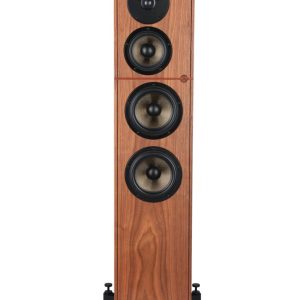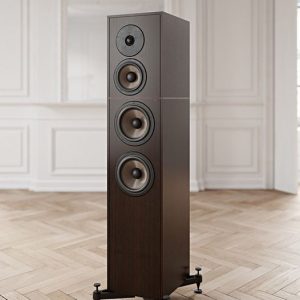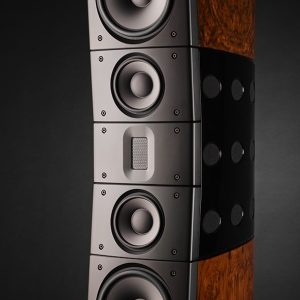


Sonus Faber SERAFINO TRADITION Floorstanding Speaker
22 000,00 €
Sonus Faber SERAFINO TRADITION is a 3.5-way floorstanding loudspeaker for a home audio system with a separate amplifier. Two 180 mm woofers and the Stealth Ultraflex system extend its response down to 30 Hz. A 28 mm silk dome with Arrow Point DAD technology handles the high frequencies. The nominal 4-ohm impedance and managed low-frequency load help guide suitable amplifier selection.
Sonus Faber SERAFINO TRADITION is a 3.5-way floorstanding loudspeaker for home audio systems. Its frequency response extends from 30 Hz to 35,000 Hz. The system combines a silk-dome tweeter, a 150 mm midrange driver and two 180 mm woofers.
Cabinet and Driver Design
The stated frequency response includes the operation of the Stealth reflex system. The staggered low-frequency section helps coordinate the two woofers with the crossover. Zero Vibration Transmission technology decouples the cabinet from the floor and limits the transfer of mechanical energy.
The H28 XTR-04 is a 28 mm silk-dome tweeter featuring an Arrow Point DAD design and a rear acoustic labyrinth chamber made from natural wood. This chamber is an integral part of the tweeter system rather than a separate accessory.
The 150 mm M15 XTR-04 midrange driver uses a neodymium magnet system and is designed for exceptional dynamic linearity. Two 180 mm W18XTR-08 woofers use lightweight multilayer cones. Each cone has a syntactic foam core between two outer layers of cellulose pulp.
Amplifier Selection and Connection
This is a passive loudspeaker and requires an external amplifier. Its nominal impedance is 4 ohms, while sensitivity is rated at 90 dB SPL, measured with a 2.83 V input at a distance of one metre.
The suggested amplifier power is 80-350 W, provided that the amplifier signal is not clipping. This range should therefore not be treated as an unconditional power-handling limit. A lower-powered amplifier driven into clipping is not necessarily safer simply because its rated output is lower.
Low-frequency impedance is managed to provide a more amplifier-friendly load. You should still choose an amplifier designed to drive 4-ohm loudspeakers. Match the speaker-cable type and terminations to the connections provided by the specific amplifier and loudspeaker terminals.
Crossover and Room Setup
The non-resonant crossover is optimised for amplitude and phase response. It uses a Paracross topology, Mundorf EVO Oil and Mundorf Silver/Gold/Oil capacitors, together with Jantzen inductors.
A double-staggered transfer-function filter manages low-frequency interaction with the room. The crossover frequencies are 80 Hz, 250 Hz and 2.5 kHz. These values do not require user adjustment because they are fixed within the internal passive circuit.
Placement
Place the loudspeaker on a level, solid floor and leave space around the cabinet. Begin with both speakers positioned symmetrically in relation to the listening position. Adjust their distance from the walls in small steps while listening for even bass response.
Moving the speakers closer to a wall may reinforce the bass because of room interaction. Moving them farther away can reduce this effect. Choose the final position by assessing both stereo speakers from the normal listening seat. The floor-decoupling design does not remove the need for stable placement.
Technical Specifications
| System type | 3.5-way floorstanding loudspeaker |
|---|---|
| Enclosure | Full-volume para-aperiodic vented box with Stealth Ultraflex system |
| Floor decoupling | Zero Vibration Transmission technology |
| Low-frequency configuration | Staggered |
| Tweeter | H28 XTR-04, 28 mm silk dome, Arrow Point DAD |
| Tweeter chamber | Rear acoustic labyrinth chamber made from natural wood |
| Midrange driver | M15 XTR-04, 150 mm, neodymium magnet system |
| Woofers | 2 × W18XTR-08, 180 mm each |
| Woofer cones | Syntactic foam core with two outer layers of cellulose pulp |
| Crossover | Non-resonant, optimised for amplitude and phase response |
| Crossover topology | Paracross, double-staggered transfer function |
| Crossover components | Mundorf EVO Oil and Mundorf Silver/Gold/Oil capacitors, Jantzen inductors |
| Crossover frequencies | 80 Hz, 250 Hz and 2.5 kHz |
| Frequency response | 30 Hz-35,000 Hz, including the Stealth reflex system |
| Sensitivity | 90 dB SPL, measured at 2.83 V / 1 m |
| Nominal impedance | 4 ohms |
| Suggested amplifier power | 80-350 W when the amplifier signal is not clipping |
| Long-term maximum input voltage | 22 V RMS according to IEC 268-5 |
FAQ
What type of system is this loudspeaker designed for?
It is intended for a passive home audio system with a separate amplifier. Its 3.5-way configuration includes tweeter, midrange and dual-woofer sections.
What amplifier should I choose?
Choose an amplifier suitable for a 4-ohm load. The stated 80-350 W range applies only when the amplifier signal is not clipping. Adequate power reserve helps prevent amplifier overload at higher listening levels.
Do the crossover frequencies need to be set on the amplifier?
No. The 80 Hz, 250 Hz and 2.5 kHz crossover points are fixed within the internal passive crossover. They are not user-adjustable controls.
How should I begin positioning the speakers?
Start by placing both speakers symmetrically and at equal distances from the listening position. Then adjust their distance from the walls in small increments, assessing bass evenness from your usual seat.
What does the 22 V RMS figure mean?
It is the long-term maximum input voltage determined according to IEC 268-5. It does not replace the amplifier power recommendation and does not describe short-term peaks in a music signal.