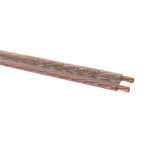
Oehlbach Speaker Wire 7 Speaker Cable
1,35 €
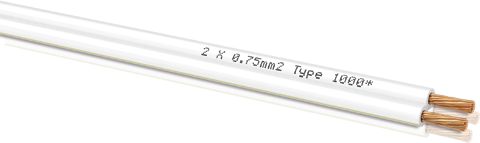
Oehlbach Speaker Wire 7 is a stereo speaker cable for connecting an amplifier to passive speakers. Its 2 × 0.75 mm² construction places both conductors inside one flat cable. Numerous thin wires twisted into bundles provide flexibility and make routing easier. The cable is intended for amplifiers rated up to approximately 70 W per channel and is sold in 1.00 m units.
Oehlbach Speaker Wire 7 is a flat stereo speaker cable designed to connect an amplifier to passive speakers. Its conductor cross-section is 2 × 0.75 mm². The recommended amplifier power is up to approximately 70 W per channel.
Each cable contains two conductors, so one cable run is sufficient for one speaker. The cable is sold in 1.00 m units, allowing you to select the length required for each side of the system.
What this cable is designed for
This model is intended for a wired stereo system. It connects the corresponding amplifier and speaker terminals.
The stated power limit applies to each individual amplifier channel. It is an approximate recommendation, so the cable should be selected with the power of the specific system in mind. This figure is not the combined power of two stereo channels.
The cable can also be used in a multichannel system.
Flat construction and flexibility
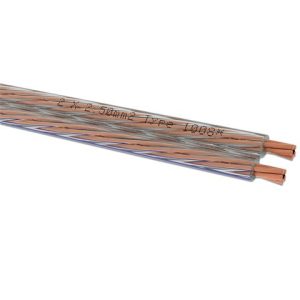
The flat geometry makes it easier to route the cable along skirting boards or behind furniture. Its cross-section is not round. The external dimensions are 4.5 × 2.5 mm.
The outer sheath is made from a durable and flexible plastic compound. This helps the cable follow the chosen route more conveniently. Its flexibility is particularly useful around bends and in areas where installation space is limited.
Inside the cable are many exceptionally thin individual wires, twisted together into separate bundles. This stranded construction helps the cable remain flexible while it is being routed.
During installation, avoid sharply folding or kinking the cable at a single point. It is better to form bends gradually so that the flat profile remains neat and consistent throughout the run.
Choosing the length and colour
The cable is supplied in 1.00 m units. Plan a separate run for every passive speaker. Measure the actual route from the amplifier channel assigned to that speaker rather than measuring only the straight-line distance. Allow a small amount of extra cable for making the connections and for moving the equipment when necessary.
A stereo system will usually require two separate runs, while the number required for a multichannel system depends on how many passive speakers are being connected. Rear-channel routes are often longer, so calculate the total quantity only after measuring every run. Using similar lengths for the two stereo speakers also helps create a consistent and tidy installation.
Three colour variants are available. 1000 denotes the white cable, 1002 the transparent cable, and 1004 the black cable. The colour can be matched to the skirting boards, furniture, or any visible section of the cable route.
Connection and polarity
Every cable run contains two conductors. One is connected to the positive terminal and the other to the negative terminal. Keep the same conductor arrangement at both ends of the cable.
Correct polarity is particularly important for a stereo pair. If the conductors are reversed on one speaker, the two speakers may operate out of phase. This can weaken the stability of the central stereo image and reduce the coherence of low-frequency sound.
Before securing the final cable route, label both ends of every run. Clear labels make it easier to identify the left and right channels. They also reduce the likelihood of a polarity error during connection.
Planning the system
The flat profile is useful in locations where there is insufficient room for a round cable. However, the cable must not be pinched beneath or against furniture edges. Plan a route that allows the sheath to retain its natural shape.
Technical specifications
| Model | Oehlbach Speaker Wire 7 |
|---|---|
| Product type | Two-conductor stereo speaker cable |
| Recommended amplifier power | Up to approximately 70 W per amplifier channel |
| Conductor cross-section | 2 × 0.75 mm² |
| Conductor construction | Many exceptionally thin wires twisted into bundles |
| Cable geometry | Flat |
| Cable dimensions | 4.5 × 2.5 mm |
| Sheath material | Durable and flexible plastic compound |
| Supply unit | 1.00 m |
| Colour variants | 1000 – white; 1002 – transparent; 1004 – black |
| Place of manufacture | Europe |
FAQ
How much cable do I need for a stereo system?
Measure the route from the amplifier to each speaker. Add the lengths of both runs together and include a small allowance for making the connections. The cable is sold in one-metre units.
Is one cable run enough for two speakers?
No. The two conductors inside one cable are used to connect a single speaker. A stereo pair requires two separate cable runs.
How do I choose the right colour?
The white version is identified by number 1000, the transparent version by 1002, and the black version by 1004. Choose the variant that best suits the visible cable route and the colours of the surrounding interior.
Is this cable suitable for a home cinema system?
It can be used for individual passive-speaker connections. Each amplifier channel and speaker being used requires its own separate cable run.
How do I maintain the correct polarity?
Assign one conductor to the positive terminal and the other to the negative terminal. Use the same arrangement at both ends. Label the ends before connecting the cable.
What does the 70 W power reference mean?
It is an approximate amplifier power recommendation for each channel. It should not be interpreted as the total power of the complete stereo system.
What is the practical benefit of the flat cable shape?
It makes routing easier in narrower spaces, along skirting boards, or behind furniture. The cable should still not be tightly compressed or sharply folded.
How should I plan the cable for several speakers?
Measure the route to every speaker separately. Label the channels at both ends, then calculate the total amount of cable required.
Related products and categories
Related products