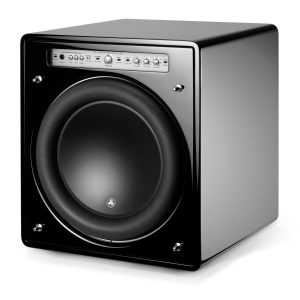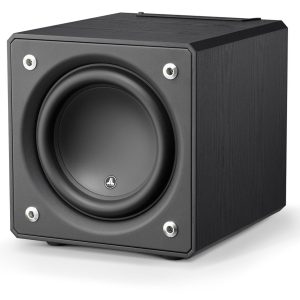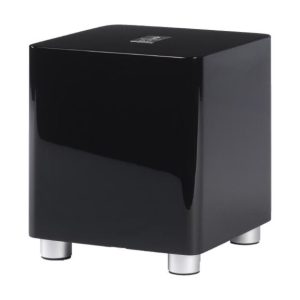
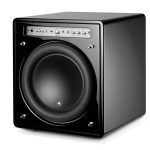
JL Audio Gotham g213v2-GLOSS Powered Subwoofer
15 000,00 €
JL Audio Gotham g213v2-GLOSS is a powered subwoofer for reproducing the lowest frequencies in stereo and home cinema systems. Its sealed enclosure and 4500 W RMS short-term power support deep bass reproduction. RCA and balanced XLR inputs let you choose a connection that matches the source. D.A.R.O. calibration, using the included microphone, helps adapt reproduction to the selected room and placement.
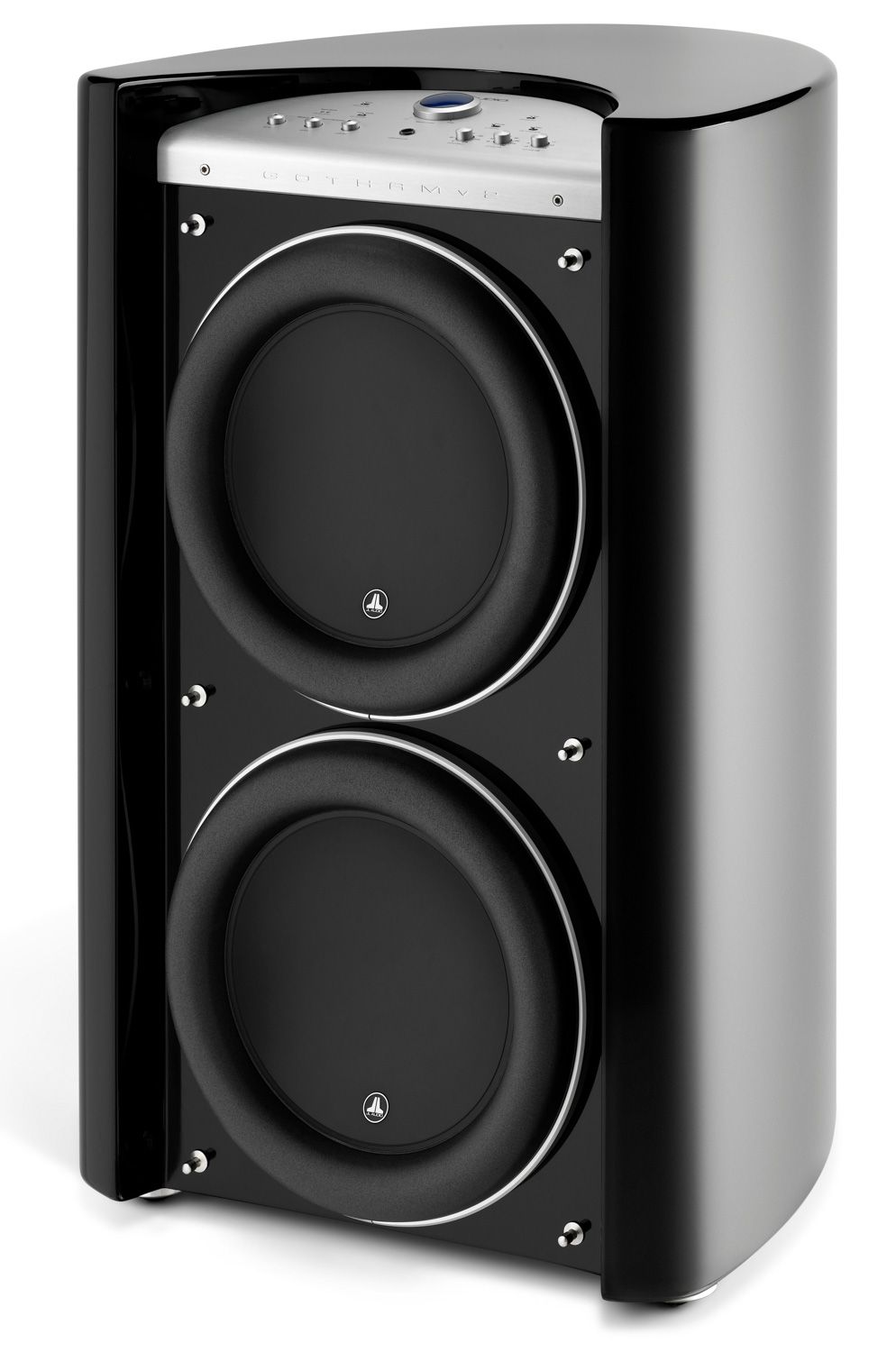
JL Audio Gotham g213v2-GLOSS is a powered subwoofer designed to reproduce the lowest frequencies in stereo and home cinema systems. Its sealed enclosure, 4500 W RMS short-term power, and D.A.R.O. calibration support deep bass reproduction and room-specific adjustment.
It accepts mono or stereo signals through RCA and balanced XLR connections. The subwoofer can be connected to a preamplifier, processor, or AV receiver that provides a line-level signal.
Sealed enclosure and placement
The sealed enclosure features non-parallel walls and a gloss-black finish. Because there is no bass-reflex port, you do not need to leave clearance for airflow from a port opening.
Placing the subwoofer near a wall or in a room corner can reinforce the lowest frequencies. Assess the final position from the main listening seat.
RCA, XLR, and multiple-subwoofer connections
Two RCA inputs accept an unbalanced stereo or mono signal. Two female XLR inputs accept a balanced stereo or mono signal. Choose the connection that matches the line-level output available on your source equipment.
There are no speaker-level inputs, so this model cannot be connected to an amplifier’s speaker terminals. Conventional line-level outputs are not provided either.
One male balanced XLR output passes the signal to a slave unit. Dedicated master and slave modes define the roles of the connected units. Input grounding can be set to isolated or grounded. If a ground-loop hum occurs, compare both settings.
Sound and operating controls
The level control can operate at fixed reference gain or in variable mode. Variable mode ranges from complete attenuation to 15 dB above reference gain. The fixed setting is useful when volume is controlled by an external processor.
The low-pass filter is adjustable from 30 to 130 Hz, with a choice of 12 or 24 dB-per-octave slopes. When crossover duties are handled by an AV receiver or processor, the internal filter can be switched off.
Polarity can be switched between 0 and 180 degrees. Phase is continuously adjustable from 0 to 270 degrees. Compare the settings at the listening position and select the combination that produces the smoothest transition to the main speakers.
E.L.F. trim at 20 Hz is adjustable from -12 to +3 dB. Use higher boost settings only after considering the room’s influence. The D.A.R.O. system helps adapt reproduction to the room, and a laboratory-grade calibration microphone is included.
Power can be switched off, left permanently on, or controlled by automatic signal sensing. Illumination can be off, on, or dimmed.
Understanding the frequency range
The stated anechoic frequency response is 19-112 Hz with a ±1.5 dB tolerance. Room walls, corners, and the listening position can change the final in-room result.
The -3 dB limits are 17.5 and 120 Hz, while the -10 dB limits are 14 and 150 Hz. Effective piston area is 0.1386 m², and effective displacement is 12.7 litres.
The 4500 W figure describes short-term RMS power. It should not be interpreted as a continuous power specification.
Technical specifications
| Type | Powered subwoofer |
|---|---|
| Enclosure type | Sealed, with non-parallel walls |
| Finish | Gloss black |
| Frequency response | 19-112 Hz, ±1.5 dB, measured in an anechoic environment |
| -3 dB limits | 17.5 Hz and 120 Hz |
| -10 dB limits | 14 Hz and 150 Hz |
| Effective piston area | 214.70 sq. in. / 0.1386 m² |
| Effective displacement | 773 cu. in. / 12.7 l |
| Amplifier power | 4500 W RMS, short-term |
| Power modes | Off, on, or automatic signal sensing |
| Illumination modes | Off, on, or dimmed |
| Unbalanced inputs | Stereo or mono, two RCA sockets |
| Balanced inputs | Stereo or mono, two female XLR sockets |
| Speaker-level inputs | None |
| Input grounding | Isolated or grounded |
| Input modes | Master or slave |
| Level control | Fixed reference or variable, from complete attenuation to +15 dB |
| Filter type | Low-pass filter |
| Filter slope | 12 or 24 dB per octave |
| Filter frequency range | 30-130 Hz |
| Filter bypass | Yes |
| Polarity | 0 or 180 degrees |
| Phase | Continuously adjustable from 0 to 270 degrees |
| E.L.F. trim | -12 to +3 dB at 20 Hz |
| Line-level outputs | None |
| Slave-unit output | One male balanced XLR socket |
| Calibration | D.A.R.O. Digital Automatic Room Optimization |
| Calibration microphone | Laboratory-grade, included |
| Dimensions | 546 mm wide, 867 mm high |
FAQ
Can the subwoofer be connected to an amplifier’s speaker outputs?
No. It has no speaker-level inputs. An RCA or XLR line-level output from an amplifier, preamplifier, or processor is required.
When should I use RCA, and when should I use XLR?
Choose the connection that matches your source’s output. XLR carries a balanced signal, while RCA carries an unbalanced signal. Both input types accept mono and stereo signals.
When should the internal filter be switched off?
Switch it off when crossover duties are already being handled by an AV receiver or audio processor. Otherwise, begin with a setting that corresponds to the lower-frequency limit of the main speakers.
How should polarity and phase be adjusted?
First compare both polarity settings from the main listening position. Then use the phase control to find the smoothest transition between the main speakers and the subwoofer.
When should D.A.R.O. calibration be performed?
Run the calibration after choosing the final subwoofer and listening positions. If the subwoofer is moved or the room layout changes, it is worth running the calibration again.
Can the signal be passed to a second unit?
Yes. The male balanced XLR output is intended for a slave unit, while the master and slave modes define each unit’s role in the system.