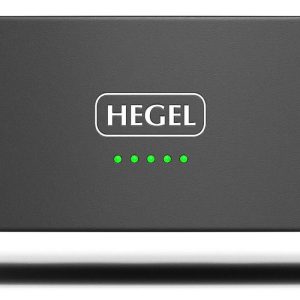

Hegel P30A Preamplifier
8 000,00 €
The Hegel P30A preamplifier is an analogue stereo control unit for a high-end system with a separate power amplifier. Its fully balanced construction provides separate amplification and volume-control circuits for each channel. Two XLR and three RCA inputs accommodate several analogue sources, while three simultaneously active outputs simplify connection to multiple power amplifiers. SoundEngine2 monitors the signal and corrects intermodulation distortion during amplification.
The Hegel P30A preamplifier is an analogue stereo control centre for a high-end separates system. It selects sources, controls volume and passes the audio signal to a separate power amplifier. Its XLR and RCA connections provide flexibility when assembling an analogue audio system.
Hegel presents the P30A as its reference preamplifier.
Signal path and construction
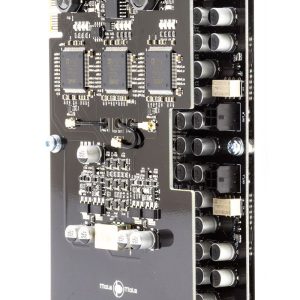
The audio signal passes through two transistors and an ultra-low-noise volume attenuator. The internal layout is designed to keep signal paths as short as possible. A single pair of FET transistors is used, with the individual transistors measured separately and matched to identical values.
SoundEngine2 operates as a feed-forward correction system. It monitors the music signal and corrects intermodulation distortion during amplification.
The construction is fully balanced. Each channel has two separate amplifiers, volume controls and SoundEngine2 modules. This means that the signals for the two channels are processed through separate circuits.
Connecting sources
Two balanced XLR inputs accommodate sources equipped with corresponding outputs. Three unbalanced RCA inputs allow conventional analogue sources to be connected. Choose each connection according to the source output and the cable being used.
The home theatre input operates at a fixed level by default. In this mode, system volume is controlled by the home theatre processor. The input can also be configured for normal operation, allowing the P30A to control the volume.
Output options
One balanced XLR output and two unbalanced variable-level RCA outputs can operate simultaneously. This allows the signal to be sent to several power amplifiers or other connected equipment.
One RCA output can instead be configured for fixed-level operation. It is suitable for equipment that requires a signal independent of the main volume control.
Operation and system setup
The remote control operates volume, source selection and mute. Before listening for the first time, select the required input and set the volume to a low level. Increase it only after all system components have been switched on.
A 3.5 mm direct IR input is provided for an external infrared control system. A 3.5 mm 12 V trigger output can send a power-on signal to a compatible power amplifier.
Placement on an equipment rack
Choose a sufficiently spacious shelf for the enclosure, which is 43 cm wide and 30 cm deep. Place the 7.2 kg unit on a firm, level surface. Leave room behind it for the XLR, RCA and control connections.
Technical specifications
| Model | Hegel P30A |
|---|---|
| Type | High-end analogue stereo preamplifier |
| Position in range | Hegel reference preamplifier |
| FET stage | One pair of FET transistors, individually measured and matched to identical values |
| Signal path | Two transistors and an ultra-low-noise volume attenuator |
| Internal layout | Short signal paths |
| Technology | Hegel SoundEngine2 with feed-forward correction of intermodulation distortion |
| Construction | Fully balanced |
| Channel circuits | Two separate amplifiers, volume controls and SoundEngine2 modules per channel |
| Balanced inputs | 2 × XLR |
| Unbalanced inputs | 3 × RCA |
| Home theatre input | Fixed level; configurable for operation as a normal input |
| Balanced output | 1 × XLR, variable level |
| Unbalanced outputs | 2 × RCA, variable level; all three outputs can operate simultaneously |
| Fixed-level output | One RCA output can be configured accordingly |
| Other connections | 3.5 mm direct IR input and 3.5 mm 12 V trigger output |
| Remote control | Volume, source selection and mute |
| Signal-to-noise ratio | Greater than 130 dB in balanced mode |
| Channel separation | Less than -100 dB |
| Distortion | Less than 0.005% |
| Intermodulation distortion | Less than 0.01% in a 19 kHz and 20 kHz test |
| Finish | Black |
| Dimensions | 9.6 × 43 × 30 cm (H × W × D) |
| Dimensions in US units | 3.8 × 17 × 12 inches (H × W × D) |
| Weight | 7.2 kg |
| Weight in US units | 15.9 lb |
FAQ
Is this a power amplifier?
No. This unit selects the source, controls volume and passes the signal onward. A separate power amplifier is required to drive the speakers.
When should I use balanced or unbalanced connections?
Choose the input and output connections separately according to the sockets available on the connected equipment. For example, a source can be connected through an XLR input while the power amplifier is connected through an RCA output.
How is the home theatre input used?
In fixed-level mode, volume is controlled by the home theatre processor. When the connection is configured as a normal input, volume is adjusted through the preamplifier.
Can I connect more than one power amplifier?
Yes. All three variable-level outputs can operate at the same time, with both XLR and RCA connection options available.
Will the P30A fit on my equipment rack?
The P30A measures 9.6 × 43 × 30 cm (H × W × D) and weighs 7.2 kg. Remember to leave additional room behind it for the rear connections and cables.
Related products