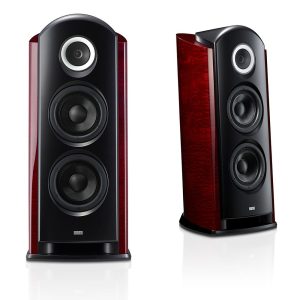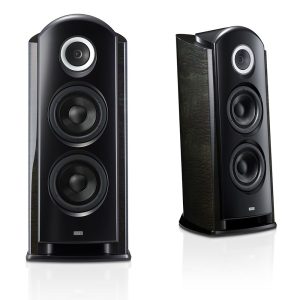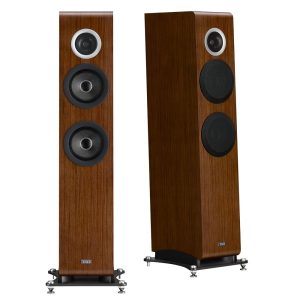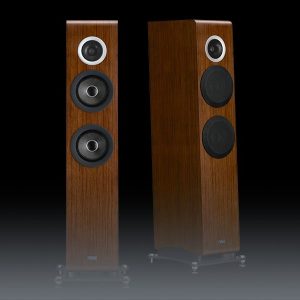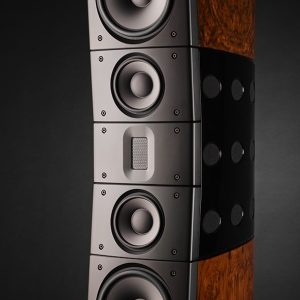


Bowers & Wilkins 703 S2 Floorstanding Speaker
3 500,00 €
Bowers & Wilkins 703 S2 is a three-way floorstanding speaker designed for a two-channel home audio system with a separate amplifier. Dedicated treble, midrange and bass drivers divide the reproduced frequency range according to their roles. Nominal impedance is 8 ohms and falls to a minimum of 3.1 ohms, making amplifier stability important. Recommended amplifier power is 30-200 W into 8 ohms.
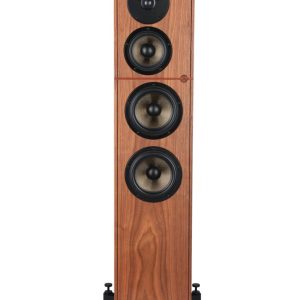
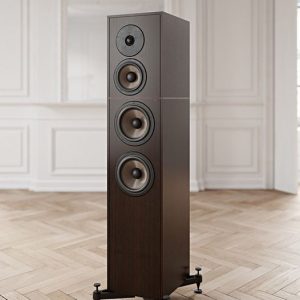
Bowers & Wilkins 703 S2 is a three-way floorstanding speaker designed for a two-channel home audio system with a separate amplifier. It uses one 25 mm tweeter, one 150 mm midrange driver and two 165 mm bass drivers. This configuration assigns separate parts of the frequency range to specialised drivers.
Three-way design
The 25 mm Carbon Dome tweeter has a decoupled design. The 150 mm Continuum cone FST midrange driver is also decoupled. This driver handles the midrange, which contains a substantial part of the information in vocals and many instruments.
Low frequencies are reproduced by two 165 mm Aerofoil Profile drivers. The cabinet uses Flowport port technology. As a 990 mm-tall floorstanding design, the speaker does not require a separate speaker stand.
Amplifier selection and connection
The recommended amplifier power is 30-200 W into 8 ohms with unclipped programme material. This condition is important when considering power ratings: the figure does not mean that a distorted signal is safe to use. Overloading and clipping can occur even with an amplifier that has a lower nominal power rating.
The nominal impedance is 8 ohms, but the minimum impedance falls to 3.1 ohms. The amplifier must therefore remain stable when driving a lower-impedance load. When choosing an amplifier, consider not only its stated power output but also its ability to deliver current.
Placement and initial setup
The dimensions of one speaker are listed as 200 × 990 × 300 mm, while the stated net weight is 25.00 kg. Choose a level, stable position. Because of the speaker’s size and weight, it is sensible to plan its final location before moving it into place.
Begin by positioning both speakers at the same distance from the listening position. Then adjust their distance from the rear and side walls in small steps. Moving the speakers closer to walls will generally strengthen the bass, although it may also make the low-frequency response less even.
Do not place anything against the cabinet in a way that blocks the Flowport opening. Angle the speakers towards the listening position and compare several orientations. Choose the final placement by listening for a well-centred vocal image, suitable stereo width and even bass response.
Purchase quantity
The minimum order quantity is two units. This provides the left and right speakers required for a conventional stereo pair. The stated net weight of 25.00 kg is not clearly identified as applying to one speaker or to the pair.
Technical specifications
| Type | Three-way floorstanding speaker |
|---|---|
| Tweeter | 1 × 25 mm, decoupled Carbon Dome |
| Midrange driver | 1 × 150 mm, decoupled Continuum cone FST |
| Bass drivers | 2 × 165 mm, Aerofoil Profile |
| Port technology | Flowport |
| Frequency range | 30 Hz-33 kHz at -6 dB |
| Frequency response | 46 Hz-28 kHz, ±3 dB |
| Sensitivity | 89 dB SPL at 2.83 V RMS and 1 m |
| Harmonic distortion | Second and third harmonics at 90 dB and 1 m: less than 1% from 90 Hz to 22 kHz; less than 0.5% from 120 Hz to 20 kHz |
| Nominal impedance | 8 ohms |
| Minimum impedance | 3.1 ohms |
| Recommended amplifier power | 30-200 W into 8 ohms with unclipped programme material |
| Dimensions | 200 × 990 × 300 mm |
| Net weight | 25.00 kg |
| Minimum order quantity | 2 units |
FAQ
What kind of amplifier do these speakers need?
Choose an amplifier that can remain stable into a lower-impedance load. The power recommendation applies to an 8-ohm load and an unclipped signal. Begin listening at a low volume.
How should I begin adjusting the speaker placement?
Place the speakers symmetrically in relation to the listening position. Then change their distance from the walls and their toe-in angle in small steps. Listen to the same recording after every adjustment so that the effect is easier to compare.
What do the two stated frequency figures mean?
The 46 Hz-28 kHz figure is specified with a ±3 dB tolerance. The wider 30 Hz-33 kHz range indicates the -6 dB limits. These figures should therefore not be compared directly without considering their measurement conditions.
Can I order just one unit?
No. The minimum order quantity is two units, which are required to form a conventional left- and right-channel pair.
Do these speakers need separate stands?
No. These are 990 mm-tall floorstanding speakers. They require a stable floor surface and enough space around the cabinet to keep the Flowport opening unobstructed.