Audio System AD A1 RCA Cable
10,00 €
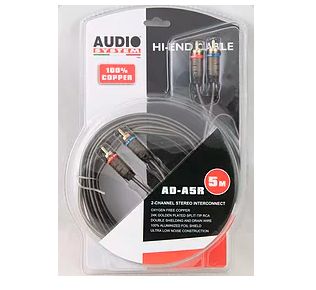
Audio System AD A1 is a one-metre RCA cable for carrying an analogue signal in a car audio system. It is intended for a short stereo connection between components equipped with RCA sockets. The conductor is made from 100% oxygen-free copper, while triple shielding helps reduce the effect of surrounding electrical circuits on the signal. Before choosing the cable, measure the complete route, including bends and the slack required beside the connectors.
Audio System AD A1 is a one-metre stereo RCA interconnect cable for car audio systems. It carries an analogue audio signal between components equipped with RCA connections. The conductor is made from 100% oxygen-free copper. Triple shielding separates the signal conductors from surrounding sources of interference.
Purpose within an audio system
This cable is designed to carry a line-level signal, so it is not a substitute for speaker cable or power cable. Choose it for a section of the system where RCA connections are used at both ends.
Its stereo configuration carries the left- and right-channel signals between parts of the audio system. The cable does not convert the signal or create additional outputs.
Choosing a one-metre cable
The one-metre length is intended for a short route between components installed close to each other. Before buying, measure the entire planned cable route rather than only the straight-line distance between the devices.
Allow for bends, trim edges and a small amount of slack beside both connected devices. This lets you connect the cable without pulling it tight or placing unnecessary strain on the RCA sockets.
If the planned route is longer, choose a single cable of the appropriate length. Adding extra connections increases the number of contact points and makes a neat installation more difficult.
Copper conductor and shielding
The conductor is made from 100% oxygen-free copper (OFC). This specification describes the material throughout the conductor, rather than a core of another metal that has only been coated with copper.
Triple shielding is designed to reduce the effect that nearby electrical circuits can have on a low-level analogue signal. This is particularly relevant in a vehicle, where power and signal cables often have to share a limited installation space.
Shielding does not replace careful route planning. Wherever practical, keep the signal cable away from the vehicle’s power cables and other potential sources of interference.
Connection and cable routing
Switch off the audio system before making the connection. Insert each RCA connector straight into its socket and avoid bending the cable immediately beside the connector housing.
Leaving a short, loose loop reduces mechanical strain on both the cable and the equipment socket. Secure the route so that the cable cannot be crushed by trim panels or damaged by moving parts.
Do not run signal and power cables parallel to each other over a long distance. If the routes have to cross, arrange the crossing at as close to a right angle as possible. This layout helps reduce the risk of unwanted hum.
Matching the cable to your equipment
In a car stereo system, this cable forms one section of the analogue signal path. It can connect only those points in the signal chain that are fitted with RCA sockets.
If one end of the required connection uses a different connector type, this model cannot make that connection on its own. It also does not convert a high-level speaker signal into a line-level signal.
The same RCA connection principles apply in a home stereo or home cinema system. The cable can carry only an analogue signal, and the one-metre route must be long enough to reach both devices without being stretched.
Checking the system after connection
When switching the system back on, begin at a low listening volume. Check that both stereo channels are playing and that there is no continuous hum.
If one channel is silent, switch off the power and check that the connectors are fully inserted. If you hear hum, first separate the signal cable route from nearby power cables.
An RCA cable does not control volume, frequency settings or channel configuration. These parameters are adjusted using the connected audio equipment.
Technical specifications
| Model | AD-A1 |
|---|---|
| Type | Stereo RCA interconnect cable |
| Application | Analogue signal connection for a car audio system |
| Length | 1 m |
| Conductor material | Oxygen-free copper (OFC) |
| Copper composition | 100% copper |
| Shielding | Triple shielding |
FAQ
Can this cable connect a car stereo to an amplifier?
Yes, provided that the stereo’s line-level output and the amplifier’s input both use RCA connections. The planned route must reach both devices without placing the cable under tension.
Can it be used to connect speakers directly?
No. This is an RCA cable for an analogue line-level signal, not a speaker cable. Speakers require connections suitable for their outputs and load.
Does triple shielding eliminate hum completely?
Shielding helps reduce the effect of nearby electrical circuits. However, hum can also be caused by connection points, grounding or incorrectly routed power cables.
What do the 100% copper and OFC specifications mean?
These specifications describe the conductor material. The cable uses oxygen-free copper, and its conductor is not a core of another metal coated with copper.
Can the cable be used in a home stereo or home cinema system?
It can connect an analogue RCA signal path if the equipment connections match and the cable is long enough. It does not carry HDMI or optical signals.
What should I do if the cable is not long enough?
Choose a longer, single-piece RCA cable based on the measured route. Joining several short sections introduces more contact points and makes installation more complicated.
How should I check the connection after installation?
Begin at a low volume and listen to both channels. If you hear hum, check the connections and make sure the signal cable is routed away from power cables.