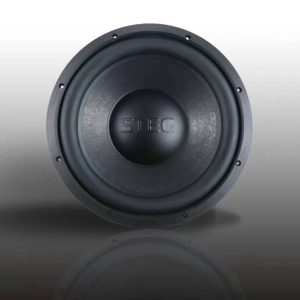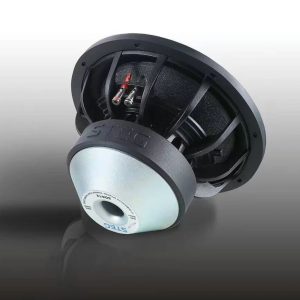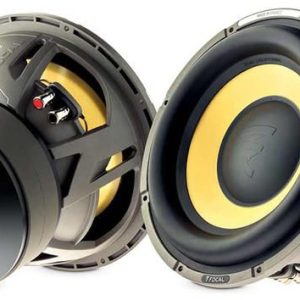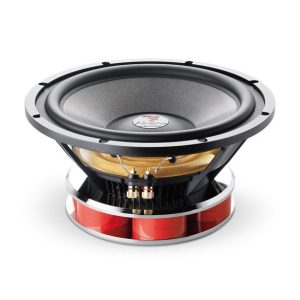

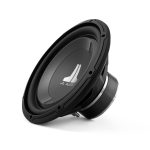

JL Audio 15W0V3-4 Subwoofer
400,00 €
The JL Audio 15W0V3-4 is a 15-inch subwoofer for an in-car audio system. It is recommended for use with a 150-500 W RMS amplifier capable of driving a 4 Ω load. Choose either a 53.10-litre sealed enclosure or a 77.88-litre bass-reflex enclosure. Both options require at least 13 mm of clearance behind the rear ventilation opening.
The JL Audio 15W0V3-4 subwoofer is a 15-inch driver designed for an in-car audio system. It handles 500 W RMS of continuous power and has a nominal impedance of 4 Ω. This is a standalone driver that requires a suitable amplifier and a purpose-designed enclosure.
Choosing an amplifier and crossover settings
The recommended amplifier power range is 150 to 500 W RMS. The amplifier must be capable of operating safely with a four-ohm load. Compare amplifiers using their RMS output rather than short-term or peak power ratings.
This subwoofer is best used in a separately amplified system, with a dedicated amplifier channel and an active crossover controlling the low-frequency signal. A passive crossover using a coil is not recommended because it may impair performance.
Choose an initial low-pass filter setting that complements the vehicle’s main speakers, then fine-tune it while listening from the driver’s seat. The aim is a smooth transition rather than bass that can be identified as coming from a separate source.
Sealed or bass-reflex enclosure
A sealed enclosure is smaller and does not require a bass-reflex port. The specified 53.10-litre capacity is the net internal volume. The volume displaced by the subwoofer and internal bracing must be added when calculating the gross enclosure volume.
The bass-reflex enclosure requires a net volume of 77.88 litres and a precisely calculated port. Its 25 Hz tuning frequency and 30 Hz F3 indicate a lower bass limit than the sealed design. Changing the port diameter or length would alter the tuning frequency.
The dimensions for both enclosures are calculated using 19 mm material. If 16 mm material is selected, subtract 6.5 mm from each external dimension. Material thinner than 16 mm should not be used, as the enclosure may lose rigidity.
Installation space and cooling
A central ventilation opening is located at the rear of the subwoofer. Leave at least 13 mm of clearance behind it so that airflow and voice-coil cooling are not restricted.
The cut-out diameter is 349 mm and the mounting depth is 182 mm. The overall diameter of 394 mm must also be considered before making the front baffle. The 160 mm motor diameter is important when positioning internal braces.
Installing multiple subwoofers in one shared enclosure requires fresh calculations for both enclosure volume and the bass-reflex port. The dimensions of a single-driver enclosure cannot simply be multiplied without accounting for partitions, openings, and bracing.
Safe installation in a vehicle
The enclosure must be securely attached to the vehicle’s metal floor or frame. Use large-diameter washers with bolted fixings. An unsecured enclosure can become a dangerous loose object in a collision.
Secure mounting is especially important in hatchbacks, estate cars, SUVs, and vans. Prolonged exposure to sound pressure levels above 100 dB can cause permanent hearing damage.
Technical specifications
| Model | JL Audio 15W0V3-4 |
|---|---|
| Type | Car subwoofer |
| Nominal diameter | 15 inches / 380 mm |
| Continuous power handling | 500 W RMS |
| Recommended amplifier power | 150-500 W RMS |
| Nominal impedance | 4 Ω |
| Overall diameter | 394 mm |
| Mounting cut-out diameter | 349 mm |
| Bolt-circle diameter | 370 mm |
| Motor outside diameter | 160 mm |
| Mounting depth | 182 mm |
| Driver displacement | 3.09 l |
| Net weight | 7.2 kg |
| Free-air resonance frequency (Fs) | 24.43 Hz |
| Electrical Q factor (Qes) | 0.508 |
| Mechanical Q factor (Qms) | 9.474 |
| Total Q factor (Qts) | 0.482 |
| Equivalent compliance volume (Vas) | 144.60 l |
| One-way linear excursion (Xmax) | 12.7 mm |
| Xmax measurement method | One-way voice-coil overhang with no correction factors applied |
| Reference efficiency | 0.18% |
| Sensitivity | 88.20 dB SPL at 1 W/1 m |
| Sensitivity rating note | This figure alone does not indicate the subwoofer’s output capability or relative loudness |
| Effective cone area (Sd) | 0.0789 m² |
| DC resistance (Re) | 3.555 Ω |
| Sealed enclosure net volume | 53.10 l |
| Sealed enclosure wall thickness | 19 mm |
| Sealed enclosure front-baffle thickness | 19 mm |
| Sealed enclosure external dimensions | 406 × 400 × 457 mm |
| Sealed enclosure F3 | 38 Hz |
| Sealed enclosure Fc | 47.14 Hz |
| Sealed enclosure Qtc | 0.9301 |
| Bass-reflex enclosure net volume | 77.88 l |
| Bass-reflex enclosure wall thickness | 19 mm |
| Bass-reflex enclosure front-baffle thickness | 19 mm |
| Bass-reflex enclosure external dimensions | 508 × 457 × 470 mm |
| Bass-reflex port internal diameter | 102 mm |
| Bass-reflex port length | 428 mm |
| Bass-reflex enclosure tuning frequency | 25 Hz |
| Bass-reflex enclosure F3 | 30 Hz |
FAQ
Which amplifier should I choose?
Check the amplifier’s RMS output specifically at a 4 Ω load. A power figure stated at a different impedance cannot be compared directly for this model.
Can the subwoofer be installed without an enclosure?
The supplied parameters are intended for a sealed or bass-reflex enclosure. Installation in an uncalculated cavity would not meet the specified enclosure conditions.
Which enclosure type should I choose?
The sealed option occupies less space. The bass-reflex option requires more volume, an accurately sized port, and additional installation space.
How do I calculate the final enclosure volume?
Add the volume displaced by the subwoofer, bracing, and bass-reflex port to the required net internal volume. The result is the necessary gross enclosure volume.
Why is clearance required behind the subwoofer?
The rear ventilation opening releases heat and pressure. Insufficient clearance would prevent it from working correctly.
Can I use a passive crossover with a coil?
This type of crossover is not recommended. The low-frequency signal is better controlled by an active crossover on a dedicated amplifier channel.