
Epos ES-28N Floorstanding Speakers
7 990,00 €
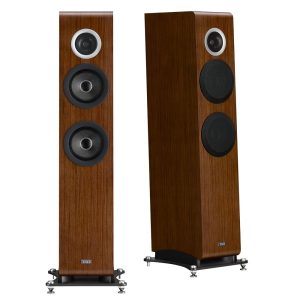
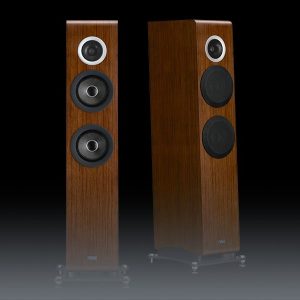
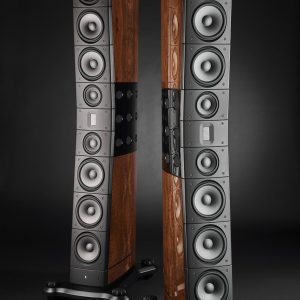
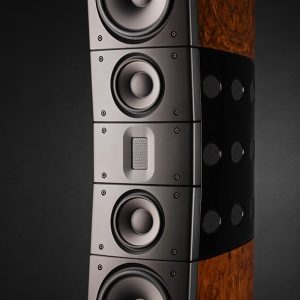
Epos ES-28N is a three-way floorstanding speaker designed for a home stereo system. Two 7-inch bass drivers and separate midrange and treble sections divide the work across three frequency regions. The bass-reflex cabinet features a low-noise port, damped multilayer panels and internal bracing. Terminals accepting 4 mm banana plugs allow connection with suitably terminated speaker cable.
Epos ES-28N is a three-way floorstanding speaker designed for a home stereo system. Two 7-inch bass drivers work alongside dedicated midrange and treble drivers, giving each part of the frequency range its own driver. The bass-reflex enclosure and low-noise port help the speaker make effective use of the lowest part of its range.
Three-way speaker system
The crossover points are set at 330 Hz and 2,700 Hz. These divide the operating ranges of the bass, midrange and treble drivers. The crossover uses second- and fourth-order Linkwitz-Riley filters.
The stated in-room frequency range begins below 30 Hz and extends to 25 kHz. Room size, proximity to walls and speaker positioning will affect the amount of bass heard at the listening position.
Driver construction
The bass section uses two 7-inch drivers. Each one has a 36 mm voice coil and a hybrid ferrite and neodymium magnet system. Their straight-profile cones are injection-moulded and filled with mica. Low-hysteresis rubber surrounds are used.
The 130 mm midrange driver has a 30 mm voice coil and a double ferrite magnet. Its polypropylene cone is also filled with mica and uses a low-hysteresis rubber surround.
The 28 mm tweeter has an aluminium and ceramic composite dome. Ferrofluid is not used in its construction.
Cabinet and placement
The cabinet is built with damped multilayer panels, directional bracing and a double-layer front baffle. These elements help stiffen the large floorstanding enclosure. The low-noise bass-reflex port is designed to reduce unwanted airflow noise.
The speaker measures 1,050 × 250 × 360 mm. Before installation, allow for the cabinet’s 360 mm depth and leave sufficient free space around the bass-reflex port.
The stated weight is 35 kg, although the source does not specify whether this figure applies to one speaker or a pair.
Connections and amplifier choice
Custom-made, low-metal-mass terminals accept 4 mm banana plugs.
Average impedance is greater than 6 ohms, while the minimum impedance is 3.9 ohms at 16 kHz.
The 86 dB sensitivity figure was measured with an input of 2.823 V at a distance of one metre. To reach higher listening levels, an amplifier will need more voltage headroom than it would with a more sensitive speaker.
Finish options
Four finishes are available: walnut, semi-matt white, semi-matt black and jade green. The 250 mm-wide front also makes it easier to judge in advance how much space each speaker will occupy beside an equipment rack or other furniture.
Technical specifications
| Type | Three-way bass-reflex floorstanding speaker |
|---|---|
| Frequency range | Below 30 Hz-25 kHz, in-room |
| Average impedance | Greater than 6 ohms |
| Minimum impedance | 3.9 ohms at 16 kHz |
| Sensitivity | 86 dB at 2.823 V and 1 m |
| Total harmonic distortion | Average below 0.2% at 86 dB, from 100 Hz to 10,000 Hz |
| Crossover points | 330 Hz and 2,700 Hz |
| Crossover filters | Second- and fourth-order Linkwitz-Riley |
| Bass drivers | 2 × 7-inch high-power drivers |
| Bass-driver voice coils | 36 mm diameter |
| Bass-driver magnets | Hybrid ferrite and neodymium system |
| Bass-driver cones | Injection-moulded, straight-profile cones with mica filling |
| Bass-driver surrounds | Low-hysteresis rubber |
| Midrange driver | 5.25 inches / 130 mm |
| Midrange voice coil | 30 mm diameter |
| Midrange magnet | Double ferrite magnet |
| Midrange cone | Mica-filled polypropylene |
| Midrange surround | Low-hysteresis rubber |
| Tweeter | 28 mm |
| Tweeter dome | Aluminium and ceramic composite |
| Ferrofluid | Not used |
| Enclosure type | Bass reflex |
| Cabinet panels | Damped multilayer panels |
| Cabinet bracing | Directional bracing |
| Bass-reflex port | Low-noise |
| Front baffle | Double layer |
| Terminals | Low-metal-mass terminals accepting 4 mm banana plugs |
| Dimensions | 1,050 × 250 × 360 mm, height × width × depth |
| Weight | 35 kg; the source does not specify whether this is the weight of one speaker or a pair |
| Finishes | Walnut, semi-matt white, semi-matt black, jade green |
FAQ
What amplifier should I choose for these speakers?
Choose an amplifier that can operate reliably with a load of around 4 ohms. The 86 dB sensitivity should also be taken into account. No permissible speaker power rating is provided, so comparing wattage figures alone is not sufficient.
How do I connect the speakers to an amplifier?
Use speaker cable terminated with 4 mm banana plugs. Keep the positive and negative conductor polarity consistent on both channels.
What is a good starting position for the speakers?
Begin with a symmetrical arrangement and place both speakers at an equal distance from the listening position. Leave clear space around the bass-reflex port. Adjust the distance from the walls according to the resulting bass balance.
What does a frequency range extending below 30 Hz mean?
This lower limit is specified for in-room conditions. The audible result will depend on the room, speaker position and distance from the walls.
How should I interpret distortion of less than 0.2%?
This average THD figure applies at a level of 86 dB and across the range from 100 Hz to 10 kHz. It does not describe distortion outside those measurement limits.