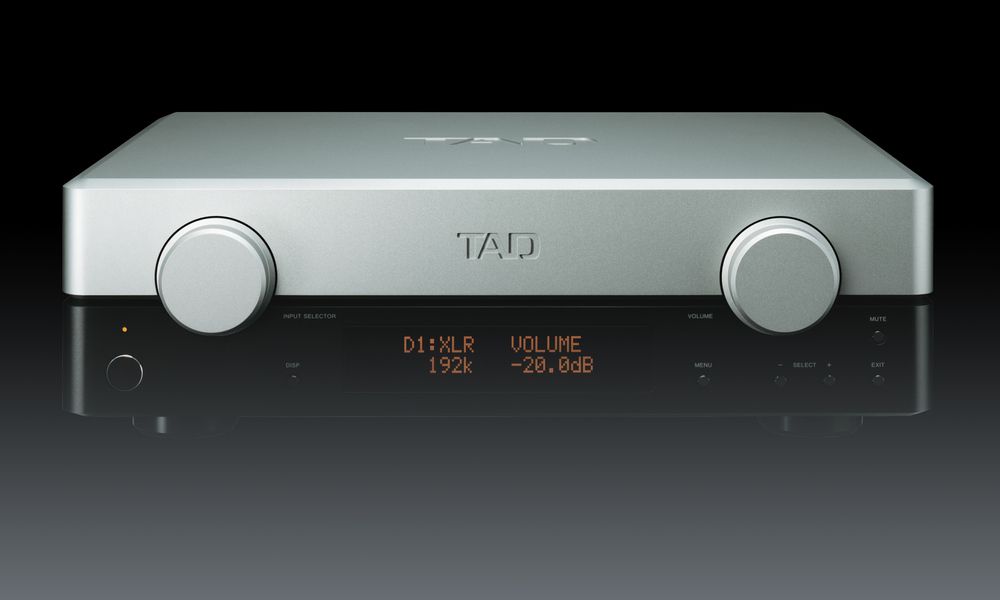
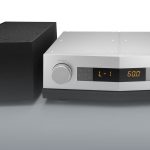
TAD C2000 Stereo Preamplifier
28 800,00 €
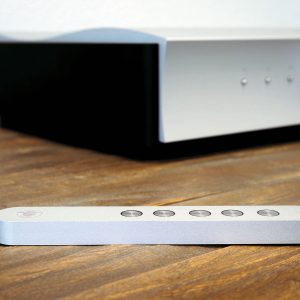
The TAD C2000 stereo preamplifier is designed for analog and digital music sources in a two-channel system. Its integrated digital-to-analog converter and asynchronous USB input allow a computer to be connected as a digital source. A fully balanced analog path, separate channel boards, and dual-mono construction provide equivalent signal-transmission conditions. The solid-aluminum chassis, direct component mounting, and three-point cast-iron supports help reduce the effects of vibration.
The TAD C2000 stereo preamplifier is designed to manage analog and digital sources in a two-channel audio system. Its built-in converter and USB Type-B input allow a computer to be used as a digital source. A fully balanced analog signal path provides equivalent signal-transmission conditions for the left and right channels.
This is a stereo preamplifier intended for connection ahead of a separate power amplifier. It does not replace a power amplifier and cannot drive passive speakers directly. This arrangement is suitable for a system in which the sources, converter, and power-amplification stage are selected separately.
Digital Signal Processing
The built-in digital-to-analog converter uses two Burr-Brown PCM1794A chips operating in a dual-differential configuration. This architecture is designed to process the two channels symmetrically.
A UPCG crystal oscillator supplies the master clock signal. Its technology is derived from the TAD D600 disc player.
In an asynchronous USB system, data transfer is controlled by the receiving device. This approach is intended to reduce clock irregularities originating in the computer or transmission chain. The format used for USB playback depends on the computer software and its settings.
Balanced Analog Circuitry
The analog signal path is fully balanced from input to output. The circuits, boards, and internal wiring are arranged symmetrically. The left and right channels are installed on separate boards and use wiring of equal length.
The dual-mono construction separates the signal paths of the two channels. This is particularly relevant when building a system with balanced sources and a balanced power amplifier. Such a connection preserves balanced operation throughout the preamplifier.
The digital and analog circuits have isolated power supplies. The circuit boards use 70 µm copper foil, while the power-supply section contains a high-capacity toroidal transformer.
Chassis and Placement
The chassis is machined from a solid aluminum billet. Internal components are mounted directly to the chassis. This construction limits the transfer of vibration to the electronic circuits.
Cast-iron feet support the chassis at three points. The unit weighs 23.5 kg, so it requires a strong, stable shelf. Its chassis is 393 mm deep, and additional clearance must be left behind it for the connectors and the bending radius of the cables.
Analog Connections
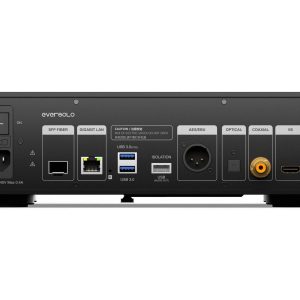
Two balanced analog inputs and two unbalanced analog inputs are provided. Choose a balanced connection when the audio source also has a balanced output. The unbalanced inputs accommodate sources without balanced outputs.
Two balanced and two unbalanced analog outputs are available for sending the signal to a power amplifier. Match the output type to the power amplifier’s input. A balanced connection preserves the preamplifier’s fully balanced analog signal path.
Digital Connections and USB
Digital sources can be connected through one balanced and one unbalanced digital input. The physical connector standards are not specified. The digital cable must therefore be selected according to the actual socket type rather than the input description alone.
The USB Type-B input supports USB 2.0 High-Speed operation. Supported sampling rates are 44.1, 48, 88.2, 96, 176.4, and 192 kHz. Playback at a particular rate depends on the operating system, driver, and playback application.
The USB environment was designed for Windows XP and later systems available at the time, as well as Mac OS 10.5 or later. Windows Vista and Windows 7 required a dedicated driver. Sampling rates up to 192 kHz were supported in the Mac OS 10.6 environment.
These compatibility details are historical and do not guarantee operation with current Windows or macOS releases. Before selecting a computer as the primary source, check the availability of a suitable driver and the capabilities of the intended playback software.
Use in Stereo and Home Theater Systems
In a stereo system, the preamplifier receives signals from the sources and sends them to a power amplifier. A separate power-amplification stage is essential when using passive speakers. The integrated converter can reduce the need for a separate DAC when supported digital sources are connected.
No dedicated home theater bypass function is specified, so automatic integration with an AV processor at a fixed signal level should not be assumed. No function is specified for linking or jointly controlling multiple preamplifiers of this type.
The power-supply version must match the local electrical network. The US version is designed for 120 V, 60 Hz power. The European and Asian version is intended for 220-240 V power at 50 or 60 Hz.
Technical Specifications
| Model | TAD-C2000 |
|---|---|
| Type | Stereo preamplifier with integrated digital-to-analog converter |
| Converter chips | Two Burr-Brown PCM1794A chips in a dual-differential configuration |
| Master clock | UPCG crystal oscillator using technology derived from the TAD D600 |
| Analog circuitry | Fully balanced from input to output |
| Channel construction | Dual-mono, with separate channel boards and equal-length wiring |
| Circuit boards | 70 µm copper foil |
| Transformer | High-capacity toroidal transformer |
| Analog inputs | 2 balanced, 2 unbalanced |
| Digital inputs | 1 balanced, 1 unbalanced |
| USB input | 1 USB Type-B, USB 2.0 High-Speed |
| Analog outputs | 2 balanced, 2 unbalanced |
| Rated output voltage | 1.5 V balanced; 0.75 V unbalanced |
| Maximum output voltage | 16 Vms balanced; 8 Vms unbalanced |
| Maximum permissible input voltage at -40 dB | 20 V balanced; 10 V unbalanced |
| Rated harmonic distortion | 0.003%; measurement conditions not specified |
| Frequency response | 10 Hz-100 kHz, -1 dB |
| Gain | 12 dB |
| Supported sampling rates | 44.1, 48, 88.2, 96, 176.4, and 192 kHz |
| Historical USB environment | Windows XP and later versions available at the time; Mac OS 10.5 and later |
| Dedicated USB driver | Provided for Windows Vista and Windows 7 |
| US-version power supply | 120 V AC, 60 Hz |
| European and Asian-version power supply | 220-240 V AC, 50 or 60 Hz |
| Power consumption | 37 W |
| Standby power consumption | 0.5 W or less |
| Dimensions | 440 × 140 × 393 mm; 17-5/16 × 5-1/2 × 15-1/2 in. |
| Weight | 23.5 kg; 51.8 lb. |
| Chassis | Machined from a solid aluminum billet |
| Supports | Cast-iron feet with three-point support |
FAQ
Can this unit drive passive speakers directly?
No. The required connection sequence is: source → TAD-C2000 → power amplifier → passive speakers.
Which analog connection should I choose?
Choose a balanced connection when both the source and power amplifier support it. In other cases, use an unbalanced connection.
How many analog sources can be connected, and what types are supported?
Up to four sources can be connected at the same time, provided their output types match the two balanced and two unbalanced inputs.
What is required to play music from a computer?
Connect the computer to the USB Type-B input. The playback rate and format are determined by the application, operating system, and a suitable driver.
Will the USB connection work with a current operating system?
Support for current systems has not been confirmed. The historical compatibility information covers older Windows and Mac OS versions, so the availability of a suitable driver is important.
Can the preamplifier be integrated easily into a home theater system?
No dedicated home theater bypass function is specified. The integration plan should therefore not depend on an automatic fixed-output-level mode.
What kind of shelf does this unit require?
The shelf must safely support the unit’s 23.5 kg weight and its 440 × 393 mm chassis footprint. Leave additional room at the rear for cables.
Why is selecting the correct power-supply version important?
The US and European/Asian models are designed for different mains voltages. A version intended for the wrong region must not be connected.