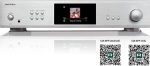
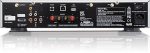
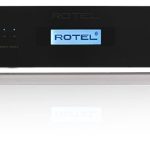
Rotel S14 Network Streamer
2 000,00 €
Rotel S14 is a network streamer with an integrated stereo amplifier, designed for a system combining passive speakers with multiple music sources. Its 32-bit ESS DAC processes digital signals, while the Class AB amplifier continuously delivers 80 W per channel into 8 ohms. Wired networking, dual-band Wi-Fi, PC-USB, optical, coaxial, analogue and Bluetooth inputs bring network, computer and other audio sources together in one component.
Rotel S14 combines an integrated network streamer, a 32-bit ESS DAC and a Class AB stereo amplifier in a single enclosure. It is designed for a system in which one component manages online sources, digital devices and passive speakers. The Class AB amplifier delivers 80 W per channel continuously into an 8-ohm load.
The stated maximum output is 150 W per channel into a 4-ohm load. This figure is not a continuous power rating. The integrated design reduces the number of separate components required while retaining the flexibility to connect a range of digital and analogue sources.
Network music sources
The S14 can connect to a home network through a wired connection or dual-band Wi-Fi. A wired connection is useful when the router is located close to the audio system. Wireless connectivity provides more freedom when choosing where to place the unit, particularly where routing a cable would be inconvenient.
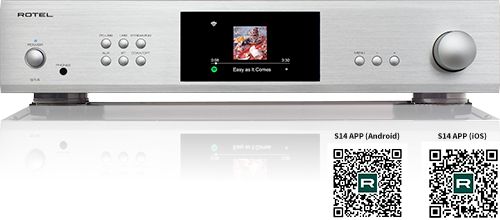
According to the seller’s supplied information, supported services and technologies include Tidal, Qobuz, Spotify Connect, AirPlay 2 and Google Cast. Roon Ready certification is also specified. The seller states that Rotel apps for iOS and Android provide access to internet radio and podcasts.
The availability of online services, apps and certifications may change independently of the hardware. Before purchasing, it is worth checking the current compatibility of the relevant service, app and certification in your region. MQA and MQA Studio decoding are supported at resolutions up to 24-bit/384 kHz.
Connections and their uses
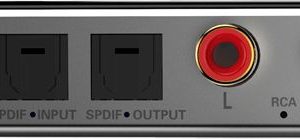
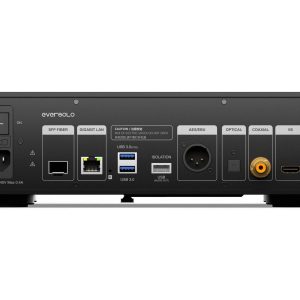
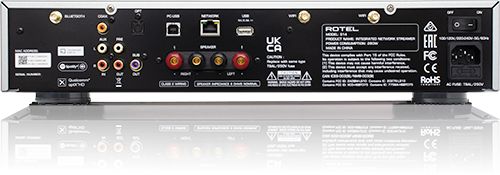
The coaxial and optical digital inputs accept S/PDIF LPCM signals up to 24-bit/192 kHz. The optical connection is a practical choice for a television or another source equipped with an optical output. The coaxial input can be used with a compatible CD player, transport or network source.
The PC-USB input operates with USB Audio Class 2.0 and accepts signals up to 24-bit/384 kHz. A driver must be installed on the computer to use the stated resolution. This connection is suitable when a computer serves as the main source for a music library.
The analogue line input is intended for a source with an analogue audio output. There is no phono input, so a turntable requires a separate phono preamplifier. A phono preamplifier is not listed among the supplied accessories.
Bluetooth with aptX HD offers a quick way to play audio from a compatible phone, tablet or computer. The unit can also play MP3 files directly from USB storage. This playback method does not depend on an internet connection or a music-service account.
Controls and display
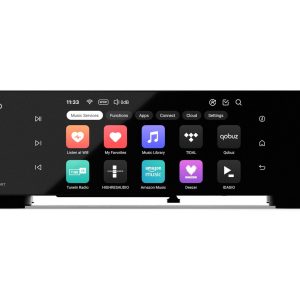
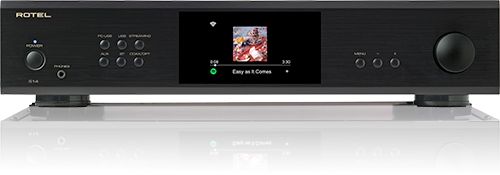
The colour front-panel display shows album artwork, track information and the track title. The same screen is used during initial setup and configuration. The supplied remote control allows settings to be adjusted from the listening position.
Bass and treble adjustment extends to ±10 dB at 100 Hz and 10 kHz. It is best to begin setup with the tone controls in their neutral positions. Small adjustments can help compensate for a particular recording or the room’s acoustics without changing the placement of the speakers.
Position in the audio system
The 430 mm-wide enclosure is designed to fit a conventional audio-equipment shelf. Its depth of 345 mm means that additional space should be left behind the unit for connections. At 9.15 kg, the S14 needs a stable, level shelf.
Maximum power consumption is 280 W, while the quoted thermal output is specified with a 4-ohm load. Air must therefore be able to circulate freely around the enclosure. The unit should not be installed inside a sealed recess or placed immediately next to a heat source.
The S14 is intended primarily for a two-channel stereo system. A television can be connected through the optical or coaxial input if it outputs an LPCM signal. A dedicated fixed-volume home-cinema input and synchronisation between multiple units are not specified.
Technical specifications
| Product type | Integrated network streamer, DAC and stereo amplifier |
|---|---|
| Amplifier topology | Class AB |
| Continuous output power | 80 W per channel into 8 Ω |
| Maximum output power | 150 W per channel into 4 Ω |
| Digital-to-analogue converter | 32-bit ESS DAC |
| Total harmonic distortion | Less than 0.04% |
| Intermodulation distortion | Less than 0.03%, 60 Hz and 7 kHz, 4:1 ratio |
| Damping factor | 400 |
| Line-input frequency response | 10 Hz-100 kHz, ±0.5 dB |
| Digital-input frequency response | 10 Hz-90 kHz, ±2.0 dB, maximum |
| Signal-to-noise ratio | Line input: 100 dB; digital input: 98 dB, IHF A-weighted |
| Input sensitivity | Line input: 200 mV; digital input: -20 dBFS |
| Input impedance | Line input: 47 kΩ; digital input: 75 Ω |
| Line-input overload | 4.5 V |
| Tone controls | ±10 dB at 100 Hz and 10 kHz |
| Coaxial and optical inputs | S/PDIF LPCM up to 24-bit/192 kHz |
| PC-USB input | USB Audio Class 2.0, up to 24-bit/384 kHz; driver required |
| Other inputs | Analogue line input, Bluetooth with aptX HD |
| Network connections | Wired network and dual-band Wi-Fi |
| Network features | According to the seller: Tidal, Qobuz, Spotify Connect, AirPlay 2, Google Cast, Roon Ready, internet radio and podcasts |
| Mobile apps | According to the seller, Rotel apps for iOS and Android |
| MQA | MQA and MQA Studio decoding up to 24-bit/384 kHz |
| USB storage files | MP3 |
| Display | Colour display showing album artwork, track information and title |
| Dimensions | 430 × 93 × 345 mm |
| Front-panel height | 80 mm |
| Net weight | 9.15 kg |
| Power consumption | 280 W |
| Standby power consumption | Less than 0.5 W |
| Thermal output | 733 BTU/h at 4 Ω and 1/8 power |
| Included accessory | Remote control |
FAQ
Can the S14 be connected directly to passive speakers?
Yes. Its integrated Class AB stereo amplifier can drive passive speakers without a separate power amplifier. Continuous output is rated at 80 W per channel into 8 Ω, while the 150 W-per-channel figure into 4 Ω is a maximum output rating.
What should I check before choosing the S14 for network services?
Check the current compatibility of the specific service, app and Roon Ready certification in your region. Their availability may change independently of the unit’s hardware.
How do I connect a television?
Use the optical or coaxial digital input. Set the television’s audio output to LPCM, as this is the signal format specified for these inputs.
Which connection is best for a computer?
PC-USB accepts signals up to 24-bit/384 kHz, while the coaxial and optical inputs accept signals up to 24-bit/192 kHz. A driver must be installed to use the full stated resolution through PC-USB.
Can I listen to music without an internet connection?
Yes. The S14 can play MP3 files directly from USB storage, so this playback method does not require an internet connection or a music-service account.
What is the difference between network playback and Bluetooth?
Bluetooth is suitable for establishing a quick, direct connection with a mobile device. The network functions are intended for compatible apps, internet services and a home music library.
Can the unit be incorporated into a home-cinema or multi-room system?
This model is focused on two-channel stereo use. Its analogue input can accept a signal from another device, but a fixed-volume home-cinema mode is not specified. A feature for synchronising multiple S14 units is not specified either.