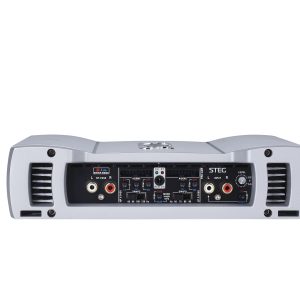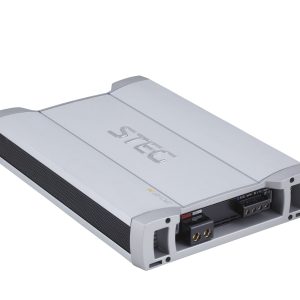
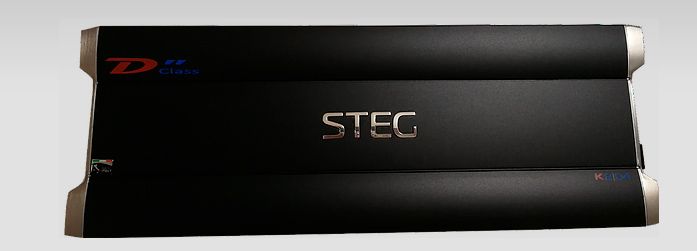
Steg K2.04D Car Audio Power Amplifier
910,00 €
Steg K2.04D is a two-channel Class D car audio power amplifier designed for high-power systems. It supports stereo and bridged mono operation, with loads down to 1 ohm per channel in stereo mode and down to 2 ohms in bridged mode. Its 0.5-5 V RMS input sensitivity allows it to be matched to audio sources with different output levels.
Steg K2.04D amplifier is a two-channel Class D car audio power amplifier designed for high-power in-car sound systems. It can be configured for stereo operation or used in bridged mono mode. All stated power ratings apply at a supply voltage of 11-14.4 V.
In stereo mode, the amplifier can operate with a 4, 2 or 1 ohm load per channel. Bridged operation is specified for 4 and 2 ohm loads. This provides the flexibility needed to work with speakers of different impedances, provided that the final load remains within the limits of the selected operating mode.
Use in a car audio system
The two channels can power two separate speakers or two correctly matched speaker circuits. This type of stereo connection keeps the left and right audio channels separate. The final load presented to each amplifier channel depends on the impedance of the speaker voice coils and on whether those coils are wired in series or in parallel.
Bridged mono mode combines both amplifier channels to drive a single load. It is particularly useful when installing a powerful subwoofer that requires one mono output. In this mode, the total connected load must be either 4 or 2 ohms. Bridged operation into a 1 ohm load is not specified for this model.
Reducing the load impedance allows the amplifier to deliver a higher stated output, but it also increases demand on the vehicle’s electrical system. The power cable size and fuse rating must therefore be calculated for the planned installation. The available capacity of the vehicle’s alternator and battery is equally important, especially when the system will be used at high output levels.
Matching the input signal
The input sensitivity range extends from 0.5 to 5 V RMS, covering different signal levels produced by car audio source equipment. During setup, the amplifier’s input level should be matched to the output voltage of the connected source.
An input setting that is too high can cause signal clipping before the desired listening volume is reached. A setting that is too low may prevent the system from making proper use of the available amplifier output. Begin adjustment with a lower gain setting, then raise the volume gradually while listening for audible distortion. The purpose of this adjustment is to match signal levels, not simply to set a volume control.
Components and electrical design
The electrical circuitry uses selected low-tolerance resistors and capacitors. Low tolerance means that the components’ actual electrical characteristics remain close to their stated nominal values. This is important in amplifier circuits where predictable and accurate operation depends on consistent component performance.
The signal path contains components chosen for high linearity and low thermal drift. High linearity supports consistent signal handling, while low thermal drift helps limit changes in electrical characteristics as operating temperature varies. Polyester capacitors intended for audio applications are also used in the design.
Installation location and power supply
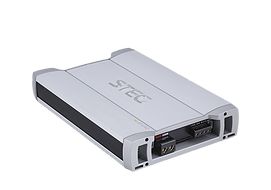
The enclosure measures 640 × 56 × 232 mm and weighs 8.26 kg. Before installation, make sure that a sufficiently large, flat mounting surface is available. The mounting point must support the amplifier’s weight securely and prevent it from moving while the vehicle is being driven.
Leave space around the enclosure for air circulation. Do not install the amplifier where carpeting, luggage or other objects could cover it and restrict ventilation. The low 56 mm enclosure can make it easier to find a suitable location, but space must still be allowed for the connected cables and their required bending radius.
The published output figures are specified for an 11-14.4 V electrical supply. Voltage drop in the vehicle wiring may prevent the amplifier from achieving those results. The positive power and ground cables should use the same conductor size, selected according to the requirements of the complete system. The grounding point must be clean, mechanically secure and firmly clamped.
Choosing the power configuration
Stereo operation is intended for two separate channel loads and supports 4, 2 or 1 ohm configurations per channel. Lower impedance corresponds to higher stated output, but it also places greater demand on the power supply and installation wiring.
Bridged mode is intended for one 4 or 2 ohm mono load. The choice of configuration should not be based on output power alone. The final impedance created by the speaker wiring must be compatible with the selected mode, and the speaker or subwoofer must also be able to handle the intended amplifier output.
Technical specifications
| Product type | Class D car audio power amplifier |
|---|---|
| Number of channels | 2 |
| Stereo power at 4 ohms | 2 × 500 W RMS at 11-14.4 V |
| Stereo power at 2 ohms | 2 × 900 W RMS at 11-14.4 V |
| Stereo power at 1 ohm | 2 × 1700 W RMS at 11-14.4 V |
| Bridged mono power at 4 ohms | 1 × 2000 W RMS at 11-14.4 V |
| Bridged mono power at 2 ohms | 1 × 3500 W RMS at 11-14.4 V |
| Input sensitivity | 0.5-5 V RMS |
| Resistors and capacitors | Selected, low-tolerance components |
| Signal-path components | High linearity and low thermal drift |
| Capacitor type | Polyester capacitors for audio applications |
| Dimensions | 640 × 56 × 232 mm |
| Weight | 8.26 kg |
FAQ
When should I choose stereo mode, and when should I use bridged mode?
Choose stereo mode when powering two separate channel loads. Bridged mode is intended for one mono load, such as a subwoofer.
How do I calculate the load of a speaker with multiple voice coils?
Connecting voice coils in series increases the total impedance, while connecting them in parallel reduces it. The resulting impedance must remain within the limits specified for the selected amplifier mode.
Can I connect a 1 ohm load in bridged mode?
No. Bridged operation is specified for 4 and 2 ohm loads. The 1 ohm rating applies only to each individual channel in stereo mode.
What does 0.5-5 V RMS input sensitivity mean?
This range allows the amplifier input to be matched to the signal level supplied by the audio source. Correct adjustment helps prevent the signal from clipping prematurely.
Is this amplifier suitable for a home stereo or home cinema system?
It is designed for an 11-14.4 V vehicle electrical system. Home audio equipment normally requires an amplifier designed to operate from a household mains power supply.
Can more than one of these amplifiers be used in the same vehicle?
Multiple amplifiers can greatly increase total electrical demand. The power cables, fuses, battery capacity and alternator load must be calculated in advance for such an installation.
What should I consider when choosing an installation location?
Provide a suitable mounting surface for the 640 × 56 × 232 mm enclosure and leave enough room for the cables. Do not cover the amplifier, and maintain clear space around it for air circulation.