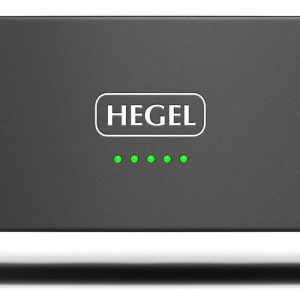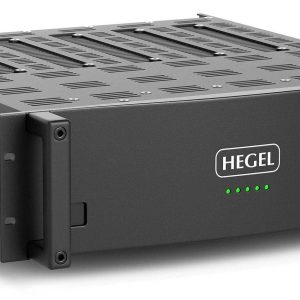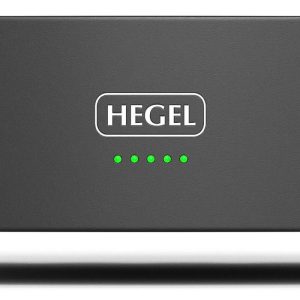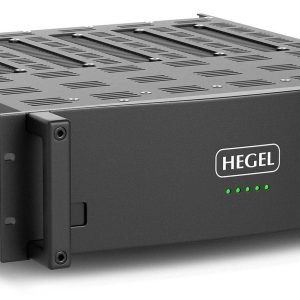
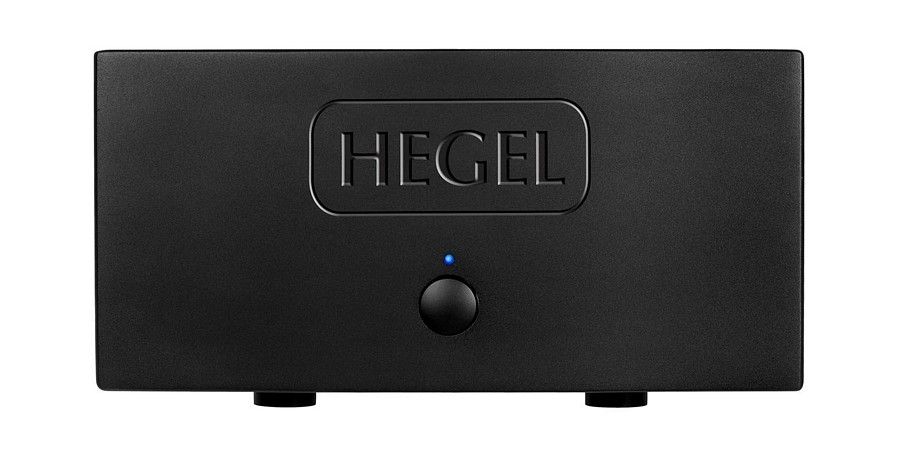
Hegel H30 Power Amplifier
12 995,00 €
The Hegel H30 is a power amplifier for a high-power stereo system or a system using two monoblock amplifiers. In stereo mode, it delivers 350 W per channel into 8 ohms. In monoblock mode, output exceeds 1100 W under the stated measurement conditions. XLR and RCA inputs allow connection to different preamplifiers. Its 45 kg weight and 55 cm depth require a strong, sufficiently deep equipment rack.
The Hegel H30 power amplifier is a switchable monoblock and stereo power amplifier for demanding two-channel systems. A single unit delivers 350 W per channel into an 8-ohm load in stereo mode. Output rises to 675 W per channel into a 4-ohm load. In monoblock mode, the power output exceeds 1100 W into an 8-ohm load.
The 1100 W figure was measured at 1 kHz with 1% total harmonic distortion. It applies to the 100, 120 and 230 V AC versions. The minimum specified load impedance is 1 ohm.
Purpose and operating modes
One amplifier is sufficient for a conventional two-channel stereo system. In monoblock mode, the entire output stage is dedicated to one channel. A two-channel system therefore requires two H30 amplifiers, with one unit driving each speaker. This arrangement also provides physical separation between the amplification for the left and right channels.
This is a power amplifier, so volume is controlled by the connected preamplifier or AV processor. A source component must not be connected directly unless it has a variable line-level output. Select the operating mode to suit the chosen system configuration, using either one amplifier in stereo or two amplifiers as monoblocks.
Power supply and output stage
The 2000 VA dual-mono power supply provides a total capacitor capacity of 270,000 µF. It supplies current to the output stage as the speaker load becomes more demanding. The 1-ohm minimum load indicates the amplifier’s specified operating limit; it should not be interpreted as a recommended load for routine use.
The output stage employs 56 high-speed, ultra-low-distortion bipolar transistors. Each transistor is rated for 15 A and 200 W. A damping factor greater than 500 helps the amplifier control the electrical movement of the speaker drivers.
Distortion is below 0.003% when the amplifier delivers 100 W into an 8-ohm load. Intermodulation distortion is below 0.01% when measured with 19 and 20 kHz signals. A signal-to-noise ratio greater than 100 dB reduces the influence of background noise during quiet passages of music.
Inputs and speaker connection
The balanced XLR input is suitable for a preamplifier or processor equipped with a corresponding line-level output. A balanced connection can be useful with longer signal runs and in environments where electrical interference is more prevalent. The impedance of this input is 20 kilohms.
The unbalanced RCA input provides a conventional analogue connection for a preamplifier with an RCA output. Its input impedance is 10 kilohms. Choose the connection type according to the source output and the interconnect being used. The presence of an XLR connector alone does not automatically guarantee a better result.
One pair of heavy-duty, gold-plated terminals is provided for the speaker cable. When planning the installation, use cable of an appropriate cross-sectional area and make sure that its terminations are secured correctly. Crosstalk is below -100 dB, indicating very little interaction between the channels.
Use in stereo and home cinema systems
In a stereo system, the amplifier is controlled by a preamplifier with an RCA or XLR line-level output. In a home cinema system, it can be connected to the variable pre-outs of an AV processor or receiver. Speaker-level outputs must never be connected to the RCA or XLR inputs.
When a separate power amplifier is used for the front channels, the AV component controls the volume and individual channel levels. System calibration is also carried out through that component. In this arrangement, the H30 amplifies the analogue signal supplied to it.
Placement and power consumption
The enclosure measures 21 cm high, 43 cm wide and 55 cm deep. Its 45 kg weight requires a stable equipment rack or shelf that is sufficiently deep and rated to support the full load. Space for connectors and cables behind the rear panel must also be considered before installation. The weight should be taken into account when planning safe transport and moving the amplifier into position.
The amplifier consumes 120 W while idling, so unobstructed airflow must be maintained around the enclosure. An enclosed cabinet without ventilation is not a suitable location. In ECO mode, power consumption is reduced to 30 W.
Model version and finish
This is the original H30 model and should not be confused with the later H30A. The H30 belongs to the manufacturer’s earlier, discontinued range. The store listing offers a choice of black or silver finish.
Technical specifications
| Product type | Switchable monoblock and stereo power amplifier |
|---|---|
| Stereo output power | 350 W per channel into 8 ohms; 675 W per channel into 4 ohms |
| Monoblock output power | More than 1100 W into 8 ohms at 1 kHz and 1% total harmonic distortion |
| AC voltage versions covered by power measurement | 100, 120 and 230 V AC |
| Minimum load impedance | 1 ohm |
| Analogue inputs | Unbalanced RCA and balanced XLR |
| Speaker output | One pair of heavy-duty, gold-plated terminals |
| Balanced input impedance | 20 kilohms |
| Unbalanced input impedance | 10 kilohms |
| Signal-to-noise ratio | Greater than 100 dB |
| Crosstalk | Less than -100 dB |
| Harmonic distortion | Less than 0.003% at 100 W into an 8-ohm load |
| Intermodulation distortion | Less than 0.01% using 19 and 20 kHz signals |
| Damping factor | Greater than 500 |
| Power supply | 2000 VA, dual-mono construction |
| Power-supply capacitor capacity | 270,000 µF |
| Output stage | 56 high-speed, ultra-low-distortion bipolar transistors |
| Individual output-transistor ratings | 15 A and 200 W |
| Idle power consumption | 120 W |
| ECO mode power consumption | 30 W |
| Finishes offered by the store | Black or silver |
| Dimensions | 21 × 43 × 55 cm, height × width × depth |
| Weight | 45 kg |
| US dimensions | 8.3 × 17 × 21.6 inches, height × width × depth |
| US weight | 99 lb |
FAQ
Is 1100 W the output in stereo mode?
No. This figure applies to monoblock operation under the stated measurement conditions. Stereo power is specified separately for each channel.
Is a preamplifier required?
Yes. The H30 requires a component with a variable line-level output. This may be a stereo preamplifier, an AV processor or a suitable AV receiver.
When should I use XLR rather than RCA?
Choose XLR when the source has a balanced output, particularly when using a longer signal cable. RCA is suitable for equipment with an unbalanced analogue output.
Can the amplifier be used in a home cinema system?
Yes, provided that the AV component has variable preamplifier outputs. The AV component then controls volume, channel levels and system calibration.
Does the 1-ohm limit mean that the H30 is suitable for any speakers?
No. This is the lowest specified load limit. Choose speakers with due regard for their nominal and minimum impedance as well as their actual power requirements.
What should I consider when choosing an equipment rack?
The rack must support the amplifier’s full weight and accommodate its deep enclosure. Leave additional room behind the amplifier for connectors, cables and airflow.
Are the H30 and H30A the same model?
No. They are different models. The specifications presented here apply to the original H30 and must not be attributed to the later H30A.
Related products and categories
Related products