![Patricia Barber Café Blue [Un-Mastered] jazz album](https://audiocentras.lt/wp-content/uploads/2026/09/patricia-barber-cafe-blue-un-mastered-1-150x150.jpg)
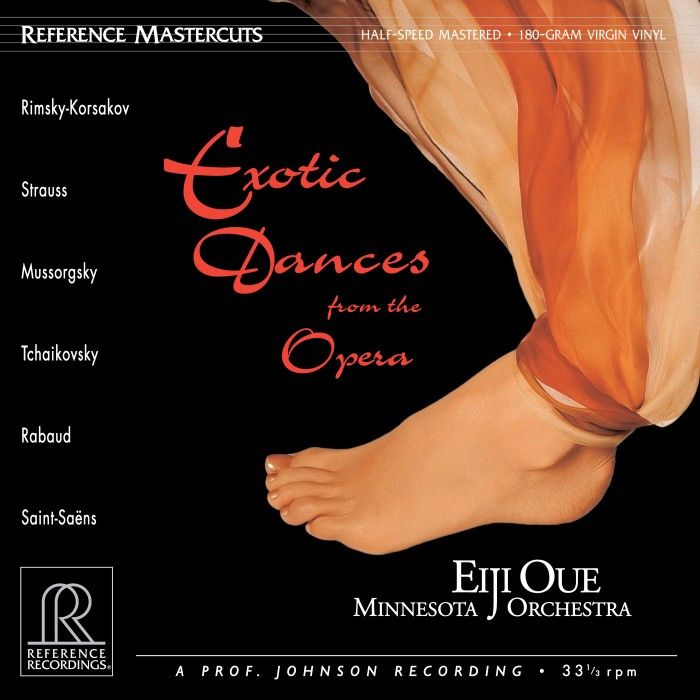
Eiji Oue & Minnesota Orchestra – Exotic Dances From The Opera
45,00 €
Eiji Oue & Minnesota Orchestra – Exotic Dances From The Opera is a classical orchestral music album for listeners interested in operatic repertoire. It contains six dance numbers from six different operas. Side A presents four shorter works, while Side B contains two longer selections. The complete listed programme lasts 46 minutes and 55 seconds.
Eiji Oue & Minnesota Orchestra – Exotic Dances From The Opera is a classical orchestral music album for listeners interested in dance repertoire drawn from opera. This Eiji Oue album presents six works from six different operas, arranged across the album’s two sides.
This is not a collection of complete operas. Instead, the programme focuses on individual pieces by Nikolai Rimsky-Korsakov, Richard Strauss, Modest Mussorgsky, Pyotr Tchaikovsky, Henri Rabaud and Camille Saint-Saëns. The shared dance theme brings these contrasting operatic selections together in one clearly structured programme.
A dance programme drawn from six operas
Side A contains four works. It opens with Rimsky-Korsakov’s “Dance of the Tumblers” from The Snow Maiden. This is followed by Richard Strauss’s “Dance of the Seven Veils” from Salome.
The third selection is Mussorgsky’s “Dance of the Persian Slaves” from Khovanshchina. Tchaikovsky’s “Hopak” from Mazepa closes the side. Together, these four pieces provide extracts from four separate operas within a programme lasting 24 minutes and 30 seconds.
Side B is devoted to two longer selections. Rabaud’s “Dances” from the opera Marouf, Cobbler of Cairo lasts 14 minutes and 55 seconds. It is followed by Saint-Saëns’s “Bacchanale” from Samson and Delilah.
The second side lasts 22 minutes and 25 seconds. With only two pieces, it offers fewer transitions between operas and gives each selection more space within the sequence. The Rabaud work receives the largest individual share of the album’s programme.
Programme flow and listening choices
Changes between works occur more frequently on Side A. Its pieces range from 3 minutes and 47 seconds to 9 minutes and 41 seconds, allowing listeners to hear operatic extracts by four composers without moving beyond a single side. The sequence is therefore well suited to anyone who wants a broader selection of shorter pieces.
Side B concentrates on two works. The first runs for almost 15 minutes, while the second lasts 7 minutes and 30 seconds. This side is the natural choice when fewer but longer programme sections are preferred. Its structure also gives the extended Rabaud selection a particularly prominent place.
The combined duration of all six listed works is 46 minutes and 55 seconds. The supplied timings make it easy to choose between hearing the complete programme, one full side or an individual selection. For a short listening break, the briefest piece requires approximately four minutes.
Who is this repertoire for?
This album is suitable for listeners seeking a themed programme of operatic dances. Every selection follows the same broad repertoire concept, although the pieces do not come from the same opera. The programme should therefore be approached as a collection of related orchestral numbers rather than as a summary of one continuous stage narrative.
The inclusion of six composers makes it possible to compare a range of operatic dance pieces within one album. The works appear in a clear, fixed order: shorter excerpts dominate the first side, while the second side gives considerably more room to Rabaud’s contribution.
The programme includes several widely recognised opera titles, among them Salome, Mazepa and Samson and Delilah. These sit alongside selections from The Snow Maiden, Khovanshchina and Marouf, Cobbler of Cairo. The result is a focused survey of six individual dance numbers rather than a general anthology of complete operatic scenes.
Technical specifications
| Product type | Classical orchestral music album |
|---|---|
| Credited performers | Eiji Oue and the Minnesota Orchestra |
| Programme theme | Dance numbers from operas |
| Number of works | 6 |
| Album structure | 4 works on Side A; 2 works on Side B |
| A1 | Rimsky-Korsakov – “Dance of the Tumblers” from The Snow Maiden – 3:47 |
| A2 | Richard Strauss – “Dance of the Seven Veils” from Salome – 9:41 |
| A3 | Mussorgsky – “Dance of the Persian Slaves” from Khovanshchina – 6:50 |
| A4 | Tchaikovsky – “Hopak” from Mazepa – 4:12 |
| B1 | Rabaud – “Dances” from Marouf, Cobbler of Cairo – 14:55 |
| B2 | Saint-Saëns – “Bacchanale” from Samson and Delilah – 7:30 |
| Side A duration | 24:30 |
| Side B duration | 22:25 |
| Total programme duration | 46:55 |
FAQ
Does the album contain complete operas?
No. The programme consists of six separate dance numbers taken from six operas. It is intended for themed repertoire listening rather than for hearing any of the operas in full.
How are the works divided between the two sides?
Side A contains four shorter numbers, while Side B holds the two longer works. Despite the different number of selections, the total playing times of the two sides remain similar.
Which is the longest work in the programme?
The longest selection is Rabaud’s number from Marouf, Cobbler of Cairo. Its duration of 14:55 accounts for a substantial part of Side B.
Which piece is suitable for a short listening break?
Rimsky-Korsakov’s “Dance of the Tumblers” is the shortest number, lasting 3:47. Tchaikovsky’s “Hopak” is another relatively brief choice at 4:12.
Does the programme include a work by Saint-Saëns?
Yes. The “Bacchanale” from Samson and Delilah is the second work on Side B. It lasts 7 minutes and 30 seconds.
Is this an album devoted to one composer?
No. Six composers are represented in the programme, with one individual operatic dance number included from each composer.
Which side offers more variety in the repertoire?
Side A presents works by four composers within 24:30. Side B contains two numbers across 22:25, so it has fewer transitions between composers and operas.
Who is credited on this album?
The album is credited to Eiji Oue and the Minnesota Orchestra. Its programme features music by Rimsky-Korsakov, Strauss, Mussorgsky, Tchaikovsky, Rabaud and Saint-Saëns.
Related products