Audio System AD A5 RCA Cable
16,00 €
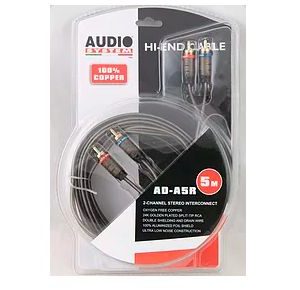
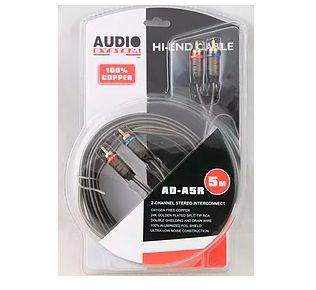
Audio System AD A5 is a 5-metre stereo RCA cable for connecting a car audio source to an amplifier. Its length allows a signal connection to be routed between equipment installed in different parts of the vehicle. Conductors made from 100% oxygen-free copper are surrounded by triple shielding, which helps limit the effect of environmental electromagnetic interference on the signal connection.
Audio System AD A5 is a 5-metre stereo RCA interconnect cable designed for car audio systems. It carries an audio signal between devices equipped with compatible RCA connections. This length is useful when the head unit and amplifier are installed in different parts of the vehicle.
The cable uses conductors made from 100% oxygen-free copper (OFC). Triple shielding helps limit the effect of electromagnetic interference from the surrounding environment. This construction is particularly relevant in a vehicle, where signal and power cables often have to share a limited amount of installation space.
What this cable is designed for
This is a stereo RCA interconnect cable. It is intended to carry an audio signal from a source with compatible RCA connections to an amplifier. In a typical car audio installation, this means connecting the line-level outputs of a head unit to the RCA inputs of a separate audio amplifier.
The cable is not intended to connect speakers directly to an amplifier’s output terminals. It also cannot be used as a power cable. When planning the installation, make sure you distinguish RCA signal connections from speaker terminals and power connections.
Why choose a five-metre cable?
The 5-metre length allows the signal connection to be routed across a larger part of the vehicle interior. It is useful when the source is installed in the dashboard and the amplifier is located in the boot or another position some distance away.
Before installation, measure the entire planned cable route rather than the straight-line distance between the devices. Allow for bends, interior trim and safe access to the connectors. A small amount of spare length makes connection easier and prevents tension in the cable from placing unnecessary strain on the sockets.
If the planned route is considerably shorter, do not compress the excess cable into a tight coil. Arrange it in broad, loose loops instead. This reduces sharp bending and keeps excess cable away from the connections themselves.
Copper conductors and shielding
Oxygen-free copper is used as the conductor material. The stated 100% copper composition means that the signal-carrying section is not described as another metal with a copper coating. This is a useful distinction when comparing car audio RCA cables of a similar length.
Triple shielding helps isolate the signal conductors from some of the electromagnetic interference present in the surrounding environment. In a vehicle, possible sources include the power wiring and electrical equipment in operation. Shielding does not replace careful installation, so the signal cable route should still be planned properly.
A shielded cable cannot eliminate humming or background noise caused by incorrect equipment grounding. If unwanted noise can be heard after the system has been connected, check the amplifier’s power supply, ground connection and signal cable route.
Connecting RCA equipment in an audio system
Switch off the equipment before making the connections. Run the cable from the audio source’s RCA outputs to the corresponding RCA inputs on the amplifier.
The shape of an RCA socket alone does not identify its purpose. A device may have inputs, outputs or connections assigned to different channels. Always follow the labels next to the sockets instead of relying only on their appearance.
Insert each plug straight into the socket while holding the plug body. Pulling on the cable can place unnecessary stress on the point where the cable meets the connector. Leave enough room behind the equipment for the cable to follow a natural curve without being sharply bent.
Car installation advice
Where possible, route the RCA cable separately from the amplifier’s power cable. If the two routes must cross, arrange the crossing at as close to a right angle as practical. Avoid long sections where signal and power cables run parallel and close together.
Do not trap the cable beneath trim panels or route it over sharp metal edges. Keep it clear of moving seat mechanisms and hot areas of the vehicle. When securing the cable, do not overtighten clips or fasteners, as this could compress its outer jacket.
Before replacing all interior trim, switch on the system and check that the signal is being transmitted correctly. This makes it easier to find a plug that has not been fully inserted while the cable route is still accessible.
Technical specifications
| Model | Audio System AD A5, also identified as AD-A5 |
|---|---|
| Cable type | Stereo RCA interconnect cable |
| Purpose | Signal transmission in a car audio system |
| Length | 5 m |
| Conductor material | Oxygen-free copper (OFC) |
| Copper composition | 100% copper |
| Shielding | Triple shielding |
| RCA connector configuration and number of channels | Not specified; before purchasing, check the number and configuration of the plugs against the connections on your equipment |
FAQ
When should I choose a 5-metre RCA cable?
It is intended for a longer cable route, such as the path from a head unit at the front of the vehicle to an amplifier installed in the boot. Calculate the required length using the cable’s actual route.
How do I know which sockets to connect it to?
Use the RCA outputs on the source and the corresponding RCA inputs on the amplifier. Follow the channel and signal-direction labels shown beside the sockets.
Can I use it instead of speaker cable?
No. This is an RCA signal cable, not a cable for connecting an amplifier’s powered outputs to speakers.
Why should the signal cable be kept away from the power cable?
Greater separation reduces the likelihood of the power wiring affecting the signal route. Triple shielding provides an additional constructional measure, but correct cable routing remains important.
Will triple shielding eliminate every type of system hum?
Not always. Humming can be caused by a grounding or power-wiring problem. In that situation, cable shielding alone is not enough.
What should I check before buying?
Check that the available length is sufficient for the planned route, that the equipment has the required RCA inputs and outputs, and that the cable’s connector configuration is suitable for those connections.
How should I arrange excess cable after installation?
Lay the remaining cable in broad, loose loops and keep it away from power wiring. Do not compress the cable or leave it close to moving mechanisms.