Chord Shawline ShawlineX Speaker Cable – Unterminated
35,00 €
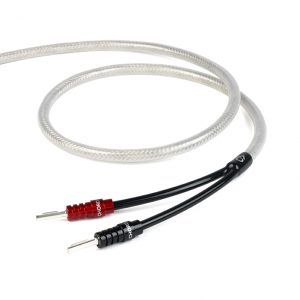
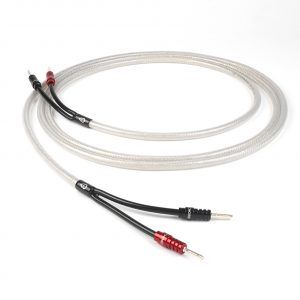
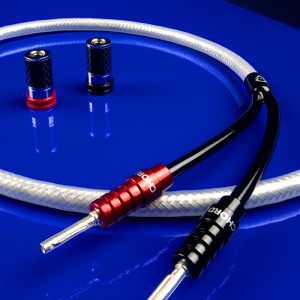
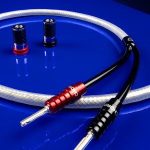
Chord Shawline ShawlineX Speaker Cable connects an amplifier to a passive loudspeaker. Its silver-plated conductors have XLPE insulation and form a twisted pair. An inner PVC jacket is intended to reduce mechanical noise, while a two-layer shield is designed to reduce high-frequency interference. This version is supplied unterminated so its ends can be prepared for your speaker terminals.
Chord Shawline ShawlineX Speaker Cable connects an amplifier’s speaker output to a passive loudspeaker. This version is supplied unterminated, so its ends can be prepared for the terminals in your system. It uses silver-plated conductors with XLPE insulation, surrounded by an inner PVC jacket and a two-layer shield. If you are planning a stereo pair or several passive channels in a home cinema system, the cable route and the terminals at each end are worth checking before you choose a length.
Conductors and insulation
The conductor arrangement is based on Chord Rumour X. Two silver-plated conductors form a twisted pair, and each conductor is insulated with XLPE, or cross-linked polyethylene. The X in the name helps distinguish this version from earlier Shawline and Rumour cables, which used PTFE insulation. Shawline X uses XLPE instead.
This is a two-conductor cable for connecting one passive loudspeaker. Before preparing the ends, decide which conductor you will use for the positive terminal. Connect that conductor to the positive terminal at both the amplifier and loudspeaker; connect the other conductor to the negative terminals. Following the same conductor from one end of the cable to the other makes it easier to keep the polarity consistent, particularly when preparing separate lengths for the left and right channels.
Jacket and shield
A specially selected inner PVC jacket surrounds the conductors and is intended to reduce mechanical noise. When routing the cable, allow enough slack that the connected terminals do not have to support a taut length. Avoid forcing a sharp bend where the cable reaches a terminal. This is especially useful to consider when you are choosing a length from a reel and preparing its ends for a particular installation: the measured route needs to leave room for the final connection.
The outer shield combines high-density foil and braid layers. Chord also uses this two-layer shield construction in its Epic cable. Its purpose here is to reduce high-frequency interference. The shield is part of the cable’s construction; it does not change the need to connect the two conductors to the appropriate positive and negative speaker terminals.
Preparing the ends and choosing terminals
The version offered here has no fitted plugs or spade connectors. Prepared conductor ends can be secured in suitable amplifier and loudspeaker terminals. Before cutting the cable or removing insulation, plan the route to each loudspeaker and leave a little extra length for comfortable access to the terminals. That makes it easier to position the cable without pulling on the connection.
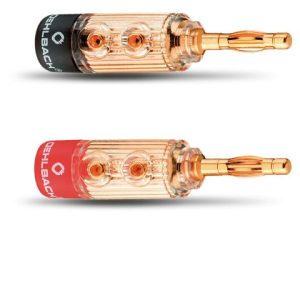
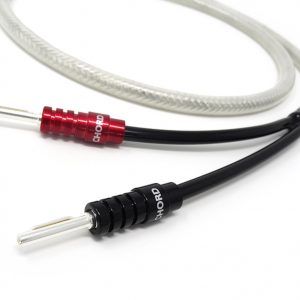
Shawline X is also available in versions terminated at the factory in the UK with ChordOhmic 4 mm banana plugs or ChordOhmic spade connectors. Those are separate termination options; they are not included with this unterminated cable. A banana plug is used with a terminal that accepts a 4 mm plug. A spade connector is secured beneath the fastening nut of a suitable terminal. Check the terminals you intend to use when deciding how the ends of this version should be prepared.
Choosing a cable length
A stereo system needs a separate cable length for each passive loudspeaker. Measure the route the cable will actually follow from the amplifier to each speaker, including turns around furniture, rather than measuring only the straight-line distance. Allow enough slack for the ends to reach the terminals without tension and for a small change in speaker position without disconnecting the cable. The two speakers may need different measured routes, so plan each one individually.
In a home cinema system, the cable performs the same job for each passive speaker channel: it connects that channel’s amplifier output to its loudspeaker terminals. Plan a separate length for each speaker according to its position. This speaker cable is not intended for the line-level input of an active subwoofer; that connection requires the appropriate line-level cable.
Technical specifications
| Type | Speaker cable |
|---|---|
| Conductor arrangement | Twisted pair configuration based on Chord Rumour X |
| Conductors | Silver-plated |
| Conductor insulation | XLPE, cross-linked polyethylene |
| Inner jacket | PVC, intended to reduce mechanical noise |
| Shield | High-density, two-layer foil and braid |
| Ends on this version | Unterminated |
| Other termination options | Factory-fitted ChordOhmic 4 mm banana plugs or ChordOhmic spade connectors |
FAQ
What is this cable for?
It connects an amplifier’s speaker output to the terminals of a passive loudspeaker. RCA and XLR line-level connections require the corresponding line-level cable.
Does this version come with connectors attached?
No. This version is supplied unterminated. Its ends need to be prepared for the terminals you will use before you connect it.
When should I choose banana plugs or spade connectors?
4 mm banana plugs suit terminals with a socket for that plug size. Spade connectors suit terminals that clamp them beneath a fastening nut. They are separate factory termination options, not fittings supplied with this version.
How do I decide what length I need?
Measure the actual route to the loudspeaker, including any turns, rather than the direct distance between components. Leave some slack for making the connection and for a possible small change in the speaker’s position.
How do I maintain the correct polarity?
Use the same conductor for the positive terminals at both ends, and connect the other conductor to the negative terminals. Follow this arrangement for each channel.
Can I use it in a home cinema system with several speakers?
Yes, for passive loudspeaker channels powered by their corresponding amplifier outputs. Allow a separate cable length for each speaker and measure the route to its position.
Related products and categories
Related products