Oehlbach Silverline 25 Speaker Cable
7,50 €
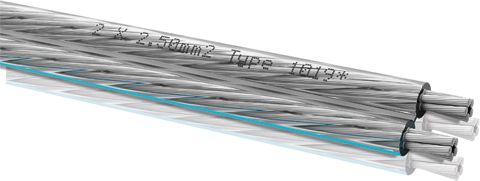
Oehlbach Silverline 25 is a stereo speaker cable designed to connect an integrated amplifier or power amplifier to passive speakers. Its two 2.5 mm² conductors are made from silver-plated copper, while bundles of fine strands give the cable flexibility. The flat, transparent plastic sheath helps with neat routing. Made in Europe, the cable is sold in one-metre units.
Oehlbach Silverline 25 speaker cable is a stereo speaker cable designed to connect an integrated amplifier or power amplifier to speakers. It is sold in one-metre units, allowing you to order the quantity required for the planned cable route. The 2 × 2.5 mm² specification refers to two conductors, each with a cross-sectional area of 2.5 mm².
According to the stated rating, the cable is suitable for amplifiers rated at up to approximately 180 W per channel. This is an approximate limit for one amplifier channel, not the total power rating of the complete system.
Purpose and suitable systems
The cable carries the amplified signal from an amplifier’s speaker outputs to passive speakers. It is intended for a direct connection between an amplifier and speakers, rather than for line-level audio connections.
In a stereo system, each speaker requires its own two-conductor cable run. In a home cinema system, the cable can connect the amplified channels of an AV receiver to the corresponding passive speakers. The required length for each channel should be calculated separately.
Conductors and cable construction
The internal conductors are made from silver-plated copper (SPC). They consist of numerous ultra-fine strands twisted together into bundles. This construction makes the cable flexible and easier to route around furniture or along skirting boards.
The outer sheath is made from a durable, flexible plastic compound. Its flat geometry allows the cable to sit closer to a level surface. The transparent sheath is less visually prominent in light-coloured interiors, although its appearance does not alter the cable’s electrical purpose.
The cable’s external dimensions are 8.0 × 4.5 mm. These measurements should be considered when planning a route behind furniture, through cable trunking or through a narrower opening.
How to choose the required length
Begin by measuring the actual route from the amplifier terminals to each speaker. Include vertical sections, bends and a small allowance for preparing and connecting the ends. Do not measure only the straight-line distance between the components.
The product is supplied in 1.00 m units. If two speakers each require four metres of cable, the total order quantity will be eight units. When the individual runs have different lengths, add them together and order the total number of metres required.
Single-wiring connection
Single wiring means that one two-conductor cable run connects one speaker to one amplifier channel. One conductor is connected to the positive terminals and the other to the negative terminals on both devices.
Use the same chosen conductor for the same polarity throughout the system. Reversing the polarity of one speaker can affect how the two speakers work together. Check both ends of every cable run before switching on the system.
Prepare the cable ends in a way that suits the terminals on the particular amplifier and speakers. No loose conductor strands protruding from a terminal should be able to touch the adjacent terminal. As the cable contains two conductors, a single run is not intended to provide a four-terminal bi-wiring connection.
This flat, flexible cable is made in Europe. It is suitable for systems that require speaker cable ordered by the metre to connect an amplifier to passive speakers.
Technical specifications
| Product type | Stereo speaker cable |
|---|---|
| Purpose | Connecting an integrated amplifier or power amplifier to speakers |
| Recommended amplifier power | Up to approximately 180 W per channel |
| Conductor material | Silver-plated copper, SPC |
| Conductor construction | Ultra-fine strands twisted into bundles |
| Cross-sectional area | 2 × 2.5 mm² |
| Sheath material | Durable, flexible plastic compound |
| Geometry | Flat |
| Connection method | Single wiring |
| Dimensions | 8.0 × 4.5 mm |
| Colour | Transparent |
| Sales unit | 1.00 m |
| Place of manufacture | Europe |
FAQ
How do I calculate the amount of cable required for a stereo system?
Measure the route to the left speaker and the route to the right speaker separately. Add the two lengths together and include a small allowance for making the connections. Because the cable is sold by the metre, the quantity ordered should match the total length required.
What does the 2 × 2.5 mm² designation mean?
The cable contains two separate conductors. Each conductor has a cross-sectional area of 2.5 mm². They connect the positive and negative terminals of one amplifier channel to the corresponding terminals on a speaker.
Does each speaker need a separate two-conductor cable run?
Yes. Each passive speaker is connected to its corresponding amplifier channel with a separate run of two-conductor cable. Calculate the necessary length of each run according to the route it will follow.
Can this cable be used in a home cinema system?
Yes, provided it is connected to the amplified speaker outputs of the receiver. Every passive speaker requires a separate cable run. A different type of cable is used for the line-level connection to an active subwoofer.
Is this cable intended for bi-wiring?
No. It is designed for a single-wiring arrangement. One cable run contains two 2.5 mm² conductors. A four-terminal bi-wiring connection would require an additional cable run or a different solution.
How do I maintain the correct speaker polarity?
Choose the same conductor for the positive terminals on both devices. Use the other conductor for the negative terminals. Follow this arrangement consistently across every channel in the system.
How does the flat, flexible construction help with cable routing?
It makes the cable easier to route along level surfaces and skirting boards or behind furniture. Before installation, account for its 8.0 × 4.5 mm dimensions and leave a suitable allowance for bends.