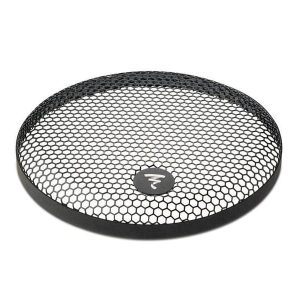
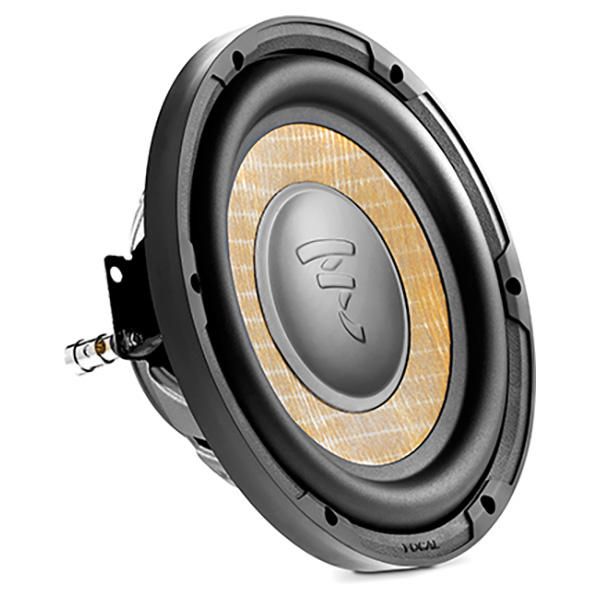
Focal P 20 FSE Slim Subwoofer
240,00 €
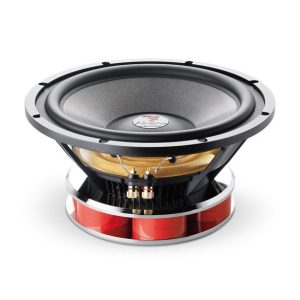
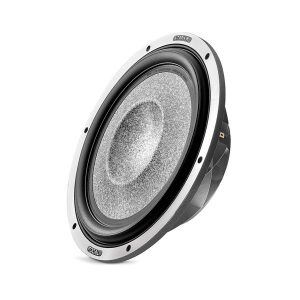
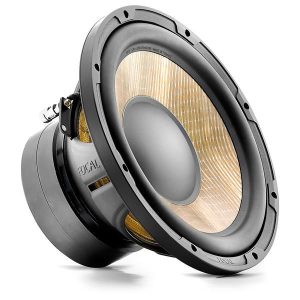
Focal P 20 FSE is a slim passive subwoofer for a custom car audio system. This 20 cm driver requires a separate enclosure and an external amplifier suitable for a 4 Ω load. It uses a multilayer flax-fibre cone and a rubber surround. Its nominal 200 W RMS rating provides the relevant reference when choosing an amplifier for everyday use.
Focal P 20 FSE is a slim 20 cm passive subwoofer designed for car audio systems. It is not an active subwoofer or a ready-made boxed speaker: the product is one separate driver that requires an external amplifier and a properly selected enclosure. Its 200 W RMS nominal power rating and 4 Ω impedance are the main criteria to consider when choosing an amplifier.
The slim design makes it easier to plan the available space in a vehicle, although the exact mounting depth is not specified.
Who this subwoofer is for
This model is intended to extend the bass response of a car audio system. It can be integrated into a system using either the original factory audio source or an aftermarket source unit.
The nominal 8-inch size allows for a more compact installation than a larger-diameter driver. However, the 200 mm designation is not the diameter of the required mounting cut-out. The enclosure and mounting position must be chosen according to the actual physical dimensions of the driver.
Cone and surround
The Focal P 20 FSE uses a multilayer flax-fibre cone, also known as a Flax sandwich cone.
The rubber surround connects the cone to the speaker frame. It allows the cone to move forwards and backwards while helping it remain correctly centred. This is important in the low-frequency range, where greater cone movement is required.
The 38 mm voice coil converts the amplifier’s electrical signal into mechanical movement of the cone. Its diameter is also stated as 1.5 inches. This measurement refers to the voice coil, not the mounting opening or the overall dimensions of the speaker.
Choosing the amplifier and load
One driver presents a nominal 4 Ω load. It therefore requires an amplifier channel that can operate reliably with this impedance. The amplifier’s RMS output should be matched to the subwoofer’s 200 W RMS nominal rating rather than to its maximum power figure.
The 400 W maximum power rating does not describe continuous operation. For everyday system setup, the nominal RMS rating is the more useful reference. Excessive amplifier gain can cause signal distortion even when the stated power output appears suitable.
The 86 dB sensitivity rating was measured at 2.83 V from a distance of one metre. These test conditions matter when comparing different models. Sensitivity should not be assessed in isolation without also considering impedance, the enclosure and the acoustics of the vehicle interior.
Connection and initial setup
The driver connects to the speaker output of an external power amplifier. This passive subwoofer does not include an amplifier, frequency filter or level control. Those settings must be provided by the amplifier, an audio processor or the car audio source.
A low-pass filter setting of approximately 80 Hz can be used as a starting point. It should then be adjusted while listening from the driver’s seat. Setting the crossover too high can make the subwoofer’s location more noticeable, while setting it too low may leave a gap in the reproduced frequency range.
Begin with the amplifier gain set low. Increase it gradually until the bass complements the vehicle’s main speakers naturally. The gain control is not a volume knob and should not be used to compensate for a weak input signal.
If the amplifier or processor provides phase adjustment, compare the available settings from the driver’s seat. Choose the setting that creates the most seamless transition between the subwoofer and the front speakers. The driver itself does not have an integrated phase switch.
Enclosure and installation position
A passive subwoofer requires a properly designed and securely mounted enclosure. Its type and internal volume cannot be selected solely from the 20 cm nominal diameter. An unsuitable enclosure volume will alter both the system’s frequency response and the mechanical load placed on the driver.
Sealed and bass-reflex enclosures operate differently, so one type cannot simply be substituted for the other without revising the design. The appropriate enclosure type and construction must be selected using the driver’s electroacoustic parameters. Although the slim design offers more installation possibilities, it does not by itself determine the correct enclosure volume.
The enclosure must be secured inside the vehicle so that it cannot move during braking or cornering. Before completing the installation, it is worth testing its orientation in the luggage compartment. Cabin boundaries and seat positions can change the bass level heard by the occupants.
Single- or dual-subwoofer system
The package contains one driver. When two identical 4 Ω drivers are used, the total load depends on how they are wired. Connecting the pair in parallel produces a lower total impedance, while wiring them in series produces a higher total impedance.
A dual-driver system should not be planned from the combined power rating alone. The amplifier must support the resulting impedance and distribute power appropriately. A single-driver installation provides a simpler way to retain the stated 4 Ω load.
Technical specifications
| Model | Focal P 20 FSE |
|---|---|
| Product type | Slim passive subwoofer driver |
| Nominal diameter | 8 inches / 200 mm |
| Voice-coil diameter | 1.5 inches / 38 mm |
| Cone | Multilayer flax-fibre cone |
| Surround | Rubber |
| Nominal power | 200 W RMS |
| Maximum power | 400 W |
| Sensitivity | 86 dB, measured at 2.83 V / 1 m |
| Nominal impedance | 4 Ω |
| Quantity | 1 piece |
FAQ
Is this a ready-to-use subwoofer?
No. It is a separate passive driver without an enclosure or integrated amplifier. Installation requires a suitable enclosure, an external amplifier and a signal from the car audio system.
Can it be connected directly to a car stereo?
A typical car stereo output is generally not intended to power a passive driver with this rating. The subwoofer should be connected to the speaker output of a separate amplifier.
What amplifier should I choose?
Choose an amplifier that can operate reliably with a 4 Ω load. Match its RMS output to the subwoofer’s nominal power rating. The final gain setting must not produce audible signal distortion.
Will it fit a universal 8-inch enclosure?
A matching nominal diameter does not guarantee that an enclosure has the correct volume or mounting cut-out. The design must take account of this specific driver’s physical dimensions and electroacoustic parameters.
Where is the low-pass filter adjusted?
Filtering is adjusted on the external amplifier, audio processor or car audio source because the driver itself does not contain an integrated frequency filter.
Is this model suitable for a home cinema system?
It is designed for a custom car installation rather than as a ready-made home cinema speaker. Using it in a home system would require a separate amplifier, a suitable enclosure and correctly matched filtering.
Can I use two of these subwoofers?
Yes, provided that the amplifier supports the total load created by the chosen wiring arrangement. Series and parallel wiring result in different overall impedance values. Each package contains one driver.