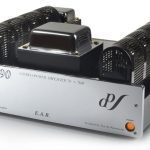
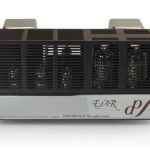
EAR Yoshino 861 valve power amplifier
8 167,00 €
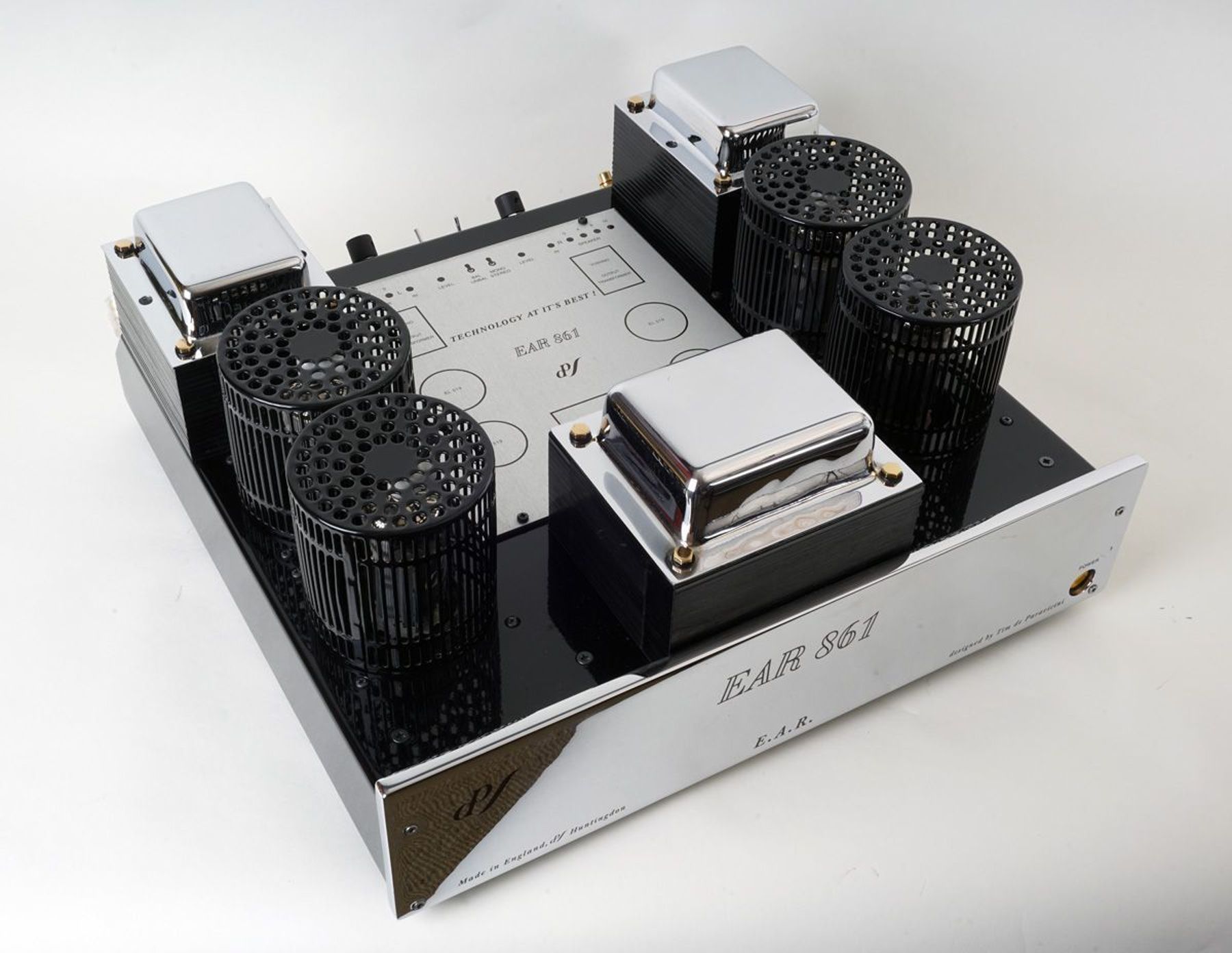
The EAR Yoshino 861 is a stereo valve power amplifier for a two-channel home audio system. It delivers 32 W per channel across 20 Hz-20 kHz and provides a balanced input alongside a separate unbalanced RCA input. Its balanced push-pull circuit extends from input to output. Volume is controlled by the connected preamplifier or another device with a variable analogue output. The valves do not need to be matched or manually biased by the user.
EAR Yoshino 861 is a standalone two-channel valve power amplifier that requires a volume-controlling preamplifier or a compatible source.
Its rated output is 32 W per channel across the full 20 Hz-20 kHz range. The audio signal can be supplied through either the balanced input or the unbalanced RCA input.
Purpose and system configuration
This model is not an integrated amplifier. It does not replace a source selector, phono stage or volume-controlling preamplifier. Its separate-component design is intended for systems in which the sources, control stage and power amplification are selected independently.
The signal can come from a preamplifier, a digital-to-analogue converter with a variable-level analogue output, or a compatible AV controller. In every case, the preceding component must control the level of the signal sent to the power amplifier. Before playing music, begin at a low volume setting and raise the level gradually using that upstream device.
Push-pull valve circuit
The amplifier uses Tim de Paravicini’s Enhanced Triode Mode (ETM). This design allows EL519-series pentodes to operate in a triode configuration, but it is distinct from the conventional method of wiring a pentode as a triode.
In the ETM circuit, the first grid of the EL519 is connected to the cathode, while the audio signal is applied to the second grid. The third grid may be grounded or left unconnected. This arrangement forms part of the amplifier’s internal circuitry; it is not a user-selectable operating mode.
The configuration was first used in the EAR 859. In the EAR 861, it is implemented as a push-pull circuit. The amplifier is balanced from input to output and employs direct coupling.
No overall negative feedback is used, including around the output transformers. Each output transformer weighs 5 kg, so together they account for a substantial proportion of the amplifier’s total 27 kg weight.
Analogue inputs
Choose the balanced input when the preamplifier or other source component provides a compatible balanced analogue output. This input complements the balanced architecture used throughout the amplifier. The type of balanced input connector is not specified, so its physical compatibility with the source should be checked before purchase.
The unbalanced RCA input is provided for components with conventional RCA analogue outputs. Select the input appropriate to the signal chain being used.
Operation and valve maintenance
If the connected source has a fixed-level output, follow the volume-control requirement explained in the system configuration section. A separate preamplifier or other suitable means of controlling the signal level must be placed before the EAR 861.
The valve complement consists of 2 × ECC83, 6 × PCC88 and 4 × EL519. Replacement valves must be of these specified types. A matched set is not required, and the user does not need to adjust the valves’ bias.
Understanding the power and frequency figures
The output rating of 32 W per channel applies across the complete 20 Hz-20 kHz range. It is therefore not a power figure measured only at a single test frequency. The rating is stated under low total-distortion measurement conditions, although no numerical distortion limit is specified.
The half-power bandwidth extends beyond 16 Hz-60 kHz. This figure should not be confused with the full-power frequency range. It describes performance under half-power measurement conditions and does not replace the stated bandwidth associated with the 32 W output rating.
Placement and ventilation
At 27 kg, the amplifier needs a stable shelf or equipment support rated to carry at least that weight. The support should remain steady while connections are changed or cables are arranged. Plan the installation so that the rear panel remains accessible after the amplifier has been placed in position.
Allow sufficient open space above the valves for air to circulate. An enclosed cabinet is suitable only if it provides adequate ventilation. Because of the amplifier’s considerable mass, it is sensible to choose its final position before connecting all the system cables.
Use in stereo and home cinema systems
In a stereo system, the amplifier drives the left and right channels and serves as a dedicated two-channel power stage.
In a home cinema system, it can power a pair of front channels. The AV controller must provide variable-level analogue outputs for those channels. Their levels are then adjusted through the controller along with the rest of the home cinema system.
Additional EAR 861 amplifiers may be used to power further pairs of channels. Such a system requires separate controller outputs for each pair, while the levels of all channels must be managed and calibrated together.
A turntable cannot be connected directly to this power amplifier. The signal path requires a phono stage as well as volume control at an earlier point in the system.
Technical specifications
| Model | EAR Yoshino 861 |
|---|---|
| Type | Stereo valve power amplifier |
| Number of channels | 2 channels; one stereo channel pair |
| Circuit topology | Balanced push-pull circuit from input to output |
| Valve operating configuration | ETM triode configuration using EL519-series pentodes |
| Circuit coupling | Direct-coupled |
| Feedback | No overall negative feedback, including around the output transformers |
| Rated output power | 32 W per channel across 20 Hz-20 kHz |
| Half-power bandwidth | Wider than 16 Hz-60 kHz |
| Measurement condition | Power and half-power bandwidth figures are stated under low total-distortion conditions |
| Analogue inputs | Balanced input; unbalanced RCA input |
| Volume control | Provided by the connected preamplifier, variable-output source or AV controller |
| Valves | 2 × ECC83, 6 × PCC88, 4 × EL519 |
| Valve matching | A matched valve set is not required |
| Bias adjustment | No user adjustment required |
| Output transformer weight | 5 kg each |
| Amplifier weight | 27 kg |
FAQ
Is this an integrated amplifier?
No. It is a standalone power amplifier without the complete source-selection and volume-control circuitry normally found in an integrated amplifier. The system therefore needs a suitable upstream control component.
Can a DAC be connected directly?
Yes, provided that the DAC has a variable-level analogue output. A fixed-level output requires a separate volume controller or preamplifier.
Which analogue input should I use?
Use the balanced input with a compatible balanced output from the source component. The RCA input is intended for a conventional unbalanced signal chain.
Can a turntable be connected directly?
Not as a complete signal path. A turntable requires a phono stage, and volume must also be controlled before the signal reaches the power amplifier.
How can the amplifier be incorporated into a home cinema system?
It can power a pair of front channels. The AV controller must supply separate variable-level analogue signals and manage the balance between the channels.
Can several of these amplifiers be used in one system?
Yes. Separate units can be assigned to different pairs of channels. The controller will need the corresponding outputs, and all channel levels must be coordinated together.
Will the bias need to be adjusted after replacing the valves?
No. User adjustment is not required, and the replacement valves do not have to form a matched set. They must, however, be of the specified types.
Where should the amplifier be placed?
Choose a stable shelf or support suitable for its weight. Leave enough space above the valves for ventilation and ensure convenient access to the connections.